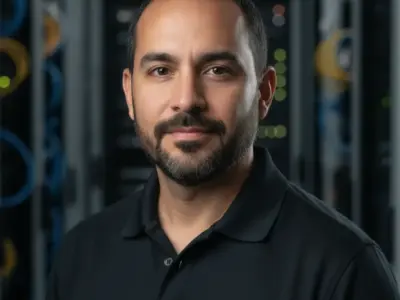
Rafael S. is a Red Hat Certified Architect (RHCA) and Linux educator with fourteen years of experience in enterprise Linux administration, automation, and platform engineering. He has held positions as a senior Linux systems administrator, site reliability engineer, and infrastructure architect at organizations in telecommunications and financial technology, managing estates of hundreds of RHEL systems and leading migrations from legacy UNIX environments to modern Linux infrastructure.
Rafael’s path into Linux began in a university computing lab where he maintained a mixed Debian and Red Hat environment for the department’s research computing cluster. That early exposure turned into a career-long focus on the operating system layer — kernel tuning, storage management, network configuration, systemd service design, and, more recently, Ansible automation for large-scale configuration management across hybrid environments. His RHCA covers performance tuning, high availability cluster administration, and Ansible automation, representing a depth of Red Hat specialization that informs how he teaches even introductory RHCSA material.
At Boost eLearning, Rafael teaches the Red Hat certification track from RHCSA through RHCE and supplementary Linux Foundation and CompTIA Linux+ paths. His sessions are entirely command-line driven. He does not use GUI shortcuts for tasks that system administrators will perform over SSH, because the muscle memory that matters in production is built at the terminal. Boost’s Live Lab environment gives students persistent, isolated RHEL instances where they can practice user and group management, SELinux policy troubleshooting, LVM configuration, and Ansible playbook development — exactly the skills tested on the performance-based Red Hat exams.
Rafael is deliberate about the performance-based nature of the RHCSA and RHCE exams — there are no multiple-choice questions, only live systems that must be correctly configured within a time limit. He calibrates his lab work to that format: students receive requirements, not step-by-step instructions, and they are expected to produce a working result using whatever approach they choose. That constraint forces real learning rather than procedure-following.
He uses Boost’s retention framework to surface commands and configuration patterns at spaced intervals between live sessions. His students report that his lab-only approach is initially demanding but directly correlated with exam-day performance.