OKG Meaning: What It Stands For and How People Use It
OKG Meaning: What It Stands For and How People Use It
In this guide
- Why "OKG" Has More Than One Meaning
- OKG Meaning in Texting and Online Chat
- OKG Meaning in Business and Industry: OKG AB
- OKG as an Airport Code
- OKG in Science and Nutrition: Ornithine Alpha-Ketoglutarate
- Quick Comparison: Which OKG Do You Need?
- How to Figure Out the OKG Meaning on Your Own
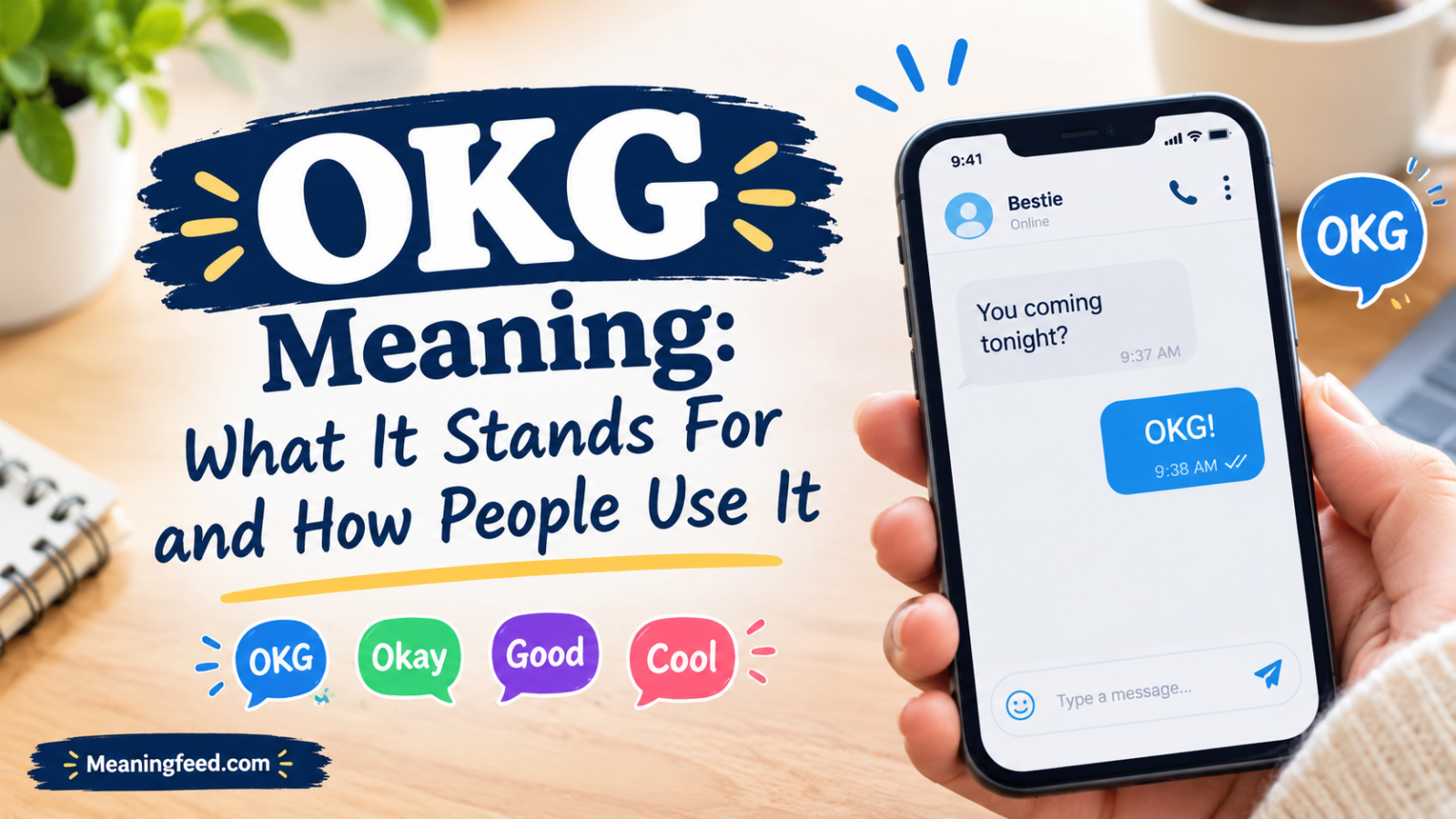
You’re scrolling through a group chat, a product label, or a flight listing, and there it is: three letters, “OKG,” with no explanation. Abbreviations like this show up everywhere, and they rarely come with a manual. The difficulty is that the OKG meaning changes depending on where you see it.
In a text message it might be a casual twist on “okay.” In an industry report it could be a Swedish energy company. On a travel site it might be an airport code, and in a nutrition article it could be a compound studied in clinical settings. This guide covers each of these so you can work out which one applies to you.
Why “OKG” Has More Than One Meaning
Short abbreviations are crowded territory. With only three letters, a lot of organizations, products, and slang terms end up sharing the same combination. Unlike a word with a dictionary definition, an acronym gets its meaning almost entirely from context.
Before settling on an answer, ask yourself:
- Where did you see it? A chat, a website, a label, and a flight itinerary all point to different meanings.
- Who wrote it? A teenager texting a friend and a scientist writing a paper use letters very differently.
- What surrounds it? Nearby words usually give the game away.
If you mainly want to know what OKG means in everyday use, the informal, chat-style reading is the one to start with. The rest of this article covers the other possibilities so you aren’t left guessing.
OKG Meaning in Texting and Online Chat
In casual messaging, “OKG” has no single, universally agreed definition. Unlike “LOL” or “BRB,” it isn’t a standardized abbreviation with an established origin. It tends to behave more like a playful variant of “OK.”
It Often Works as a Stretched or Stylized “OK”
People change the spelling of simple words constantly to add tone. Anyone who has received an “okkkk” or an “okayyy” knows how much attitude an extra letter can carry. “OKG” belongs to the same habit: a familiar word reshaped to sound more casual, more emphatic, or a bit more personal.
Because there’s no official definition, the tone depends on who is sending it. Possible readings include:
- Casual agreement. “OKG, sounds good” works as a relaxed yes.
- Mild exasperation. Similar to a drawn-out “okaaay,” it can signal that someone is going along with something reluctantly.
- A typo. On a phone keyboard, “G” sits close to several other letters, so “OKG” is sometimes just a slip.
- An in-group joke. Friend groups invent their own shorthand, and the letters may mean something only the group understands.
How to Tell Which One You’re Dealing With
When someone sends “OKG” in a chat, you can usually work out the intent by checking three things:
- The rest of the message. If it follows a request or plan, it’s probably agreement.
- The sender’s usual style. Someone who often stretches words is likely doing it again.
- The punctuation. “OKG!” reads differently from “OKG…” or “OKG.”
If it still isn’t clear, asking is perfectly fine. A quick “wait, what does OKG mean here?” is far better than guessing wrong and misreading someone’s mood.
OKG Meaning in Business and Industry: OKG AB
Outside of texting, one of the most recognized uses of the letters is OKG AB, a Swedish company connected to nuclear power generation. The name relates to the Oskarshamn area of Sweden, where the company operates in the energy sector.
If you came across “OKG” in an article about energy policy, power plants, or Scandinavian industry, this is very likely what the writer meant. Clues that point to this meaning include:
- Mentions of nuclear reactors, electricity output, or grid capacity
- References to Sweden, Oskarshamn, or European energy markets
- Company reports, news coverage, or regulatory discussion
In this setting, “OKG” is a proper noun (a company name), not slang. That’s why context matters so much: the same three letters can be a casual “okay” in one place and a major energy operator in another.
OKG as an Airport Code
Travel is another place the abbreviation appears. OKG is the code associated with Okoyo Airport, a small airfield in the Republic of the Congo.
Airport codes are three-letter identifiers used in ticketing, baggage tags, and flight schedules. If you spot “OKG” in a booking system or on an itinerary, it’s almost certainly this airport.
For most travelers, this meaning only comes up in unusual circumstances, such as logistics work, humanitarian travel, or regional aviation. It’s a good example of how a rarely seen code can still be the right answer in a specific setting.
OKG in Science and Nutrition: Ornithine Alpha-Ketoglutarate
The fourth common meaning comes from biochemistry. In scientific and medical literature, OKG is shorthand for ornithine alpha-ketoglutarate, a compound formed from two amino acid–related components.
Where It Appears
You’re most likely to see this meaning in:
- Clinical nutrition research, particularly studies on recovery after injury, surgery, or severe stress on the body
- Discussions of muscle preservation and protein metabolism
- Some sports nutrition and supplement marketing
A Word of Caution
Research on this compound has focused mostly on specific clinical situations, and results from medical settings don’t automatically apply to healthy people hoping to build muscle. If a product label or article mentions OKG in a supplement context, treat the claims carefully. Check the evidence, and talk to a doctor or registered dietitian before taking anything new, especially if you have a medical condition or take medication.
Quick Comparison: Which OKG Do You Need?
Here’s a simple way to match the context to the likely meaning:
Where you saw it
Most likely meaning
Text message or social media chat
Casual variant of “OK” or a personal shorthand
Energy or business news
OKG AB, the Swedish company
Flight booking or travel documents
Okoyo Airport code
Nutrition or medical article
Ornithine alpha-ketoglutarate
How to Figure Out the OKG Meaning on Your Own
Acronyms will keep appearing, and not every one has a tidy definition. A few habits make decoding them much easier.
Look at the Surrounding Text
Words near the abbreviation almost always give it away. A sentence about reactors, flights, or muscle recovery points you to a very different answer than a sentence about weekend plans.
Consider the Platform
Slang tends to live in chats, comment sections, and social apps. Technical or institutional meanings live in reports, databases, and official documents. The platform narrows the options quickly.
Search With Context, Not Just the Letters
Searching “OKG” alone returns a jumble. Adding context, such as “OKG text message,” “OKG airport,” or “OKG nutrition,” gets you to the right result much faster.
Don’t Assume One Answer Is Universal
This is the biggest mistake people make with short abbreviations. Because “OKG” has several established meanings, any single definition presented as the only one is incomplete.
Tips for Using “OKG” Without Confusing People
If you’re thinking of using the abbreviation yourself, a little care goes a long way.
- Stick to casual settings. Informal spellings suit friends and group chats, not work emails or formal writing.
- Know your audience. If the recipient might not recognize it, write “okay” and avoid the confusion.
- Be clear in professional contexts. If you mean OKG AB or ornithine alpha-ketoglutarate, spell it out in full the first time, then use the short form.
- Watch your tone. Stylized spellings can come across as sarcastic or dismissive, even when you don’t mean it that way.
Keeping Up With Changing Slang
Language online moves quickly. Abbreviations appear, shift in meaning, and sometimes disappear within a couple of years. Resources that track informal language, such as Meaning Feed, can help when you run into a term you haven’t seen before. Still, the most reliable method is the one described above: read the context, consider the source, and confirm when you’re unsure.
It also helps to remember that slang belongs to its users. Meanings spread through communities, and what a term signals in one group may differ from another. That’s part of what makes digital language interesting, and part of what makes it confusing.
Frequently Asked Questions
Is OKG a standard text abbreviation?
Not in the way that “LOL” or “OMG” are. In casual messages, it usually works as a loose variation of “OK,” and its exact meaning depends on the sender.
Can OKG mean something different from “okay”?
Yes. Outside of chat, it can refer to a Swedish energy company, an airport code, or a compound used in nutrition research.
Should I use OKG in professional writing?
Only if you define it clearly and your audience will understand which meaning you intend. For casual agreement, use “okay” in professional settings.
How can I quickly find out what an abbreviation means?
Check where it appeared, read the nearby text, and search the letters together with a context word. If it came from a person, simply ask them.
Final Thoughts
The OKG meaning you need comes down to context. In a chat, it’s usually a relaxed version of “OK.” In energy news, it points to OKG AB. In travel, it’s an airport code. In nutrition, it’s a compound called ornithine alpha-ketoglutarate.
Next time you see those three letters, pause for a second and look around them. The answer is usually sitting right in the surrounding words.
Ready to earn your certification?
Boost eLearning offers Live Labs, a Pass Guarantee, and online, live virtual, and on-site delivery.


