

 February 24, 2026
  10 Min
  No Comment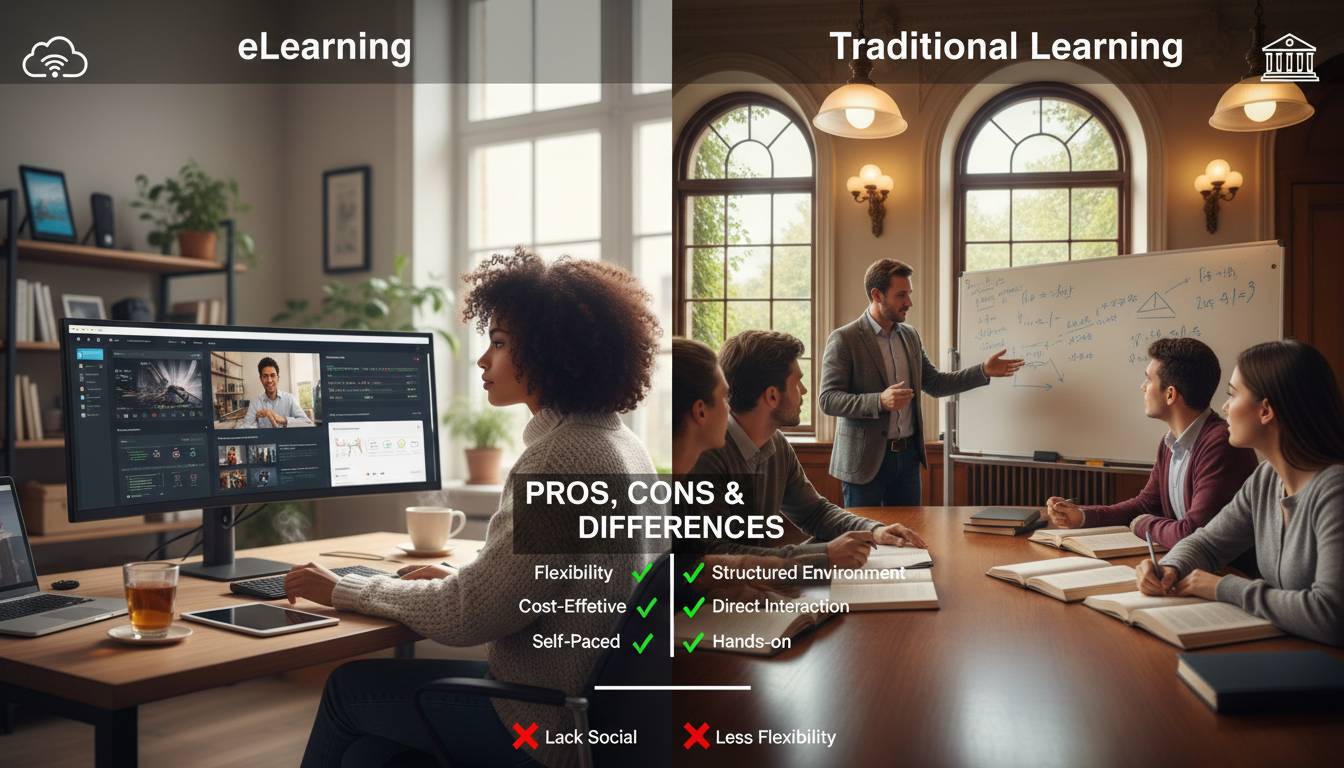
Picture a working parent in rural Montana who needs a healthcare certification to advance her career. She can’t relocate or quit her job. Traditional classroom options don’t exist within driving distance. This is where eLearning transforms possibilities—and it’s the same story playing out millions of times over as these two education models increasingly compete for learners.
The choice between online learning versus classroom education impacts students charting their paths, HR professionals designing training programs, and educators reaching learners. Having spent years reviewing learning platforms and educational research, I’ve seen how each approach genuinely serves different needs. This guide cuts through the marketing noise to examine what each delivers.
What eLearning Actually Is
eLearning delivers education through digital technology—learning management systems, video conferencing, mobile apps, and interactive platforms. The format has evolved dramatically since early internet-based training in the 1990s. Today’s eLearning encompasses video lectures, virtual classrooms, adaptive quizzes, gamified modules, and AI-powered systems that respond to learner performance.
The primary appeal is accessibility. Learners access courses from any location with internet connectivity, eliminating geographic constraints. The global eLearning market reached approximately $399.3 billion in 2022 and continues growing at roughly 20% annually, according to Grand View Research data. This expansion reflects genuine demand from working professionals seeking skills development without abandoning current employment, rural populations underserved by traditional institutions, and individuals managing scheduling conflicts that preclude regular classroom attendance.
Most eLearning operates asynchronously, allowing participants to progress at individual speeds—reviewing challenging material repeatedly while advancing quickly through familiar content. This self-pacing approach particularly benefits learners who found traditional classrooms either too slow or excessively rapid.
Modern eLearning platforms generate detailed analytics: quiz performance, module completion times, common error patterns. Instructors receive actionable data enabling targeted intervention when learners struggle. In rapidly evolving fields like technology and healthcare, digital content updates instantly—a significant advantage over printed textbooks that may contain outdated information.
What Traditional Learning Actually Is
Traditional learning centers on physical co-presence—instructor and students occupying shared space. This model, refined over centuries, provides institutional structure, predictable schedules, and built-in social interaction.
Structure functions as the defining characteristic. Fixed schedules, physical attendance requirements, and external accountability create environmental scaffolding. From observation, learners who struggle with self-direction often depend on these external constraints to maintain progress.
In-person learning naturally facilitates dialogue, collaborative projects, and spontaneous discussions. These interactions develop interpersonal competencies—reading social cues, navigating disagreement, constructing professional relationships—that purely academic settings cannot fully replicate. The classroom environment demands real-time engagement rather than passive consumption.
Classroom instructors receive immediate feedback through observation. Confusion manifests visibly; questions arise organically; pedagogical adjustments happen instantaneously. When collective misunderstanding appears, skilled instructors pivot immediately rather than continuing on incorrect foundations.
How They Actually Differ
Practical distinctions between these approaches reveal themselves most clearly through direct comparison.
| Factor | eLearning | Traditional Learning |
|---|---|---|
| Flexibility | High – learn anytime, anywhere | Low – fixed schedule and location |
| Cost | Generally lower overall costs | Higher due to facilities, materials |
| Pace | Self-paced or cohort-based | Fixed pace for entire group |
| Interaction | Digital communication, forums | Face-to-face immediate interaction |
| Feedback | Automated or delayed human feedback | Immediate, real-time feedback |
| Technical Requirements | Stable internet, devices needed | Minimal technical requirements |
| Social Development | Limited in-person interaction | Full social environment |
| Content Updates | Instantaneous updates possible | Requires new print/material updates |
| Assessment Methods | Automated quizzes, digital portfolios | Written exams, oral presentations |
| Learning Style Support | Adaptive, personalized pathways | One-size-fits-all typically |
Infrastructure requirements differ fundamentally. eLearning demands reliable internet connectivity, compatible devices, and basic digital literacy. Traditional instruction requires only physical space. This gap creates significant barriers in underserved communities, developing regions, and lower-income households.
Cost structures diverge substantially. eLearning eliminates expenses for physical infrastructure, utilities, maintenance, and on-site personnel. These savings potentially translate to reduced tuition or expanded institutional capacity. Research from the Babson Survey Research Group indicates that public institutions spend approximately $8.50 per student contact hour on online instruction compared to higher rates for traditional delivery.
Why eLearning Keeps Growing
Several factors sustain eLearning expansion across educational sectors.
Flexibility and Accessibility
Self-directed scheduling accommodates working professionals managing employment, family responsibilities, and educational advancement simultaneously. Geographic barriers dissolve entirely—a medical professional in Southeast Asia can complete American university coursework without relocating. The World Bank reports that 1.6 billion learners globally lack access to secondary education; digital delivery addresses this accessibility gap.
Adaptive pacing serves diverse learning speeds effectively. Proficient learners accelerate through familiar material while struggling learners access additional practice without impeding others. Traditional classrooms default to group-average pacing, systematically underserving both ends of the performance spectrum.
Cost Savings
Financial benefits extend beyond tuition reduction. Eliminated commute expenses, avoided relocation costs, and maintained employment income during evening or weekend study represent significant advantages. Corporate training data demonstrates substantial savings from online delivery: reduced trainer travel, eliminated venue rental, minimized productivity loss from extended absences.
Digital content scalability provides long-term economic advantages. Initial development costs are substantial, but marginal distribution costs approach zero. Traditional instruction requires incremental resource allocation for each additional student—physical space, instructor time, materials.
Personalized Learning
Adaptive systems analyze performance patterns and adjust content difficulty dynamically. Struggling learners receive additional practice problems; advanced learners encounter challenging material sooner. Human instructors can provide similar differentiation but require substantially more time per student.
Multimodal delivery accommodates varied learning preferences—video content, audio explanations, interactive simulations, written materials. Learners select preferred modalities and revisit content repeatedly. Recorded lectures enable pause, rewind, and review impossible during live instruction.
Where eLearning Struggles
Honest assessment requires acknowledging genuine limitations.
Missing the In-Person Thing
Physical separation eliminates incidental interactions that often prove educationally valuable. Spontaneous hallway discussions, collaborative problem-solving during breaks, and friendship formation occur naturally in shared spaces but require deliberate cultivation online. Developmental research indicates younger learners particularly benefit from structured peer interaction that builds conflict resolution and teamwork competencies.
Help-seeking behavior differs between modalities. Immediate in-class assistance contrasts sharply with asynchronous online support where forum responses or email replies may take hours or days. Some learners hesitate to request help digitally and experience knowledge gaps that compound over time.
Tech Problems and Screen Fatigue
Reliable internet connectivity and functional devices represent prerequisites that aren’t universal. The International Telecommunication Union estimates 2.7 billion people remain offline globally. Technical failures—connection drops, software malfunctions, hardware issues—interrupt learning abruptly. Physical classrooms continue operating despite power fluctuations or equipment failures.
Extended screen exposure creates cognitive fatigue distinct from traditional lecture attendance. The attentional demands differ qualitatively; video-mediated learning often exhausts learners faster than equivalent in-person instruction.
You Have to Motivate Yourself
Self-direction requirements challenge many learners. External accountability structures—attendance monitoring, peer expectations, physical presence requirements—disappear in online environments. Completion rate data reveals this challenge: HarvardX and MITx longitudinal research documented MOOC completion rates between 3-4%, though structured programs with deadlines and support achieve substantially higher rates.
Distraction management becomes individual responsibility. Home environments contain competing stimuli—household responsibilities, entertainment options, family interruptions—that classrooms physically exclude. Maintaining focus demands cognitive effort that structured environments eliminate.
Why People Still Choose Traditional Classrooms
Traditional instruction provides advantages that current technology hasn’t fully replicated.
Built-In Structure
Environmental scaffolding assists learners who struggle with autonomous scheduling. Physical attendance requirements, fixed deadlines, and external due dates create accountability structures that self-directed learners must otherwise self-impose. Spatial separation between home and learning environments may facilitate cognitive transitions into focused study states.
Social accountability influences behavior positively. Peer visibility creates motivation to prepare and participate that solitary study lacks. This external pressure, while occasionally uncomfortable, supports performance for many learners.
Instant Feedback
Immediate instructional response to confusion prevents misconception consolidation. Clarifying questions receive instant answers; wrong reasoning gets corrected before becoming entrenched. Live demonstration and Socratic dialogue enable responsive teaching that asynchronous formats cannot fully replicate.
Real-time peer interaction provides feedback benefits beyond instructor response. Audience reaction during presentations, collaborative problem-solving discussions, and spontaneous question-asking sharpen thinking through immediate social feedback.
Social Skills and Networks
Physical co-presence develops interpersonal competencies increasingly valued in professional contexts—nonverbal communication interpretation, collaborative negotiation, group facilitation. The National Association of Colleges and Employers consistently reports that employers prioritize these soft skills alongside technical competencies.
Professional networks formed during traditional programs provide long-term career value. Alumni relationships, faculty mentorship, and peer connections developed through extended physical proximity often prove more durable than purely digital equivalents.
Where Traditional Learning Falls Short
Conventional education faces genuine constraints limiting accessibility and scalability.
Fixed Schedules and Locations
Physical attendance requirements exclude learners facing scheduling conflicts, transportation barriers, or geographic distance. Shift workers, caregivers, and individuals in remote areas frequently cannot access traditional programming regardless of motivation or ability. The College Board reports that scheduling conflicts rank among the top reasons adults cite for not pursuing additional education.
The Price Tag
Total program costs exceed tuition substantially. Transportation, housing, meals, and foregone employment income compound dramatically. Research from Georgetown University’s Center on Education and the Workforce indicates that working adults increasingly cannot afford full-time traditional enrollment due to income interruption requirements.
Institutional overhead—physical infrastructure, administrative staff, facility maintenance—drives cost structures regardless of individual learner utilization. These fixed costs distribute across enrolled students, creating pricing pressure that digital alternatives can circumvent.
What the Research Actually Shows
Empirical comparisons reveal context-dependent findings rather than universal superiority.
The U.S. Department of Education’s 2009 meta-analysis examining 99 studies comparing online and face-to-face learning found that on average, students in online conditions performed better than those receiving pure face-to-face instruction. However, substantial variation existed across studies; implementation quality predicted outcomes more strongly than delivery medium.
More recent research supports blended approaches combining both modalities. The Society for Research in Higher Education found that courses incorporating both online content delivery and face-to-face interaction typically achieved superior outcomes compared to fully online or fully traditional alternatives.
Completion rate disparities persist. While massive open online courses demonstrate extremely low completion rates—HarvardX data shows approximately 3-4%—structured online programs with clear deadlines, instructor engagement, and institutional support achieve completion rates comparable to traditional formats. Corporate training programs combining eLearning with human coaching frequently match or exceed traditional training completion.
Learning outcomes research consistently indicates that active learning strategies—practice application, immediate feedback, spaced repetition—produce results regardless of delivery medium. Pure information transmission through lectures, whether live or recorded, represents the least effective approach across both modalities.
Picking What Works for You
Optimal choice depends on individual circumstances rather than universal superiority claims.
Choose eLearning when: Scheduling flexibility is essential; self-direction capabilities are strong; budget constraints are significant; independent learning suits your preferences; subject matter evolves rapidly; or skills development doesn’t require physical practice.
Choose traditional learning when: External structure supports your success; interpersonal skill development is priority; hands-on practice is required; immediate feedback is critical; accreditation mandates physical presence; or social accountability motivates you.
Hybrid models increasingly combine strengths of both approaches—digital content delivery paired with periodic in-person components. This blended approach often delivers superior outcomes by deploying each modality where it excels.
Frequently Asked Questions
Is eLearning more effective than traditional learning?
Effectiveness depends heavily on implementation quality, individual learner characteristics, and subject matter. Well-designed online instruction produces equivalent