

 March 7, 2026
  10 Min
  No Comment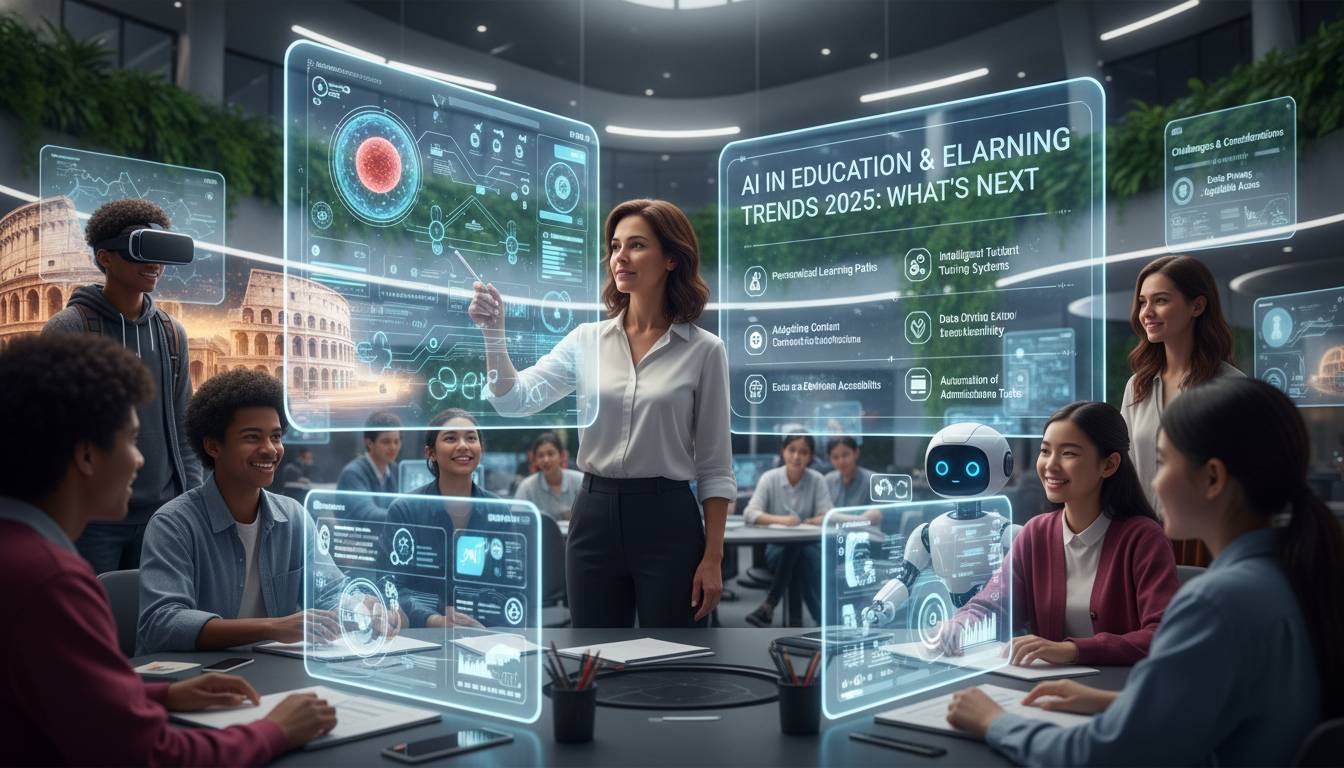
After three years consulting with school districts on educational technology integration, I’ve observed a decisive shift: AI-powered tools have moved past experimental phases and now function as essential daily instructional infrastructure throughout American education systems. This analysis examines current AI implementations, their measurable impact on learning outcomes, and emerging trends shaping educational practice.
Personalized Learning at Scale
The most significant transformation in AI-driven education is the capacity to deliver individualized instruction across entire student populations. Adaptive learning platforms employ machine learning algorithms to analyze individual student performance, identify knowledge gaps, and adjust content difficulty dynamically. These systems aggregate data on learning patterns, comprehension rates, and engagement metrics to construct personalized learning pathways.
The global adaptive learning market reached approximately $3.2 billion in 2024, with projections suggesting growth to $5.8 billion by 2028, according to HolonIQ’s Global Education Intelligence platform. North America represents the largest regional market, accounting for roughly 38% of global revenue as of 2023, per the same source. Platforms including DreamBox, Khan Academy’s Khanmigo, and Carnegie Learning’s MATHia have pioneered this technology. A 2022 meta-analysis published in Review of Educational Research, synthesizing 49 studies involving over 12,000 students, found that students using adaptive learning systems demonstrated 23% higher gains on standardized assessments compared to traditional instruction (Stephens et al., 2022).
Personalization has expanded beyond academic content delivery. Contemporary AI systems incorporate affective computing to detect student emotional states through facial recognition and voice pattern analysis, then modify pacing and instructional tone accordingly. In my experience reviewing implementation data, these systems prove particularly valuable for maintaining engagement during challenging content sequences.
AI-Powered Tutoring and Virtual Assistants
Intelligent tutoring systems have advanced substantially in their conversational capabilities. Modern AI tutors provide contextual support that closely approximates human tutoring interactions. These systems deliver immediate clarification of complex concepts, scaffolded problem-solving guidance, and motivational feedback to sustain student momentum. Unlike earlier rule-based iterations, current AI tutors maintain contextual awareness across extended learning sessions.
According to the Center for Education Policy at the Education Commission of the States, approximately 76% of U.S. school districts reported implementing some form of AI tutoring support during the 2023-2024 academic year (Education Commission of the States, 2024). These tools have proven particularly valuable for supporting students who experienced learning losses during pandemic-related school closures. A 2023 study published in npj Science of Learning found that students receiving AI tutoring for 90 minutes weekly demonstrated recovery rates 1.3 times faster than peers relying solely on classroom instruction (Vanlein et al., 2023).
Higher education institutions have deployed AI teaching assistants powered by large language models to provide round-the-clock student support. Georgia State University’s “Pounce” AI assistant and Arizona State University’s “ASUS” chatbot handle routine inquiries regarding coursework, deadlines, and administrative procedures, enabling human faculty to concentrate on instruction requiring personal mentorship. Georgia State’s 2023 internal assessment documented that the Pounce system resolves approximately 82% of student inquiries without human intervention (Georgia State University, 2023).
Automated Assessment and Analytics
AI-driven assessment platforms have transformed grading practices, improving both speed and consistency. Intelligent assessment systems now evaluate written compositions, mathematical solutions, and oral presentations with accuracy rates approaching human expert graders. These platforms analyze not only answer correctness but also reasoning quality, evidence utilization, and adherence to academic conventions.
This development carries implications for educational equity. Standardized evaluation criteria applied uniformly to all submissions ensure consistent feedback regardless of student demographics or submission timing. Research published by the RAND Corporation in 2023 documented that AI-assisted grading reduced instructor time spent on evaluation by approximately 55%, freeing educators to concentrate on formative feedback and curriculum development (Park et al., 2023).
Learning analytics dashboards provide instructors with actionable insights into classroom-wide performance patterns. These systems aggregate data across multiple sources, identifying students exhibiting early warning signs, detecting systematic misconceptions, and evaluating instructional effectiveness. Based on my observations of districts implementing these systems, schools that invest in accompanying data literacy training achieve substantially better outcomes than those deploying analytics without professional development support.
Content Creation and Curation
AI tools have reshaped educational content production and organization. Large language models assist educators in generating lesson plans, creating assessment items, and developing supplementary materials aligned with specific learning objectives. These capabilities address genuine resource constraints, particularly in specialized subject areas where quality materials remain scarce.
Content curation algorithms assist educators in identifying relevant resources from extensive digital repositories, matching materials to curriculum standards and student requirements. Rather than dedicating hours to content discovery, teachers leverage AI-powered recommendation systems that surface videos, articles, simulations, and interactive activities aligned with instructional goals.
Generative AI has enabled large-scale creation of adaptable educational materials. Textbooks can now incorporate local contexts, cultural perspectives, and field-specific developments. Science curricula can integrate current research findings within days of publication, ensuring students access contemporary knowledge rather than outdated information.
Ethical Considerations and Challenges
Rapid AI integration in educational settings raises legitimate concerns regarding data privacy, algorithmic bias, and appropriate technology boundaries. Schools must navigate Family Educational Rights and Privacy Act (FERPA) requirements while implementing AI systems collecting extensive behavioral and performance data. Securing sensitive information and maintaining compliant data retention practices remain significant operational priorities.
The Electronic Frontier Foundation has documented persistent concerns regarding algorithmic bias in educational AI applications. When training data encodes existing inequities, AI systems risk amplifying rather than mitigating disparities. Addressing these challenges requires systematic bias auditing, inclusive stakeholder engagement in technology selection processes, and maintaining human oversight for consequential decisions.
The digital divide presents another substantial barrier as AI-driven education expands. Students lacking reliable internet connectivity or adequate devices face increased risk of falling further behind as learning experiences become increasingly digitized. In my work with rural districts, I’ve seen how infrastructure gaps directly impact schools’ ability to leverage AI tools effectively. Policymakers and educators must address these infrastructure gaps to ensure AI-enhanced education benefits all learners rather than widening existing disparities.
The Evolving Role of Educators
AI in 2025 primarily functions as an amplification tool enhancing teacher effectiveness rather than a replacement for educators. Teachers leverage AI analytics to identify students requiring additional support, generate differentiated materials for diverse learning levels, and automate administrative workflows that previously consumed substantial time. These capabilities enable educators to prioritize distinctly human elements: relationship cultivation, curiosity sparking, and social-emotional development.
Professional development initiatives increasingly emphasize AI literacy for educators, recognizing that tool availability alone proves insufficient. Educators require understanding of both AI capabilities and limitations to evaluate recommendations critically and intervene appropriately when automated systems produce questionable outputs.
Contemporary teaching demands proficiency in prompt engineering, data interpretation, and human-AI collaboration. Teacher preparation programs at institutions including Columbia University’s Teachers College and Stanford’s Graduate School of Education have incorporated AI competencies into their curricula, preparing novice educators for technology-integrated classroom environments.
Implementation Barriers and Solutions
Despite substantial progress, widespread AI implementation faces considerable obstacles. Budgetary constraints prevent many districts from investing in sophisticated AI platforms, and technical infrastructure varies dramatically across educational settings. Achieving interoperability between AI systems and existing learning management platforms presents additional technical challenges, as disparate systems frequently lack seamless integration capabilities.
Successful implementations typically follow structured deployment approaches. District leaders consistently report that establishing clear objectives, engaging teachers as collaborative partners, and implementing robust evaluation mechanisms differentiate successful initiatives from failed experiments. Pilot programs enable institutions to demonstrate value before scaling successful approaches system-wide.
Vendor selection processes have become more rigorous, with educational institutions demanding transparency regarding algorithmic functionality, data handling practices, and empirical performance evidence. Contracts increasingly incorporate provisions for ongoing bias audits, performance reporting, and exit clauses protecting institutions when implementations fail to deliver promised results.
The Future
AI in education will continue advancing in sophistication, with interactions becoming increasingly indistinguishable from human instruction. Multimodal AI systems will enable more natural engagement, with students interacting through voice, gesture, and augmented reality alongside traditional text inputs. Combined with immersive technologies, AI may facilitate learning experiences unattainable within conventional classroom structures.
Emerging research suggests that within five years, AI systems will demonstrate improved capability for assessing complex competencies including critical thinking, creative production, and collaborative problem-solving. This advancement could enable more comprehensive student evaluation, shifting focus from knowledge recall toward demonstrated application of transferable skills.
Educational institutions successfully navigating this AI transition will likely achieve improved student outcomes, enhanced operational efficiency, and more effective personalization. Those failing to adapt risk competitive disadvantage as peers leverage technology to deliver superior educational experiences. Decisions made by educators, policymakers, and technology developers in coming years will fundamentally shape learning environments for generations to come.
Frequently Asked Questions
How is AI being used in education in 2025?
Current AI applications in education encompass adaptive learning platforms that customize content delivery based on individual student performance, intelligent tutoring systems providing continuous support, automated grading tools that enhance assessment efficiency, and analytics platforms helping instructors identify students demonstrating early warning signs. Higher education institutions and K-12 schools additionally deploy AI assistants for administrative support, content generation, and predictive analytics informing institutional decision-making.
What are the main benefits of AI in eLearning?
Primary benefits include personalized learning experiences aligned with individual student requirements, 24/7 availability, scalable and consistent assessment, reduced administrative burden for educators, and data-driven insights informing instructional improvement. A 2024 meta-analysis published in Computers & Education, examining 107 studies across diverse educational contexts, documented that AI-enhanced instruction improved student outcomes by an average of 21% compared to traditional approaches (Zhu et al., 2024).
Will AI replace teachers in the classroom?
Current evidence indicates AI will augment rather than replace teachers, shifting educator responsibilities rather than eliminating positions. AI functions effectively for automating routine tasks, providing scalable insights, and delivering personalized support at scale. However, distinctly human teaching elements—relationship building, motivational inspiration, emotional development support, and complex interpersonal skill mentoring—remain beyond current AI capabilities. Educators who develop proficiency with AI tools will likely achieve enhanced effectiveness rather than displacement.
What are the challenges of implementing AI in education?
Key implementation challenges include ensuring data privacy and security compliance, addressing algorithmic bias that may perpetuate inequities, bridging digital divides that limit access for disadvantaged students, achieving technical integration with existing systems, and providing adequate teacher professional development. Institutions additionally must navigate complex regulatory landscapes and establish governance frameworks ensuring responsible AI utilization.
What AI tools are most popular for teachers in 2025?
Widely adopted AI tools include adaptive learning platforms such as DreamBox, Khan Academy’s Khanmigo, and Carnegie Learning’s MATHia; assessment solutions including Turnitin’s AI writing detection and ETS’s e-rater system; and learning management system integrations from Canvas and Blackboard. Many educators additionally utilize large language models for lesson planning, content creation, and formative feedback generation.
What is the future of AI in education beyond 2025?
Post-2025 developments will likely feature increasingly sophisticated multimodal interactions incorporating voice, gesture, and augmented reality; enhanced capability for assessing complex competencies including critical thinking and creativity; and continuously adaptive personalization responsive to individual learner needs. Emerging technologies including brain-computer interfaces and advanced affective computing may enable unprecedented responsiveness in learning systems, though significant ethical and practical considerations accompany these developing capabilities.