

 February 7, 2026
  6 Min
6 Min  No Comment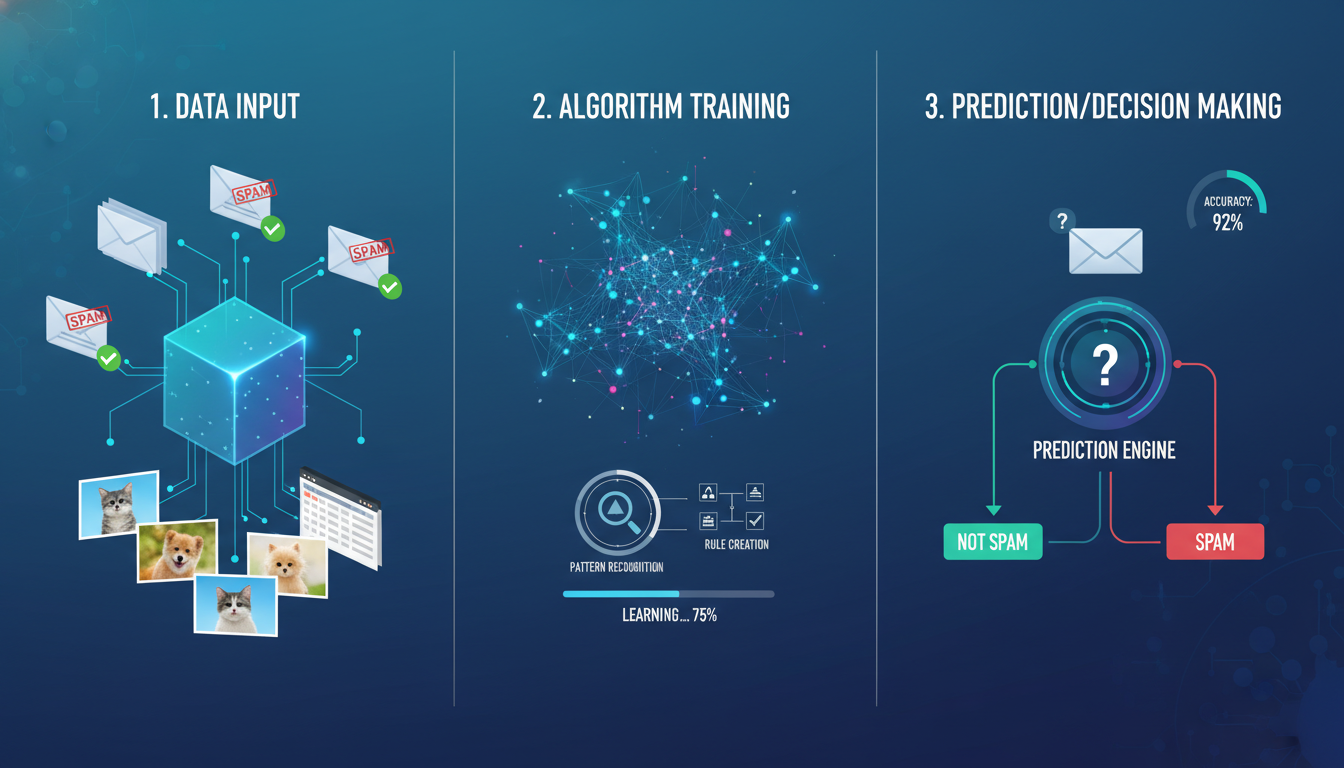
That moment when your favorite app seems to anticipate your needs before you do? That’s often machine learning at work—a branch of artificial intelligence that enables computers to learn patterns from data and improve performance over time without explicit programming for every scenario. From Netflix recommendations to fraud detection at your bank, these systems quietly power much of modern digital life.
What Machine Learning Really Means
Machine learning bridges the gap between rigid programming and real-world ambiguity. Instead of writing exhaustive rules for every possibility, developers feed models data and let them discover patterns on their own. Having worked alongside data science teams implementing AI across multiple industries, I can tell you this shift from rule-based systems to data-driven learning represents one of computing’s most significant advances in recent years.
According to McKinsey’s 2023 Global Survey on AI adoption, 55% of organizations have implemented AI and machine learning in at least one business function—compared to just 20% in 2017 (source). This widespread adoption reflects how valuable these techniques have become for extracting actionable insights from vast datasets.
In practice, machine learning typically falls into three main categories:
- Supervised learning, where models train on labeled data—like images tagged “cat” or “dog” or transactions marked as “fraudulent” or “legitimate.”
- Unsupervised learning, which discovers hidden structures in unlabeled data—like grouping customers with similar purchasing behaviors without predefined categories.
- Reinforcement learning, where algorithms learn through trial and error, guided by rewards or penalties for their decisions.
Real-world Example: Personalized Streaming
Consider how streaming platforms suggest your next watch. Rather than asking directly, these systems analyze your viewing history, identify patterns shared with similar users, and even factor in time-of-day preferences. Netflix has reported that approximately 80% of viewer engagement comes from their recommendation algorithm (source), demonstrating how profoundly these techniques shape user experience.
Why This Matters (and Why It‘s Not Sci-Fi)
Despite sensationalized media coverage about AI takeover scenarios, machine learning applications are far more mundane—and genuinely useful—than Hollywood depicts. The technology powers medical imaging analysis that helps radiologists detect abnormalities, optimizes traffic flow in smart cities, and reduces energy consumption in commercial buildings through predictive maintenance.
What unites these diverse applications is their dependence on quality data and adaptive learning capabilities. The more relevant and diverse the training data, the better models generalize to new situations. However, this reliance on data also creates vulnerabilities: models can absorb and amplify biases present in their training sets if developers don’t implement careful oversight and data governance practices.
Exploring Core Techniques in Depth
Supervised Learning: Teaching with Examples
Supervised learning is the most intuitive approach—essentially providing the answer key alongside training examples. Models adjust their internal parameters to minimize prediction errors against known labels. From marketing teams predicting customer churn to healthcare providers diagnosing conditions from medical imaging, this technique underpins countless production systems.
The advantages include clear optimization targets and strong performance with sufficient quality data. The main limitation is dependency on accurate labeling, which often requires domain expertise—radiologists annotating thousands of X-rays, for instance.
Unsupervised Learning: Finding Hidden Patterns
Clustering algorithms group data points by similarity without predefined categories. This exploratory approach helps retailers segment customers by purchasing patterns, enables anomaly detection in cybersecurity, and supports research across scientific disciplines. While powerful for discovery, interpreting what clusters actually represent requires human judgment and domain knowledge.
Reinforcement Learning: Learning by Doing
Reinforcement learning excels in environments where outcomes can be measured and optimized over time. The algorithm discovers strategies through interaction, maximizing cumulative rewards. AlphaGo’s victory over human champions demonstrated the technique’s potential for mastering complex games. However, applying these methods to business scenarios requires carefully designed reward functions and simulated environments—challenges that limit broader adoption outside gaming and robotics research.
Balancing the Benefits and Pitfalls
Understanding both capabilities and limitations helps ensure responsible implementation:
- Pros:
- Dramatically improves efficiency across sectors.
- Enables personalization at unprecedented scale.
- Discovers patterns invisible to human analysis.
- Cons:
- Can perpetuate or amplify biases from training data.
- Requires specialized expertise and computational infrastructure.
- Often lacks transparency—”black box” decisions are difficult to explain.
A practical example: recommendation systems optimizing for engagement may inadvertently promote expensive products if training data over-represents high-income users, marginalizing budget-conscious alternatives and reducing marketplace fairness.
Summary and Takeaways
Machine learning represents an evolving toolkit that learns from experience much like humans do. Whether through labeled examples, pattern discovery, or trial-and-error optimization, each approach offers distinct strengths suited to different problems. Real-world applications—from personalized streaming to customer segmentation—demonstrate these techniques in action daily.
Thoughtful implementation matters enormously. Human oversight ensures models remain fair, accurate, and interpretable. As adoption accelerates, market researchers project the global machine learning market will grow from $26.3 billion in 2023 to $264.4 billion by 2030 (source), making the balance between innovation and responsibility increasingly critical.
FAQs
1. What’s the simplest way to describe machine learning?
Machine learning involves training computers on data so they can make predictions or identify patterns without step-by-step programming for every possible scenario.
2. How does supervised learning differ from unsupervised learning?
Supervised learning uses labeled examples (images marked “cat” or “dog,” transactions flagged as “fraudulent”) to train models, while unsupervised learning finds hidden structures in unlabeled data—discovering groups or patterns without predefined categories.
3. Why is machine learning useful in everyday apps?
It enables personalized experiences by continuously learning from user behavior and large datasets. Recommendation engines, predictive text, and fraud detection all operate behind the scenes to improve convenience and security.
4. Can machine learning be biased?
Yes. Models trained on biased data can reproduce or amplify those biases in their predictions. Thorough data auditing, diverse training sets, and fairness testing help mitigate these risks.
5. Is reinforcement learning widely used outside games and robotics?
Applications remain relatively specialized. Reinforcement learning thrives in domains with clear feedback signals—like game strategy or robotic control—but broader business adoption is still emerging as organizations develop suitable implementation frameworks.
6. What’s a quick tip for someone starting with machine learning?
Begin with straightforward supervised learning projects using well-documented datasets like those available through UCI Machine Learning Repository. Gradually explore clustering and basic reinforcement concepts as you build intuition for different learning paradigms.
Whether you’re evaluating AI tools for your organization or simply curious about the technology shaping daily digital experiences, understanding these fundamentals provides a solid foundation for navigating this rapidly evolving field.
