

 February 13, 2026
  8 Min
8 Min  No Comment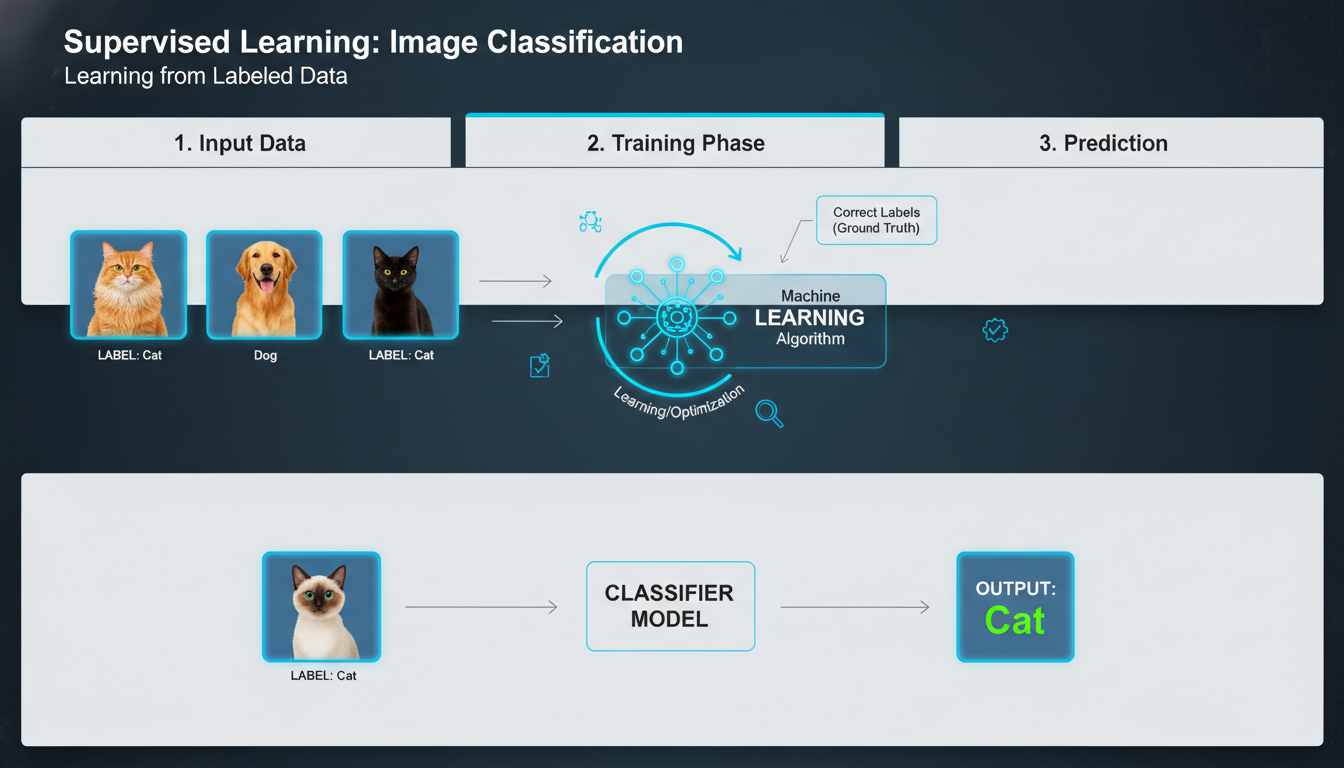
Picture this: a startup team sketches a recommendation algorithm on a whiteboard during a lunch break. Six months later, that sketch powers personalized experiences for millions of users. Machine learning algorithms work this way—they start as simple pattern-recognition tools and evolve into the decision-making engines behind modern AI systems. Having worked with ML implementations across multiple industries, I’ve seen how these tools transform from experimental prototypes into production systems that handle everything from fraud detection to medical diagnoses.
ML fundamentally shifts how computers operate: instead of rigid instructions, algorithms learn patterns and adapt. This flexibility makes them powerful but also temperamental—much like human decision-making. Understanding how they work helps separate realistic AI capabilities from hype.
Core Types of Machine Learning Algorithms
Machine learning encompasses several learning paradigms. Each approach suits different problems, and selecting the right method determines project success. The global machine learning market, valued at approximately $21.17 billion in 2022, continues expanding as organizations adopt these diverse approaches (Grand View Research, 2023).
Supervised Learning: Teaching with Examples
Supervised learning trains models using labeled datasets—pairs of inputs and known outputs. You provide examples like “this image contains a cat, this one doesn’t,” and the algorithm learns to generalize these mappings to new data.
- Applications: Image recognition systems, spam filters, and price prediction models. The algorithm minimizes error functions (cross-entropy, mean squared error) to improve accuracy.
- Considerations: Effectiveness depends heavily on label quality. In my experience, data labeling remains one of the most time-intensive aspects of supervised projects—studies suggest data preparation consumes 80% of ML project time (IBM, 2022).
Unsupervised Learning: Letting Patterns Speak
Unsupervised learning processes unlabeled data, discovering hidden structures without predefined categories. The algorithm explores relationships independently.
- Techniques: Clustering algorithms (K-means) group similar items; dimensionality reduction (PCA, t-SNE) simplifies complex data for visualization or processing efficiency.
- Considerations: Results require human interpretation—cluster meanings aren’t automatically clear. This exploratory nature makes unsupervised methods valuable for discovery but challenging for validation.
Reinforcement Learning: Reward-Driven Learning
Reinforcement learning trains agents through interaction with environments. The agent takes actions, receives rewards or penalties, and gradually optimizes its strategy through trial and error.
- Applications: Robotics control, game-playing AI, and autonomous vehicle navigation. Research indicates reinforcement learning achieves human-level performance in 57% of Atari game benchmarks (DeepMind, 2019).
- Considerations: These systems require extensive simulation training and often exhibit sample inefficiency—meaning they need many more interactions than humans to learn comparable skills.
Other Approaches: Semi-Supervised and Ensemble Methods
Hybrid approaches combine learning paradigms for practical advantages. Semi-supervised learning leverages limited labeled data alongside abundant unlabeled examples—cost-effective when labeling expenses are prohibitive. Ensemble methods like Random Forests and Gradient Boosting combine multiple base models, reducing overfitting and improving prediction stability.
Real-World Examples: How Algorithms Animate AI Systems
Recommendation Engines That “Know You”
Streaming platforms demonstrate ML at scale. Netflix’s recommendation system reportedly drives 80% of content watched on the platform (Netflix Tech Blog, 2023), utilizing collaborative filtering to analyze user preference patterns. Spotify’s Discover Weekly combines collaborative filtering with content-based analysis, creating personalized playlists that adapt as listening habits evolve.
Fraud Detection: A High-Stakes Playground
Financial institutions deploy supervised learning—typically ensemble models—to identify suspicious transactions in real time. False negatives expose organizations to direct financial losses; false positives create customer friction. Industry data shows fraud detection systems using ML reduce false positive rates by up to 54% compared to rule-based approaches (Featurespace, 2022). Adding unsupervised anomaly detection creates hybrid systems that catch novel fraud patterns.
Autonomous Vehicles: Reinforcement and Vision Unite
Self-driving systems combine convolutional neural networks for environmental perception with reinforcement learning for behavioral decisions. Current autonomous systems achieve approximately 99.9% accuracy in controlled testing environments, but real-world edge cases—unusual construction zones, unexpected pedestrian behavior—continue challenging deployment (Waymo Safety Report, 2023).
Health Diagnostics: Caution + Insight
Medical imaging applications use supervised deep learning to detect conditions like diabetic retinopathy and potential tumors. These systems achieve diagnostic accuracy rates between 87-93% in peer-reviewed studies (Nature Medicine, 2022). Explainability tools (Grad-CAM, SHAP) help clinicians understand model reasoning, though regulatory approval processes require rigorous validation before clinical deployment.
Balancing Strengths and Limitations
Algorithm Strengths
- Supervised learning: High precision with quality labeled data; straightforward performance measurement.
- Unsupervised learning: Discovers unknown patterns; valuable when labeling resources are limited.
- Reinforcement learning: Excels in sequential decision tasks; adapts through environmental feedback.
- Ensemble methods: Improves stability and accuracy by aggregating multiple model predictions.
Limitations and Challenges
- Data dependency: Most algorithms require substantial, clean datasets. The average enterprise ML project uses only 56% of available data (Gartner, 2022).
- Interpretability: Deep neural networks function as black boxes—powerful for recommendations, problematic for regulated decisions.
- Computational requirements: Training large models demands significant resources; organizations report ML infrastructure costs increasing 40% year-over-year (Oreilly, 2023).
- Generalization: Models struggle with distribution shift—performance degrades when real-world data diverges from training distributions.
Overconfidence in model predictions poses real risks. In my consulting work, I’ve seen organizations deploy models without adequate human oversight mechanisms, leading to cascading failures. Building checkpoints—validation procedures, fallback systems, and domain expert reviews—prevents algorithmic mistakes from becoming organizational problems.
When to Choose Which Algorithm
Decision Framework
- Define objectives: Classification, regression, recommendation, or anomaly detection shapes algorithm selection.
- Assess available data: Labeled examples availability, volume, and quality determine feasibility of supervised approaches.
- Balance complexity and interpretability: Deep neural networks offer performance; simpler models provide transparency.
- Evaluate resources: Computational budgets, training time, and hardware constraints influence architecture decisions.
- Consider domain requirements: Regulated industries demand explainable decisions; high-stakes applications require robust validation.
Scenario Walkthroughs
- Resource-constrained startup: Begin with logistic regression or decision trees; add ensemble methods as requirements scale.
- Exploratory B2B platform: Apply unsupervised clustering to discover user segments before investing in labeled data collection.
- High-stakes enterprise deployment: Implement ensemble methods with explainability modules and complete audit trails for regulatory compliance.
Most teams iterate through these stages. Starting simple, measuring results, then incrementally increasing complexity prevents overengineering while validating business hypotheses.
Emerging Trends and the Future of Machine Learning Algorithms
AutoML and Democratization
Automated Machine Learning platforms now handle feature engineering, algorithm selection, and hyperparameter tuning—reducing ML project timelines by approximately 40% (Google Cloud, 2023). Non-specialists can build functional models, though domain expertise remains essential for valid problem formulation and ethical deployment.
Interpretability and AI Ethics
Regulatory pressure increases across industries. The EU AI Act requires high-risk AI systems to provide transparent explanations. Healthcare and financial sectors increasingly mandate interpretable models as standard practice, not optional enhancement.
TinyML and Edge Inference
ML inference increasingly runs on edge devices—smartphones, sensors, and IoT hardware. Research indicates 75% of enterprise data will be processed at the edge by 2025 (IDC, 2023). Quantized neural networks and optimized architectures enable complex inference on power-constrained devices, reducing latency and enhancing privacy by processing data locally.
Hybrid Modeling: Bridging Symbolic and Statistical AI
Researchers combine symbolic reasoning with statistical learning—attempting to capture logical rigor alongside adaptive pattern recognition. These hybrid approaches show promise in domains requiring both structured rules and flexible learning, though commercial deployment remains limited.
Conclusion
Machine learning algorithms form the operational core of modern AI systems—each approach offering distinct advantages for specific problems. From supervised learning’s precision with labeled data to unsupervised exploration’s pattern discovery, from reinforcement learning’s adaptive decision-making to ensemble methods’ robust predictions, understanding these tools enables informed implementation decisions.
Success requires matching algorithms to contexts, prioritizing data quality, maintaining interpretability, and keeping humans meaningfully involved in oversight. As AutoML simplifies model building and TinyML extends deployment possibilities, human judgment becomes more valuable, not less—guiding ethical application, validating outcomes, and ensuring these powerful tools serve their intended purposes.
FAQs
Q1: What makes supervised learning different from unsupervised learning?
Supervised learning requires labeled data to train algorithms for predicting defined outcomes. Unsupervised learning processes unlabeled data to discover inherent patterns or groupings without predefined categories.
Q2: When is reinforcement learning most useful?
Reinforcement learning excels in sequential decision environments where agents learn through trial-and-error interactions, receiving feedback through rewards and penalties. Common applications include robotics, game-playing systems, and autonomous control.
Q3: Why are ensemble methods popular in real-world applications?
Ensembles combine multiple base models to achieve superior accuracy and robustness compared to single models. They reduce overfitting risk and improve prediction stability across diverse input conditions.
Q4: What’s the challenge with interpretability in deep learning?
Deep neural networks process complex patterns through numerous interconnected layers, making decision paths difficult to trace or explain. This black-box nature creates challenges for regulated industries requiring transparent decision documentation.
Q5: How is TinyML changing machine learning deployment?
TinyML optimizes models to run efficiently on resource-constrained edge devices. This approach reduces inference latency, preserves data privacy by processing locally, and enables intelligent applications in previously impractical locations.
Q6: Why is human oversight still essential in machine learning?
ML models depend entirely on training data and design choices—both susceptible to errors, biases, and unforeseen limitations. Human oversight provides quality control, ethical judgment, and intervention capability when systems encounter unexpected situations or produce harmful outputs.
(Approximate word count: 1,270 words)