
 February 7, 2026
  6 Min
6 Min  No Comment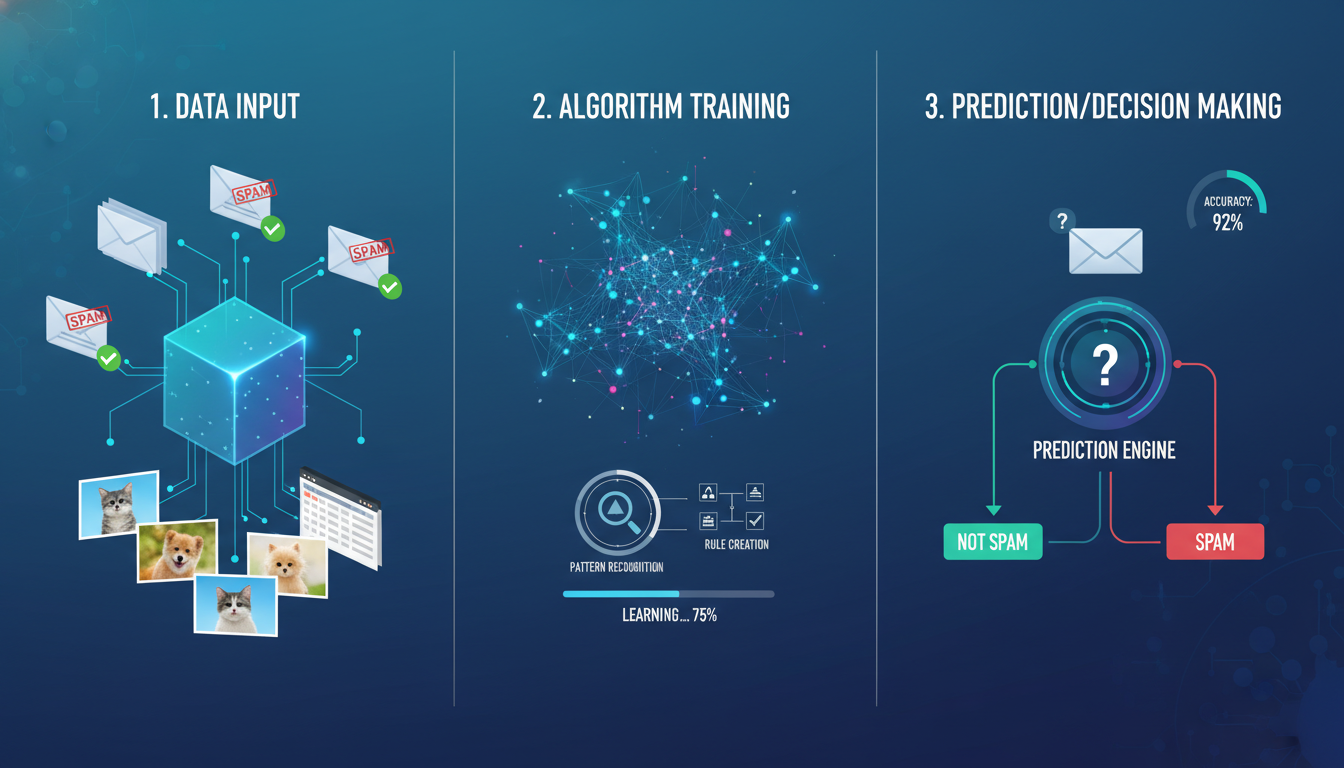
Let’s be honest: explaining What is Machine Learning? AI Explained Simply can sometimes feel like untangling a knot—yet, when the thread is clear, everything falls into place. At its core, machine learning is about teaching computers to learn from data and improve over time, almost like a curious student picking up patterns without someone spelling out every rule. This narrative isn’t just theoretical—it’s shaping everything from how apps recommend music to how banks detect fraud. So, here’s an approachable dive into the essence of machine learning, peppered with real-world insights and just enough imperfection to stay, well, human.
What Machine Learning Really Means
Machine learning bridges the gap between programming and ambiguity. Rather than hard-coding precise instructions, you feed models data—and let them infer patterns. Think about a spam filter that gets better at spotting annoying emails because it’s exposed to hundreds, thousands, maybe millions of examples. That’s the huge leap: from instruction-based to experience-based learning.
In practice, machine learning can be split into several broad categories:
- Supervised learning, where a model is trained on labeled data—like images tagged ‘cat’ or ‘dog’.
- Unsupervised learning, which deals with unlabeled data and finds structure—like grouping similar customers together.
- Reinforcement learning, where an algorithm learns to make decisions by trial and error, guided by rewards or penalties.
Real-world Example: Personalized Streaming
Consider a streaming platform trying to suggest your next binge-worthy show. It doesn’t ask you directly; instead, it observes your viewing history, what others with similar tastes like, and even what time of day you’re watching. That’s supervised and collaborative filtering in action. The model refines its suggestions continuously—slowly learning you better than you might yourself.
“Machine learning transforms data from static records into a living guide for smarter decisions.”
That bit of insight captures how machine learning transcends mere automation—it’s a living, breathing system that adapts.
Why This Matters (and Why It’s Not Sci-Fi)
You’ve probably heard claims about robots taking over, but machine learning is far more mundane—and powerful—than Hollywood sci-fi. Yes, artificial intelligence can automate complex tasks, but the real power is often behind the scenes: improving medical diagnoses, optimizing traffic lights, or even reducing energy waste in buildings.
What ties these applications together is data—lots of it—and the ability to adapt. The more diverse and relevant the data, the better the model becomes at generalizing. That’s both its promise and its Achilles’ heel: without thoughtful data curation or ethical guardrails, models can misfire or unintentionally encode bias.
Exploring Core Techniques in Depth
Supervised Learning: Teaching with Examples
Supervised learning is the most intuitive route—it’s like a teacher giving the answer key along with the test. The model adjusts its parameters to minimize the difference between its predictions and the true labels. Everyone from marketers predicting churn to doctors diagnosing illness relies heavily on this.
Advantages include clarity (you know what goal you’re optimizing for) and robustness (given enough quality data). On the downside, it hinges on accurate labeling, which sometimes requires expert knowledge—like radiologists annotating X-rays.
Unsupervised Learning: Finding Hidden Patterns
Think of clustering algorithms that group customer behavior without pre-set categories. It’s less about prediction and more about discovery. For example, retail analysts might segment shoppers into groups that exhibit similar spending patterns—without ever telling the algorithm what to look for. It’s powerful for uncovering surprising insights, though it can feel fuzzy—without labels, you need to interpret what clusters actually mean.
Reinforcement Learning: Learning by Doing
This one’s more experimental—tasks where outcomes can be measured, like game performance or robotic movement. The model learns actions that yield the biggest rewards. Breakthroughs like AlphaGo mastering Go through self-play show the potential. But scaling that to everyday business problems remains tricky—it requires carefully designed environments and feedback mechanisms.
Balancing the Benefits and Pitfalls
It’s easy to gush about innovation, but a balanced lens is vital:
- Pros:
- Improves efficiency across sectors.
- Enables personalization at scale.
-
Discovers patterns humans might overlook.
-
Cons:
- Can propagate biases from training data.
- Needs technical expertise and infrastructure.
- Sometimes lacks transparency—making it hard to understand why a decision was made.
A retail example: a model may increase sales by recommending popular items—but if training data reflects over-promotion of pricey products, it may bias recommendations unintentionally toward high-ticket items, marginalizing budget-friendly choices.
Summary and Takeaways
Machine learning isn’t some mystical black box; it’s an evolving toolkit that learns from experience—much like we do. Whether it’s through labeled data, structure discovery, or trial-and-error, each method brings unique strengths. Real-world examples—from streaming recommendations to business segmentation—make these techniques more than just theory. Yet, thoughtful application matters. Human oversight ensures models stay fair, relevant, and transparent. By embracing both innovation and responsibility, machine learning becomes a genuinely transformative force.
FAQs
1. What’s the simplest way to describe machine learning?
Machine learning means teaching a computer to learn from data, so it can make predictions or decisions without explicit programming for each scenario.
2. How does supervised learning differ from unsupervised learning?
Supervised learning uses labeled examples (like images tagged as “cat” or “dog”) to train a model, while unsupervised learning finds hidden structure in unlabeled data—like grouping similar users based on behavior.
3. Why is machine learning useful in everyday apps?
It helps personalize experiences—like movie recommendations or predictive typing—by learning from large datasets and adapting continuously, often behind the scenes.
4. Can machine learning be biased?
Yes. If the training data reflects existing biases, the model can replicate them. Careful data selection and fairness checks are crucial to avoid reinforcing unfair patterns.
5. Is reinforcement learning widely used outside games and robotics?
It’s growing, but applications are more niche. Reinforcement learning excels in scenarios with clear feedback loops—like game strategies or robotics—though broader business use is still emerging.
6. What’s a quick tip for someone starting with machine learning?
Begin with simple supervised projects using readily available datasets and gradually explore other areas like clustering or basic reinforcement tasks to understand their strengths and limits.
There—plainspoken, data-aware, and a bit messy in all the right ways.
