

 March 9, 2026
  6 Min
6 Min  No Comment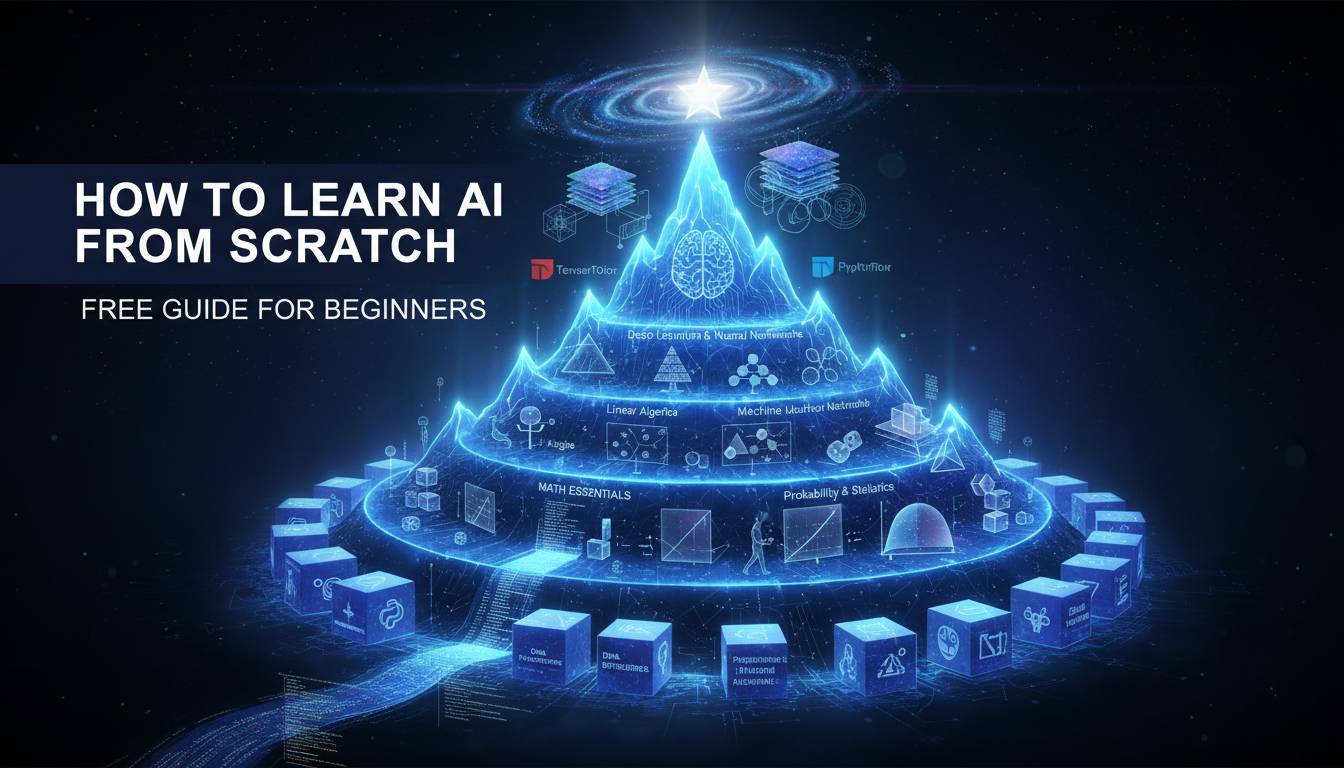
Artificial intelligence has moved from science fiction into everyday life. The recommendation engine that suggests your next show, the spam filter keeping your inbox clean, the voice assistant on your phone—these are all AI in action. As companies adopt AI solutions, the demand for people who actually understand this stuff has exploded, creating real career opportunities for those willing to put in the work.
This guide walks through how to learn AI from scratch, covering what you need to know first, where to learn it, and how long it realistically takes.
Why Learning AI Matters
AI refers to computer systems that perform tasks requiring human intelligence—solving problems, recognizing patterns, processing language, making decisions. Machine learning, a subset of AI, lets systems learn from experience without being explicitly programmed. Deep learning uses neural networks with many layers to handle complex data.
Beyond career benefits, AI literacy helps anyone make better decisions. If you run a business, you need to evaluate AI vendor proposals intelligently. If you work in marketing, you should understand how targeting algorithms work. According to the World Economic Forum’s 2024 report, AI and machine learning skills rank among the top competencies employers want, with AI-related job postings in the US growing over 60% year-over-year.
What You Need to Know First
Before jumping into AI-specific material, you’ll want some foundation in place. Python is the main language for AI work, so getting comfortable with its syntax, data structures, and basic libraries matters. Statistics and probability show up constantly in machine learning—understanding how models process data and generate predictions requires this background.
Linear algebra helps with understanding how neural networks manipulate data through matrices and vectors. You don’t need to be a mathematician, but comfort with calculus concepts helps when learning about optimization algorithms that train models. Don’t let this intimidate you—most people build these skills alongside their AI learning.
A More Natural Learning Path
Rather than thinking of this as a rigid sequence, think of it as building blocks. You’ll cycle between learning concepts and applying them.
Start with Python. Focus on the fundamentals: variables, loops, functions, and how object-oriented programming works. Codecademy, freeCodeCamp, and Python.org all offer starting points. Plan for 30-40 hours of practice before moving to machine learning content.
Add data science skills. Pandas, NumPy, and visualization libraries like Matplotlib let you explore and understand datasets. DataCamp and Kaggle provide environments where you can practice with real data.
Move into machine learning theory. Andrew Ng’s Machine Learning course on Coursera (he teaches at Stanford) is widely considered the best starting point. It covers supervised learning, unsupervised learning, neural networks, and how to evaluate models.
Pick up a deep learning framework. TensorFlow (Google’s) and PyTorch (Meta’s) are the dominant options. TensorFlow has extensive documentation and cloud integration. PyTorch is popular in research because of its dynamic computation graph and easier debugging. Many people start with TensorFlow’s Keras interface, then switch to PyTorch later.
Build things. Theory means nothing without practice. Enter Kaggle competitions, work with real datasets, create projects like image classifiers, sentiment analyzers, or recommendation systems. A portfolio of completed work proves your skills to employers.
Specialize eventually. AI branches into many directions: natural language processing, computer vision, reinforcement learning, generative AI. After you have the basics, explore what interests you most.
Resources That Actually Help
FreeCodeCamp’s machine learning curriculum covers Python through deep learning—thousands of hours of content at no cost. MIT OpenCourseWare offers actual university courses with lecture videos and assignments. Google’s Machine Learning Crash Course provides hands-on TensorFlow practice. Microsoft’s AI Business School focuses on strategy rather than coding.
Paid options like Coursera, edX, and Udacity partner with universities and companies for professional certificates. These typically cost $300-$1,000 but include structured paths, graded work, and credentials that employers recognize. Bootcamps, online or in-person, offer intensive training for career changers.
For books, Aurélien Géron’s “Hands-On Machine Learning with Scikit-Learn, Keras, and TensorFlow” is practical and implementation-focused. “The Deep Learning Book” by Ian Goodfellow, Yoshua Bengio, and Aaron Courville goes deeper theoretically.
How Long Does This Take?
It depends on your background and how much time you can dedicate.
If you’re starting from zero and studying 10-15 hours weekly, expect 6-12 months to reach basic AI literacy—enough to understand publications, enter Kaggle competitions, and build simple models.
For job-ready proficiency, plan on 1-2 years if you’re starting fresh. This gives time for multiple projects, portfolio building, and developing expertise in a specific area. People with adjacent skills (software development, data analysis) often reach this level in 6-12 months by building on what they already know.
Bootcamps compress this to 3-6 months but demand serious time and often require extra self-study afterward.
AI learning never really “finishes.” The field keeps evolving, so practitioners need to keep learning throughout their careers.
Common Struggles You’ll Face
Math makes people nervous. You don’t need to become a mathematician—focus on practical interpretation rather than proving theorems. Khan Academy and 3Blue1Brown explain concepts accessibly.
Too many resources overwhelm newcomers. Pick one solid curriculum and finish it before jumping to others. Quality matters more than quantity.
Theory doesn’t always translate to working code. Practice consistently with real datasets. The UCI Machine Learning Repository and Kaggle have appropriate starting data.
Motivation fades. Set small goals, celebrate progress, and find community. Reddit’s r/MachineLearning, local meetups, and online forums provide accountability.
What’s Out There Professionally
AI offers several career paths. Machine learning engineers build and deploy models. Data scientists analyze data to find insights. AI research scientists develop new algorithms.
LinkedIn’s 2024 Emerging Jobs Report shows AI specialist roles growing over 40% annually. US salaries typically range from $120,000 to $180,000 depending on experience and location. Remote work opens opportunities nationally and internationally.
Non-technical roles exist too. AI product managers bridge technical and business work. Ethicists ensure AI gets deployed responsibly. Domain experts apply AI to healthcare, finance, manufacturing, or entertainment.
Final Thoughts
Learning AI takes dedication and steady practice, but the payoff is real. Free resources, structured programs, and project opportunities make AI education more accessible than ever. As AI transforms industries, people with skills will have options.
Start with fundamentals, build gradually, and push through the hard parts. Whether you want a career switch or just want to understand what everyone talking about, the investment pays off. Begin today, stay consistent, and enjoy the process.