

 February 24, 2026
  16 Min
  No Comment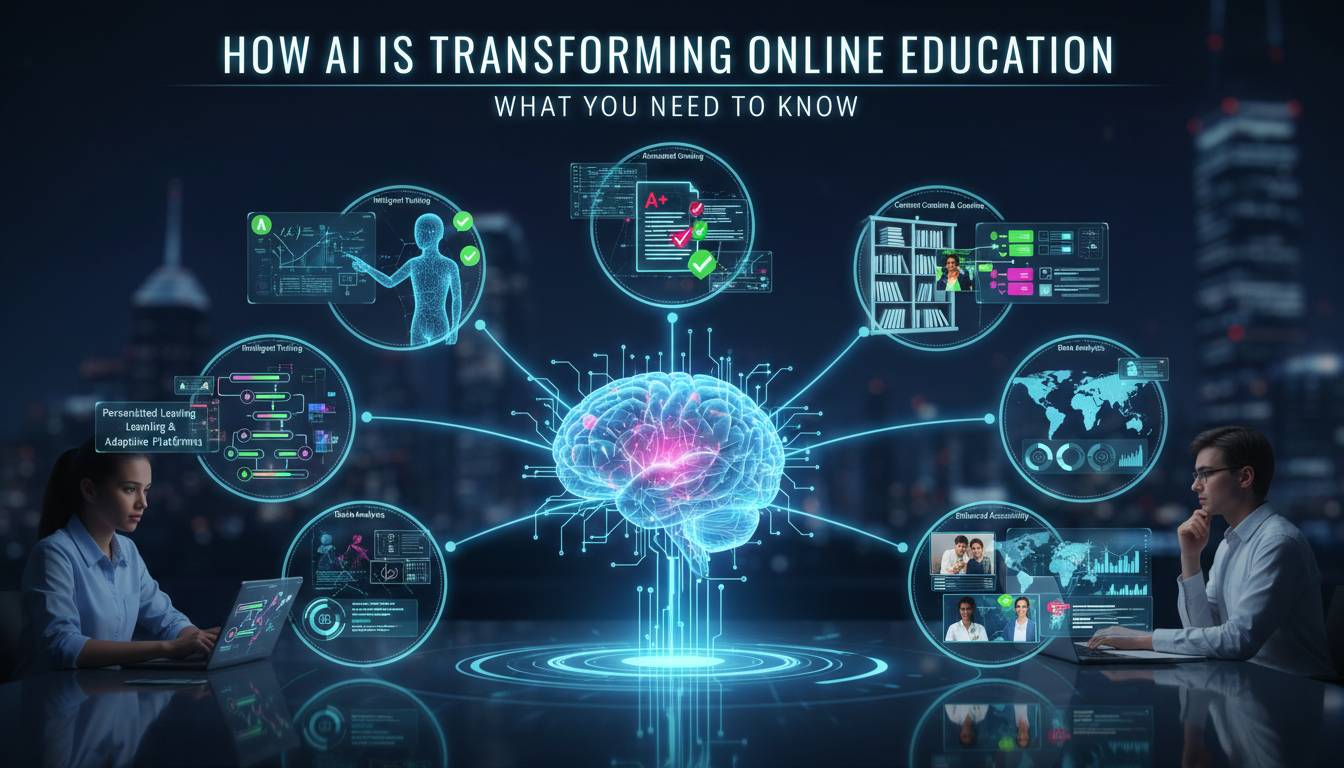
The past decade has brought major changes to online learning, but artificial intelligence has accelerated things dramatically. AI now powers personalized learning paths that adjust to each student’s needs, intelligent tutoring systems available any time of day, and tools that are fundamentally changing how students learn and teachers operate in digital spaces. These advances go beyond simple automation—they’re creating real possibilities for accessibility, engagement, and better educational results that weren’t possible before. Understanding these changes matters for students, teachers, administrators, and anyone curious about where learning is heading.
This guide looks at the various ways AI is changing online education, covering both the significant benefits and the real challenges that come with this technological shift. Whether you’re a teacher exploring AI tools for your virtual classroom, a student using AI-assisted learning platforms, or an administrator making choices about ed-tech investments, this article gives you what you need to understand what’s happening and why it matters.
What Is AI in Online Education?
AI in online education means using machine learning algorithms, natural language processing, and adaptive technologies to improve the learning experience in digital settings. Traditional software follows set instructions, but AI systems can analyze data, recognize patterns, and make decisions with varying independence. In education, this lets platforms respond to student behavior dynamically, offering tailored support that scales far beyond what human teachers alone could provide.
Integrating AI into online learning didn’t happen all at once. Early efforts in the 1990s and early 2000s focused on basic adaptive testing and simple recommendation systems. These early versions laid the groundwork for today’s more advanced tools, but the real shift began around 2015 when deep learning and natural language processing matured. Suddenly, AI could do more than recommend content—it could actually understand and respond to student questions, evaluate written work, and spot knowledge gaps as they happened.
“The difference between AI education tools of five years ago and today is like comparing a basic calculator to a smartphone,” says Dr. Sarah Chen, an educational technology researcher at Columbia University. “We’re no longer talking about rote automation—we’re talking about systems that genuinely augment human capability in the learning process.”
Today, AI-powered educational tools range from chatbots that answer student questions at 2 AM to platforms that can detect when a student is struggling based on patterns no human observer would catch. The technology has advanced to the point where many students regularly interact with AI learning assistants without knowing it, and teachers increasingly rely on AI-derived insights to shape their teaching strategies.
Key Ways AI Is Transforming Online Learning
Personalized Learning Paths
One of the most important contributions of AI to online education is the ability to create truly personalized learning experiences. Traditional online courses present the same content to every student in the same order, assuming a one-size-fits-all approach. AI changes this by analyzing each student’s learning history, performance data, and behavioral patterns to build a customized pathway through the material.
These adaptive systems work by constantly checking student understanding through quizzes, assignments, and interaction patterns. When a student shows mastery of a concept, the AI can move them ahead to more advanced material. When the system detects confusion or poor performance, it automatically provides extra resources, simpler explanations, or prerequisite content to fill gaps. This adjustment happens in real-time, creating a learning experience that feels almost like having a personal tutor who knows your exact strengths and weaknesses.
The impact of this personalization goes beyond convenience. Research shows that adaptive learning systems can meaningfully improve student outcomes, especially for struggling learners who might fall behind in traditional classroom settings. By keeping students at their optimal challenge level—hard enough to promote growth but not so hard they get frustrated—AI helps maintain the “zone of proximal development” that learning scientists have long recognized as crucial for effective education.
Intelligent Tutoring Systems
Intelligent tutoring systems represent another frontier in AI-powered education. These programs can simulate the guidance a human tutor would provide, offering explanations, hints, and feedback tailored to the student’s specific situation. Unlike static educational content, these systems have real conversations with students, asking clarifying questions and adjusting their teaching approach based on student responses.
The most advanced intelligent tutors now use natural language processing that lets students ask questions in their own words and get responses that address their actual confusion—not just the confusion the system expected. This conversational interface makes learning more engaging and lets students explore topics more freely, asking “what if” questions and pursuing tangents that interest them without worrying about falling behind or wasting a tutor’s time.
Many online platforms have integrated these tutoring capabilities with solid results. Students working with AI tutors often show learning gains comparable to those achieved with human tutoring, but at a fraction of the cost and with unlimited availability. The 24/7 accessibility matters especially for students in different time zones, those who study at odd hours, or anyone who needs help immediately when their human instructor isn’t available.
Automated Grading and Feedback
Grading has long been one of the most time-consuming parts of teaching, especially online where instructors may be responsible for hundreds of students at once. AI-powered grading systems are changing this, offering quick evaluation of student work that lets educators focus on higher-value activities like direct instruction and mentorship.
Modern AI grading goes well beyond multiple-choice tests. These systems can now evaluate written essays, analyze code submissions, assess mathematical proofs, and provide feedback on creative projects. While early automated graders could only check for keywords or simple pattern matching, current systems use sophisticated semantic analysis to evaluate reasoning quality, argument coherence, and originality. This lets students get detailed feedback on their writing much faster than human grading alone could provide.
The efficiency gains are real. What might take an instructor hours to grade can often be done by an AI system in seconds, with the added benefit of consistency—AI applies the same criteria to all submissions, eliminating grading fatigue or unconscious bias that can affect human evaluators. For educators, this means more time for one-on-one interaction and less time stuck in paperwork.
Enhanced Accessibility Features
AI is making online education more accessible to learners with disabilities in ways that weren’t technically possible a few years ago. Automatic captioning and transcription services have become very accurate, helping not only deaf and hard-of-hearing students but also those who learn better by reading or who need to review material in noisy environments. Real-time translation services are breaking down language barriers that once made it difficult for non-native speakers to access educational content.
More impressive are AI systems designed to identify and accommodate learning differences. These tools can detect patterns that suggest dyslexia, ADHD, or other learning challenges, allowing educators to intervene earlier and provide appropriate support. Some platforms now offer AI-powered reading assistants that can modify text presentation, adjust pacing, or provide audio support based on individual learner needs—all without requiring formal diagnosis or special accommodation requests.
The broader accessibility implications extend beyond traditional disabilities. AI-powered tools can help students with anxiety navigate social aspects of online learning, assist those with physical limitations through voice-controlled navigation, and support students with cognitive overload by simplifying complex interfaces. This democratization of education aligns with the original promise of online learning: making quality education accessible to anyone with an internet connection.
Predictive Analytics for Student Success
Educational institutions are increasingly using AI-powered predictive analytics to identify students at risk of falling behind or dropping out. These systems analyze lots of data—including login patterns, time on task, assignment completion rates, and assessment performance—to generate early warning indicators that can trigger intervention before small problems become big ones.
The power of predictive analytics lies in its ability to spot patterns that human observers might miss. A student whose engagement has been gradually declining over several weeks, for example, might go unnoticed in a large online course where instructors can’t personally observe every learner. An AI system, though, can flag this decline right away, alerting instructors or advisors who can then reach out with support. This proactive approach has shown promising results in pilot programs, with some institutions reporting meaningful improvements in retention rates after implementing AI-driven early warning systems.
Beyond individual student support, predictive analytics can inform institutional decision-making. By analyzing which course designs, instructional approaches, or support services correlate with student success, administrators can make evidence-based choices about resource allocation and curriculum development. This data-driven approach to education management represents a shift from intuition-based decision-making to continuous improvement based on measurable outcomes.
Statistics: The Impact of AI on Online Education
The scale of AI’s impact on online education becomes clearer when looking at the data. The global market for AI in education has grown quickly, with recent estimates suggesting it could exceed $20 billion by 2027. This growth reflects both increasing adoption rates and expanding capabilities—what AI can do in educational contexts continues to broaden at a remarkable pace.
Student performance data shows compelling patterns. Studies of adaptive learning platforms consistently find that students using AI-powered personalization perform measurably better than those in traditional online courses. Improvements in exam scores typically range from 10 to 30 percent, with the biggest gains appearing among students who were previously struggling. Perhaps more importantly, completion rates in AI-enhanced courses tend to be higher than in conventional online offerings, addressing one of the persistent challenges of digital education.
“The numbers tell a clear story,” says Marcus Williams, Chief Learning Officer at a major online education platform. “When we implemented AI-driven personalization across our course catalog, we saw a 23 percent improvement in course completion rates and a 19 percent increase in student satisfaction scores within the first year.”
Teacher adoption has also accelerated. Surveys show that over 60 percent of teachers and instructors now use some form of AI tool in their work, whether for grading assistance, content creation, or student analytics. This represents a fundamental shift in the teaching profession’s relationship with technology—AI is no longer an optional add-on but an integrated part of modern educational practice.
The demographic shifts are equally notable. Students in rural areas, developing countries, and other contexts traditionally underserved by education systems have benefited disproportionately from AI-powered online learning. The ability to provide high-quality, personalized education at scale through AI addresses longstanding equity concerns that have plagued traditional educational systems.
Benefits of AI for Students and Educators
For students, the benefits of AI in online education extend far beyond improved grades. AI-powered tools can provide instant feedback that speeds up the learning process, eliminating the frustrating delay between completing an assignment and receiving evaluation. This immediacy lets students correct misconceptions quickly, before they become entrenched, and keeps the momentum that keeps learners engaged.
The personalized nature of AI learning addresses a fundamental problem in education: the mismatch between teaching pace and learning pace. In a traditional classroom, teachers must compromise—teaching too fast for some students and too slow for others. AI eliminates this compromise by letting each student progress at their optimal speed, ensuring advanced students stay challenged while struggling students get the support they need without feeling singled out or slowed down.
For educators, AI offers both relief from administrative burdens and enhanced capabilities for supporting students. The time freed from grading and basic content delivery can be redirected toward higher-value activities: mentoring, facilitating discussions, designing innovative learning experiences, and providing the human connection that remains essential to education. Many teachers report that AI tools have not replaced their roles but have elevated them, letting them focus on the aspects of teaching they find most meaningful.
The scalability of AI-powered education represents perhaps its most transformative potential. A single expert educator’s knowledge and methods can now reach millions of students simultaneously through AI-assisted platforms. This scaling effect has the potential to address teacher shortages that affect millions of students worldwide, particularly in subjects where qualified instructors are scarce.
Challenges and Limitations of AI in Education
Despite its promise, AI in education faces significant challenges that can’t be overlooked. Data privacy concerns top the list for many educators and parents. AI systems need lots of student data to work effectively, raising questions about how this information is collected, stored, and potentially misused. The prospect of student behavior being tracked, analyzed, and stored by private companies raises legitimate concerns about surveillance and the commodification of educational data.
Equity issues present another critical challenge. While AI has the potential to democratize education, it could also worsen existing inequalities if access to AI-powered tools becomes unequal. Students from wealthy families and well-funded institutions may benefit from cutting-edge AI education while others are left with inferior alternatives—or no AI support at all. The digital divide that already affects access to online education could easily extend to AI access, creating new forms of educational inequality.
The quality and bias of AI systems remain ongoing concerns. AI models can accidentally perpetuate or amplify biases present in their training data, potentially leading to unfair treatment of students from certain demographic groups. Additionally, the “black box” nature of some AI systems makes it difficult to understand why they make particular recommendations or assessments, complicating efforts to identify and correct errors.
“We need to approach AI in education with both excitement and appropriate skepticism,” warns Dr. Michelle Rodriguez, an education policy expert at Stanford University. “These tools have enormous potential, but we must remain vigilant about their limitations and ensure that human judgment remains central to educational decision-making.”
Perhaps most fundamentally, there are aspects of education that AI struggles to replicate. The social-emotional dimensions of learning—the encouragement from a mentor, the collaboration with peers, the inspiration from a passionate teacher—remain difficult to automate. Education is not merely the transfer of information; it’s the development of human potential in all its complexity. AI can support this process but cannot replace the fundamentally human relationships at its core.
The Future of AI in Online Education
Looking ahead, the trajectory of AI in education points toward even greater integration and capability. Emerging technologies like large language models are already starting to change how students interact with educational content, enabling more natural conversational learning experiences that blur the line between human and AI interaction. These developments suggest a future where AI assistants become standard learning companions, available to guide students through their educational journeys.
The integration of AI with other emerging technologies promises even more transformative possibilities. Virtual and augmented reality, combined with AI, could create immersive learning experiences that make abstract concepts tangible. AI-powered systems could orchestrate complex simulations, allowing students to conduct virtual experiments, explore historical events from multiple perspectives, or practice professional skills in realistic scenarios.
However, the future will also require careful governance and thoughtful implementation. As AI becomes more capable, questions about appropriate use, ethical boundaries, and human oversight will become increasingly pressing. The education sector must develop frameworks for responsible AI use that preserve the human elements essential to learning while harnessing technological capabilities.
Most experts predict a future of augmented rather than replaced educators. The most successful implementations will likely be those that find the optimal balance between AI capability and human judgment, using technology to enhance rather than eliminate the human connections that make education meaningful.
Frequently Asked Questions
How is AI changing online education?
AI is changing online education through personalization, automation, and enhanced accessibility. Modern AI systems can adapt to individual student needs, provide instant feedback, and offer support around the clock. These capabilities address many of the limitations that have historically plagued online learning, making digital education more effective and accessible than ever before.
What are the benefits of AI in e-learning?
The benefits include personalized learning experiences tailored to individual student needs, 24/7 availability of learning support, reduced administrative burden for educators, improved accessibility for students with disabilities, and data-driven insights that can improve educational outcomes. Students can progress at their own pace while receiving immediate feedback, and educators can focus on high-value interactions rather than routine tasks.
Will AI replace teachers?
While AI will certainly transform teaching roles, most experts believe it will augment rather than replace human educators. AI excels at certain tasks—grading, content delivery, basic tutoring—but lacks the ability to provide the emotional support, mentorship, and human connection that remain central to education. The most likely scenario is a future where AI handles routine tasks while teachers focus on mentoring, facilitation, and the social-emotional development of students.
What are the challenges of AI in education?
Key challenges include data privacy concerns, potential for worsening existing inequalities, questions about AI bias and fairness, the difficulty of automating complex pedagogical decisions, and the risk of losing human elements in education. Additionally, the rapid pace of technological change can outstrip the ability of educators and institutions to adapt effectively.
Conclusion
The transformation of online education by artificial intelligence represents a significant development in the history of learning. From personalized learning paths that adapt to individual student needs to intelligent tutoring systems available anytime, anywhere, AI is creating possibilities that would have seemed like science fiction just a decade ago. The benefits are real: improved outcomes, greater accessibility, enhanced efficiency, and the potential to address long-standing inequities in educational access.
Yet this transformation requires thoughtful navigation. The challenges—data privacy, equity concerns, algorithmic bias, and the preservation of human connection in education—are not trivial. As AI capabilities continue to expand, the education sector must develop frameworks for responsible implementation that prioritize student welfare and educational values over technological novelty.
For students, educators, and institutions, the message is clear: AI is not a distant future possibility but a present reality reshaping how we teach and learn. Understanding these changes, engaging critically with AI tools, and maintaining focus on the fundamental purposes of education will be essential for navigating this transformation successfully. The future of online education will be shaped by how well we combine the power of artificial intelligence with the irreplaceable qualities of human guidance and connection.
