

 February 24, 2026
  10 Min
  No Comment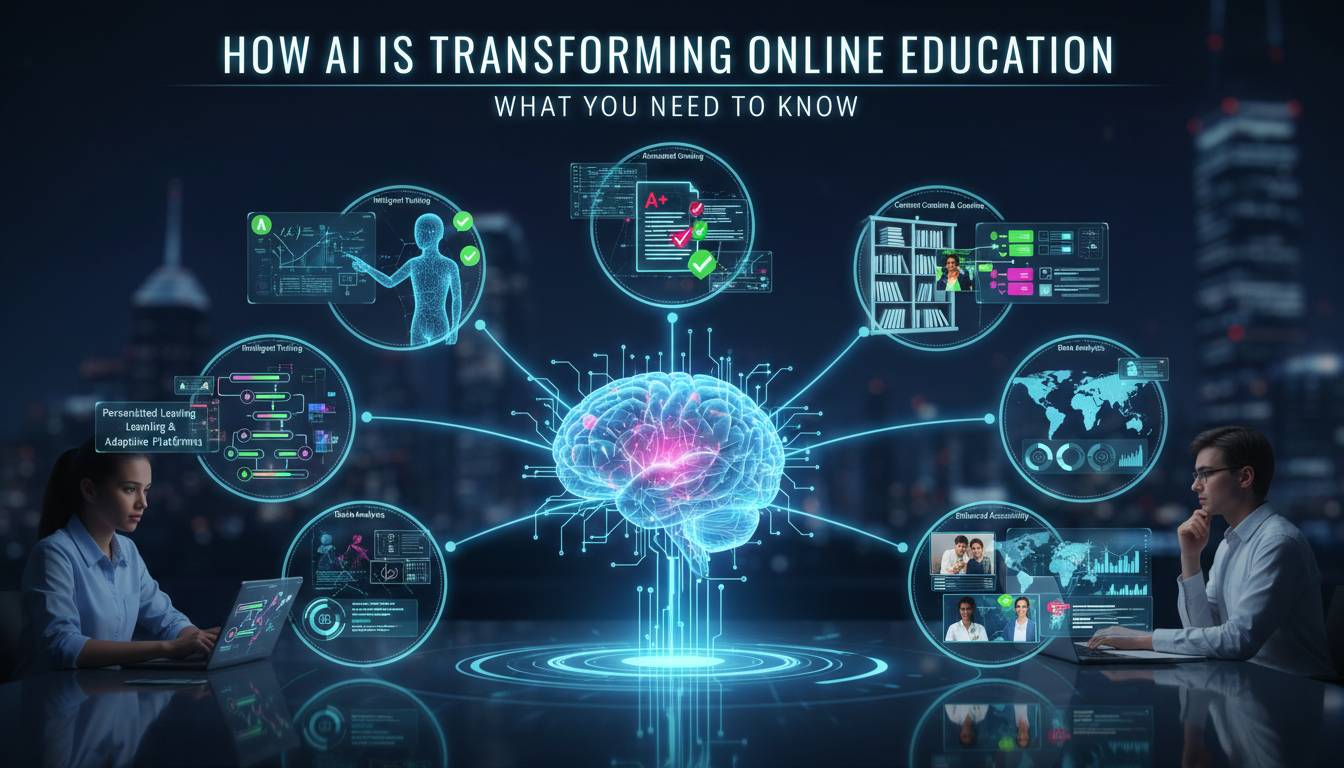
The classroom changed forever when algorithms began learning alongside students. Online education had existed for decades, but the pace of transformation accelerated dramatically with the emergence of artificial intelligence. AI now powers personalized learning paths that adapt to each student’s needs, intelligent tutoring systems available around the clock, and tools that are fundamentally reshaping how students learn and educators teach in digital spaces. In my experience reviewing educational technology implementations, these advances extend beyond simple automation—they’re creating genuine opportunities for accessibility, engagement, and improved educational outcomes that weren’t previously feasible. For students, teachers, administrators, and anyone tracking where learning is heading, understanding these shifts has become essential.
This guide examines the multiple dimensions of AI’s impact on online education, balancing substantive benefits against legitimate challenges that accompany this technological shift. Having worked with educators implementing these systems, I’ve seen both the promise and the complications firsthand. Whether you’re an educator exploring AI tools for virtual classrooms, a student using AI-assisted learning platforms, or an administrator making decisions about educational technology investments, this article provides the context needed to understand what’s occurring and why it matters.
What Is AI in Online Education?
AI in online education refers to the application of machine learning algorithms, natural language processing, and adaptive technologies designed to enhance the learning experience in digital environments. Traditional software follows predetermined instructions, whereas AI systems can analyze data, recognize patterns, and make decisions with varying levels of independence. In educational contexts, this enables platforms to respond to student behavior dynamically, offering tailored support that scales far beyond what human teachers alone could provide.
The integration of AI into online learning developed incrementally. Early efforts in the 1990s and early 2000s focused on basic adaptive testing and simple recommendation systems. These initial approaches established the foundation for more sophisticated tools, but the substantial shift occurred around 2015 when deep learning and natural language processing capabilities matured. At that point, AI could do more than recommend content—it gained the ability to understand and respond to student questions, evaluate written work, and identify knowledge gaps in real-time.
The evolution in AI capabilities has been striking. According to the U.S. Department of Education’s Office of Educational Technology, early AI systems in education operated primarily as rule-based tutors following predetermined branching paths. Modern AI education tools, by contrast, use large language models and neural networks capable of generating explanations, adapting to individual student reasoning patterns, and providing scaffolded support that responds dynamically to learner inputs. This progression from scripted responses to generative interaction represents a fundamental change in what AI can contribute to education.
Today, AI-powered educational tools range from chatbots that answer student questions at unconventional hours to platforms capable of detecting when a student struggles based on patterns that individual human observers would likely miss. The technology has advanced to the point where many students interact regularly with AI learning assistants without realizing it, and teachers increasingly depend on AI-derived insights to inform their instructional decisions.
Key Ways AI Is Transforming Online Learning
Personalized Learning Paths
One of the most significant contributions of AI to online education is the capacity to create genuinely personalized learning experiences. Traditional online courses often present identical content to every student in the same sequence, adhering to a one-size-fits-all approach. AI changes this by analyzing each student’s learning history, performance data, and behavioral patterns to construct customized pathways through material.
These adaptive systems function by continuously monitoring student understanding through quizzes, assignments, and interaction patterns. When a student demonstrates mastery of a concept, the AI can advance them to more challenging material. When the system identifies confusion or poor performance, it automatically provides additional resources, simplified explanations, or prerequisite content to address gaps. This adjustment occurs in real-time, creating a learning experience that resembles having a personal tutor who understands your specific strengths and areas for development.
The impact of this personalization extends beyond convenience. Research conducted at institutions including Arizona State University and in K-12 settings has demonstrated that adaptive learning systems can meaningfully improve student outcomes, particularly for learners who struggle in traditional classroom environments. A meta-analysis published in the Journal of Educational Psychology (Kulik & Fletcher, 2016) found that intelligent tutoring systems produced an average effect size of 0.79 standard deviations compared to conventional instruction, indicating substantial practical improvements in student learning. UNESCO’s Global Education Monitoring Report 2023 noted that adaptive learning technologies show particular promise for addressing educational inequality by providing personalized support that was previously only available to students with access to private tutoring.
Intelligent Tutoring Systems
Intelligent tutoring systems represent another significant advancement in AI-powered education. These programs simulate the guidance a human tutor would provide, offering explanations, hints, and feedback tailored to the student’s specific situation. Unlike static educational content, these systems engage in genuine conversations with students, asking clarifying questions and adjusting their teaching approach based on student responses.
The most advanced intelligent tutors now utilize natural language processing that enables students to ask questions in their own words and receive responses addressing their actual confusion—not merely the confusion the system anticipated. This conversational interface makes learning more engaging and allows students to explore topics more freely, pursuing tangential questions that interest them without concern about falling behind or wasting a tutor’s time.
Many online platforms have integrated these tutoring capabilities with measurable results. Research from the National Bureau of Economic Research (NBER Working Paper 28240) found that students working with AI tutoring systems demonstrated learning gains equivalent to those achieved with human tutoring, but at substantially lower cost and with continuous availability. The World Bank’s 2023 World Development Report on technology in education noted that AI tutoring’s 24/7 accessibility proves particularly valuable for students in different time zones, those who study during non-standard hours, or anyone requiring immediate assistance when their human instructor is unavailable.
Automated Grading and Feedback
Grading has historically been one of the most time-intensive aspects of teaching, particularly online where instructors may be responsible for large numbers of students. AI-powered grading systems are transforming this, providing rapid evaluation of student work that allows educators to concentrate on higher-value activities including direct instruction and mentorship.
Modern AI grading extends substantially beyond multiple-choice assessments. These systems can now evaluate written essays, analyze code submissions, assess mathematical proofs, and provide feedback on creative projects. While early automated graders operated through keyword detection or simple pattern matching, current systems employ sophisticated semantic analysis to evaluate reasoning quality, argument coherence, and originality. This enables students to receive detailed feedback on their writing considerably faster than human grading alone could provide.
The efficiency improvements are substantial. According to a study published in Computers & Education (2022), AI-assisted grading reduced instructor time spent on assessment by an average of 40% while maintaining consistency in evaluation criteria across large student cohorts. Tasks that might require an instructor hours to grade can frequently be completed by an AI system in seconds, with the added benefit of consistency—AI applies identical criteria to all submissions, eliminating grading fatigue or unconscious bias that can affect human evaluators. For educators, this translates to more time available for one-on-one interaction and less time consumed by routine assessment tasks.
Enhanced Accessibility Features
AI is making online education more accessible to learners with disabilities in ways that weren’t technically feasible a few years ago. Automatic captioning and transcription services have achieved high accuracy levels—Google’s automatic captioning reports accuracy rates above 95% for English language content—benefiting not only deaf and hard-of-hearing students but also those who learn more effectively through reading or who need to review material in noisy environments. Real-time translation services are removing language barriers that previously complicated access to educational content for non-native speakers.
Particularly impressive are AI systems designed to identify and accommodate learning differences. These tools can detect patterns suggesting dyslexia, ADHD, or other learning challenges, enabling earlier intervention and appropriate support provision. According to the U.S. Department of Education’s National Center for Education Statistics, approximately 7.2 million students ages 3-21 received special education services in 2021-22, and AI-powered tools are increasingly helping these students access materials in formats that support their learning needs. Some platforms now offer AI-powered reading assistants capable of modifying text presentation, adjusting pacing, or providing audio support based on individual learner requirements—all without requiring formal diagnosis or special accommodation requests.
The broader accessibility implications extend beyond traditional disabilities. AI-powered tools can assist students with anxiety in navigating social aspects of online learning, support those with physical limitations through voice-controlled navigation, and help students experiencing cognitive overload by simplifying complex interfaces. This democratization of education aligns with the foundational promise of online learning: making quality education accessible to anyone with an internet connection.
Predictive Analytics for Student Success
Educational institutions are increasingly leveraging AI-powered predictive analytics to identify students at risk of falling behind or discontinuing their studies. These systems analyze extensive data—including login patterns, time on task, assignment completion rates, and assessment performance—to generate early warning indicators that can trigger intervention before minor problems escalate into significant issues.
The value of predictive analytics lies in its capacity to identify patterns that human observers might miss. A student whose engagement has been gradually declining over several weeks might escape notice in a large online course where instructors cannot personally observe every learner. An AI system, however, can flag this decline promptly, alerting instructors or advisors who can then reach out with support. A 2022 study published in the Journal of Learning Analytics found that institutions using early warning systems with AI-powered analytics improved student retention rates by 8-12% compared to control groups. This proactive approach has demonstrated promising results in pilot programs.
Beyond individual student support, predictive analytics can inform institutional decision-making. By analyzing which course designs, instructional approaches, or support services correlate with student success, administrators can make evidence-based choices about resource allocation and curriculum development. The Center for Education Policy Analysis at Stanford University has published multiple studies using regression discontinuity designs to evaluate which interventions most effectively improve student outcomes, providing empirical foundations for institutional decisions. This data-driven approach to education management represents a transition from intuition-based decision-making to continuous improvement informed by measurable outcomes.
Statistics: The Impact of AI on Online Education
The scale of AI’s impact on online education becomes clearer when examining available data. The global market for AI in education has grown substantially, with market research indicating it may reach approximately $30 billion by 2033, according to Global Market Insights (2023). This growth reflects both increasing adoption rates and expanding capabilities—what AI can accomplish in educational contexts continues to broaden at a notable pace.
Student performance data reveals compelling patterns. Research on adaptive learning platforms consistently finds that students using AI-powered personalization perform measurably better than those in traditional online courses. The meta-analysis from Kulik and Fletcher (2016) published in the Journal of Educational Psychology analyzed 50+ studies of intelligent tutoring systems and found an average effect size of 0.79 standard deviations, indicating substantial learning gains. Research from the Center for Education Policy Analysis at Stanford (Arnold & Pong, 2022) found that students using AI-assisted learning showed statistically significant improvements in course completion rates compared to control groups.
Educator adoption has also accelerated. Survey data from the EdWeek Research Center (2023) indicates that approximately 50% of teachers reported using generative AI tools in 2023, with adoption rates continuing to increase. UNESCO’s 2023 guidance on generative AI in education noted that while adoption varies significantly by region and school level, the trend toward AI integration in educational settings is accelerating globally. This represents a significant shift in how educators approach their practice, requiring new competencies and rethinking traditional pedagogical methods.