

 February 24, 2026
  11 Min
  No Comment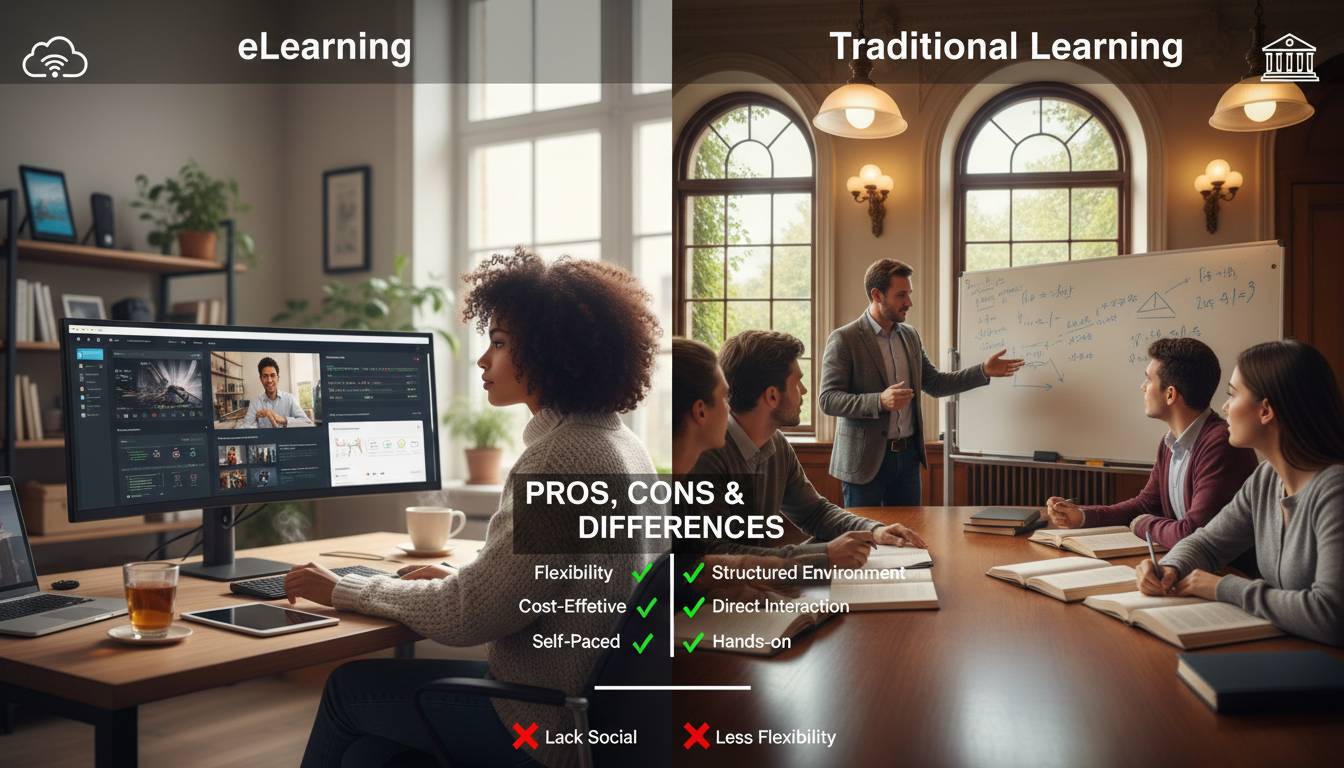
The debate between eLearning and traditional classroom learning matters more now than ever. If you’re a student figuring out your education path, an HR person looking at training options, or a teacher thinking about how to reach people better, understanding what each approach actually offers matters. This guide breaks down the strengths, weaknesses, and real differences between eLearning and traditional learning—so you can pick what actually works for your situation.
What eLearning Actually Is
eLearning means learning delivered through digital technology—websites, apps, learning management systems, video calls, that kind of thing. It’s come a long way since the early internet days of the 1990s. Now it includes video lectures, interactive simulations, virtual classrooms, gamified modules, and adaptive systems that change based on how well you’re doing.
The big draw is flexibility. You can log in from anywhere with internet, which means geography doesn’t matter much. This has been huge for working adults who want to learn new skills without quitting their jobs, people in rural areas far from good schools, and anyone who can’t easily get to a classroom. A lot of eLearning is asynchronous—meaning you go at your own speed, rewatching the hard parts and skimming what you already know.
Modern eLearning platforms track how you’re doing: quiz scores, time spent on modules, where you get stuck. Teachers can see this data and jump in when someone needs help. And unlike printed textbooks, digital content updates instantly—so in fields like tech or healthcare where things change fast, that’s a real advantage.
What Traditional Learning Actually Is
Traditional learning means showing up in person—teacher and students in the same room. This is the centuries-old model that built modern education, with all its routines, expectations, and social dynamics.
The structure is the main thing. You have a schedule, a place to be, people expecting you there. A lot of students actually need that. Fixed class times, homework due dates, the whole routine helps keep you on track. Being in a room with other people also means natural conversation, group work, and the kind of social skills that develop through everyday interaction—not just talking about things, but reading the room, working through disagreements, building relationships that can last for years.
Teachers in classrooms get instant feedback too. They can see confusion on faces, answer questions right away, and change their approach on the spot when something isn’t landing. If half the room looks lost, they know it immediately. That real-time adjustment is hard to replicate online.
How They Actually Differ
Here’s where the rubber meets the road. These two approaches aren’t just different in theory—they work differently in practice.
| Factor | eLearning | Traditional Learning |
|---|---|---|
| Flexibility | High – learn anytime, anywhere | Low – fixed schedule and location |
| Cost | Generally lower overall costs | Higher due to facilities, materials |
| Pace | Self-paced or cohort-based | Fixed pace for entire group |
| Interaction | Digital communication, forums | Face-to-face immediate interaction |
| Feedback | Automated or delayed human feedback | Immediate, real-time feedback |
| Technical Requirements | Stable internet, devices needed | Minimal technical requirements |
| Social Development | Limited in-person interaction | Full social environment |
| Content Updates | Instantaneous updates possible | Requires new print/material updates |
| Assessment Methods | Automated quizzes, digital portfolios | Written exams, oral presentations |
| Learning Style Support | Adaptive, personalized pathways | One-size-fits-all typically |
The delivery method is the basic difference. eLearning needs tech—internet, a computer or phone, some basic know-how. Traditional learning just needs a room. That matters a lot in places where internet is spotty or people can’t afford devices.
Costs diverge significantly too. eLearning skips the building, utilities, maintenance, on-site staff. Those savings can mean lower tuition or letting schools serve more people with the same money. Traditional schools have all those overhead costs, which is part of why tuition has kept climbing.
Why eLearning Keeps Growing
eLearning isn’t going anywhere, and here’s why people keep picking it.
Flexibility and Accessibility
Being able to learn from your couch at 10pm matters. Working adults can fit coursework around jobs and families without uprooting their lives. Someone in Thailand can take a course from a university in Germany without moving. That’s powerful.
Self-pacing helps too. If you get something quickly, you can speed ahead. If you struggle, you can slow down and rewatch without holding anyone back. In a regular classroom, the teacher moves at the group’s average speed—which means bored fast learners and left-behind slow ones.
Cost Savings
It’s not just about tuition. No commute costs, no housing near campus, no taking time off work (if you’re doing it evenings). Companies have saved big by moving training online—no travel for trainers, no renting rooms, no lost productivity from employees sitting in all-day sessions.
Once you build digital course content, you can use it forever with almost no added cost. That’s different from a classroom, where every new student needs more of everything.
Personalized Learning
Adaptive systems watch how you perform and adjust accordingly. Struggling with fractions? Here’s some extra practice. Already mastering this? Here’s the harder stuff. A human teacher can do this too, but it takes a lot more time.
Digital platforms also let you learn your way—watch videos, listen to audio, do interactive exercises, read text. You pick what works for you and revisit as much as you need. Try pausing and rewind a live lecture sometime.
Where eLearning Struggles
eLearning isn’t perfect. Here’s the honest downside.
Missing the In-Person Thing
You lose something when you’re not in the same room. The casual conversations, the group projects, the friendships—those happen naturally in classrooms but don’t just appear online. Younger kids especially need that structured social time to learn how to work with others, handle conflicts, build people skills that employers care about.
Getting help is different too. Raise your hand in class, get an answer instantly. Online, you might wait for a forum response or hope your email gets answered. Some people are shy about asking for help online and will just fall behind.
Tech Problems and Screen Fatigue
You need decent internet and a working device. That’s not true everywhere—rural areas, low-income households, developing countries sometimes don’t have reliable access. And when tech fails—connection drops, software crashes, laptop dies—it stops learning cold. In a classroom, you just keep going.
Also, staring at screens for hours is exhausting in a way that sitting in a lecture isn’t. The mental load is different. Some students genuinely struggle to stay focused through long video modules.
You Have to Motivate Yourself
This is the big one. Without a teacher taking attendance, without classmates expecting you to show up, without that physical presence creating accountability—a lot of people procrastinate. Or they start a course and never finish. The flexibility that helps organized people actually hurts people who need external structure.
And there’s always the phone, the TV, the whole internet distracting you. In a classroom, you’re there. At home, you’re fighting every notification.
Why People Still Choose Traditional Classrooms
Traditional learning offers things that haven’t been fully replicated online.
Built-In Structure
The classroom provides scaffolding that some people genuinely need. You have to be there at this time, do this work by this date. That external pressure works for students juggling lots of responsibilities. The physical separation from home also helps your brain shift into “learning mode” in a way that being in your living room doesn’t.
The presence of other people matters too. You’re more likely to prepare because others will know if you didn’t. That social pressure, even when it’s uncomfortable, actually helps some people perform.
Instant Feedback
Teachers can see you’re confused and try a different explanation right now. Questions get answered immediately. Wrong assumptions get corrected before they calcify. That’s hard to match online, even with live video classes.
Peer feedback happens in real-time too—you present, people react, you adjust. That back-and-forth sharpens thinking in a way that asynchronous comments don’t always replicate.
Social Skills and Networks
Being in a room with people teaches you to read body language, negotiate, collaborate, speak up in groups. These soft skills matter for jobs, but they develop best through face-to-face interaction. You can’t practice eye contact over email.
The relationships built in traditional programs often last—alumni networks, mentors, business connections. Online cohorts sometimes develop these, but it’s harder.
Where Traditional Learning Falls Short
But traditional education has real problems too.
Fixed Schedules and Locations
You have to be there. That’s obvious, but it creates real barriers. Can’t skip work for class? Can’t afford to move to campus? Can’t travel long distances? Then traditional school might not work for you. A lot of people who want to learn simply can’t show up at 9am in a building across town.
The Price Tag
Tuition is just part of it. Transportation, housing, meals, plus the income you’re not earning because you’re in class—those add up fast. Many students can’t work full-time while attending traditional programs, which extends how long before they start earning and increases debt.
Institutions have real costs—buildings, staff, maintenance—and those drive prices up whether or not you use everything they offer. That’s pushed many learners toward cheaper online alternatives.
What the Research Actually Shows
Studies comparing these approaches give a mixed picture. It depends a lot on how well the program is designed, what subject it is, who’s learning, and what you’re trying to achieve.
Well-designed eLearning can match traditional classroom results. One major analysis found online learning generally performed comparably to in-person instruction—but with huge variation. Quality of implementation mattered more than the medium itself.
Both approaches struggle with pure information transfer. Lectures, whether live or recorded, only get you so far. Active learning, practice, feedback—those drive results regardless of whether you’re online or in a room.
Completion rates are one area where traditional programs tend to do better. MOOCs have famously low completion rates—sometimes under 10%. But those are usually free, self-paced, with no accountability. Structured programs with deadlines and support do much better. Companies that pair eLearning with human check-ins often see completion rates match or beat traditional training.
Picking What Works for You
There’s no universal answer here. The best choice depends on your specific situation.
Choose eLearning when: You need flexibility you can’t get otherwise; you’re self-disciplined; cost matters a lot; you learn well independently; the subject updates frequently; or you just need knowledge and skills you can develop digitally.
Choose traditional learning when: You need the structure to stay motivated; social skills and networking matter; you need hands-on practice; instant feedback is crucial; accreditation requires physical presence; or you learn better with other people in the room.
A lot of programs now blend both—online content plus in-person labs or discussions. That’s often the best of both worlds, using each method where it works best.
Frequently Asked Questions
Is eLearning more effective than traditional learning?
It can be equally effective, but it depends. Good eLearning works well. Bad eLearning doesn’t. Your self-discipline, the course design, and what you’re learning all matter more than the format itself. Some people thrive online; others need a classroom.
What are the main disadvantages of eLearning?
The lack of face-to-face contact is real. Tech requirements can be barriers. You need more self-motivation. And some subjects—anything involving physical skills, for instance—just work better in person.
How much does eLearning cost compared to traditional learning?
Usually quite a bit less. No building costs, no commute, no often no time away from work. But it varies widely—some online degrees cost as much as traditional ones.
What’s the key difference?
eLearning is flexible and self-directed but requires tech and self-motivation. Traditional learning is structured and social but requires your physical presence and more money. That’s the core trade-off.
The Bottom Line
Neither eLearning nor traditional learning is objectively better. They suit different people, different goals, different situations.
For a lot of people, eLearning makes education possible at all—it removes geography and schedule barriers that would otherwise stop them. For others, the classroom structure and social environment are what they need to actually learn.
The smart move is to honestly assess your own habits, needs, and constraints. Try both if you can. The goal is effective learning that gets you where you want to go—and the best path varies from person to person.
