

 March 20, 2026
  13 Min
  No Comment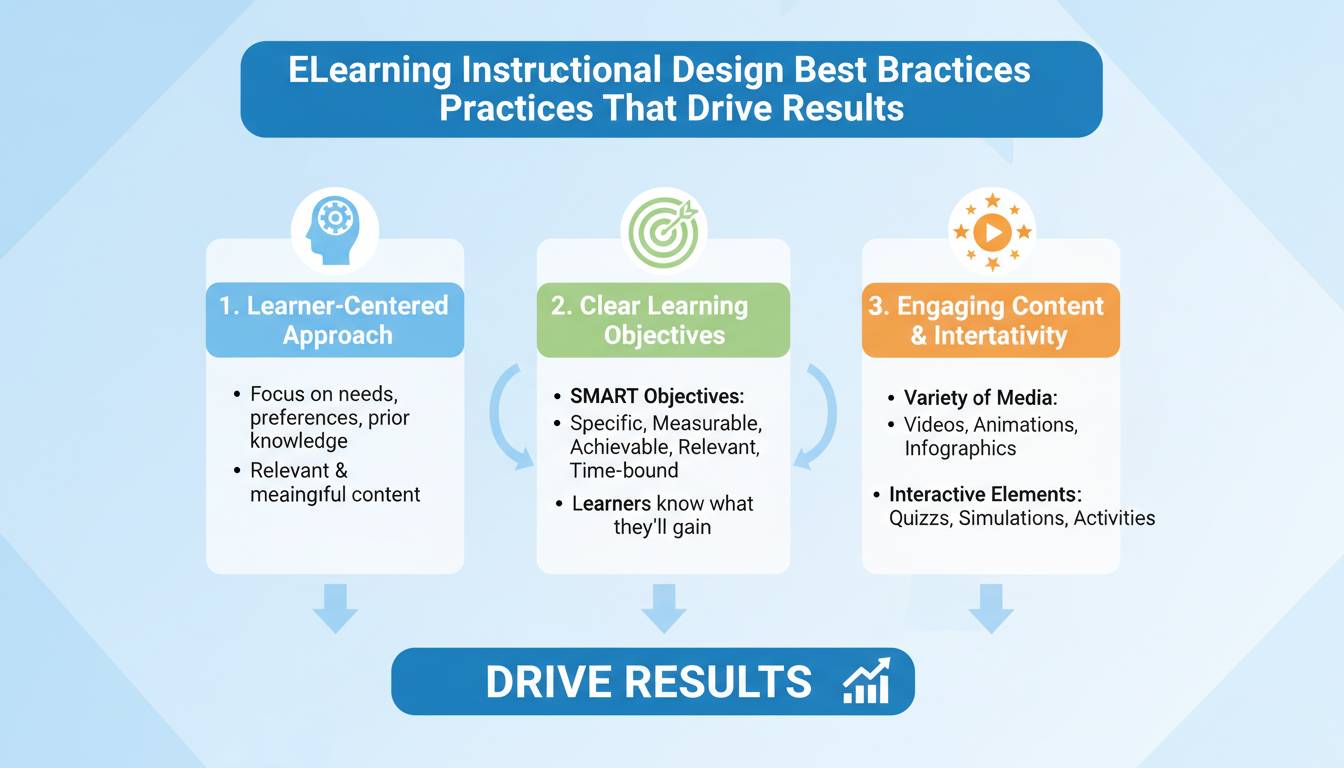
Effective eLearning instructional design transforms how organizations develop their workforce, yet many training programs fail to deliver measurable outcomes. Research from the Association for Talent Development shows that companies with comprehensive training programs see 218% higher income per employee than those without formalized learning initiatives. The difference lies not in the technology used, but in the strategic approach to instructional design that aligns learning objectives with business outcomes.
This guide provides actionable best practices that instructional designers and L&D professionals can implement immediately to create courses that actually drive performance improvement and deliver tangible business results.
What Makes eLearning Instructional Design Effective
Effective eLearning instructional design centers on one fundamental principle: every design decision should serve a specific learning outcome. This seems obvious, yet the eLearning industry is cluttered with courses that prioritize flashy visuals over meaningful learning experiences.
The most successful instructional design follows evidence-based principles that bridge the gap between knowledge acquisition and real-world application. When designed correctly, eLearning can achieve completion rates above 85% and knowledge retention improvements of up to 60% compared to traditional classroom training, according to the Journal of Online Learning and Teaching.
The key differentiator between effective and ineffective eLearning comes down to three core elements: clear learning objectives that align with job performance, instructional strategies that engage active learning, and assessment methods that verify competency transfer. Without these foundations, even the most sophisticated technology platform fails to produce results.
Effective instructional designers understand that adult learners bring extensive experience to the learning environment. They need to understand the “why” behind content, require opportunities to apply new skills immediately, and prefer self-directed learning paths over rigid sequences. These principles, rooted in andragogy—the art and science of helping adults learn—should inform every design decision.
The Foundation: Learning Objectives That Work
Learning objectives serve as the blueprint for every successful eLearning course. Without clearly defined objectives, instructional designers cannot make informed decisions about content selection, activity design, or assessment strategies. The industry standard follows Bloom’s Taxonomy, which categorizes learning outcomes from basic recall to complex creation.
Effective learning objectives share five characteristics:
- Specific: Objectives clearly state what learners will be able to do after completing the course
- Measurable: The desired performance can be assessed through observable criteria
- Achievable: Learners can realistically accomplish the objective with provided resources
- Relevant: The objective connects directly to job performance requirements
- Time-bound: A clear timeframe establishes when mastery should occur
Consider the difference between a weak objective—”Understand customer service principles”—and a strong one: “Within 30 days, learners will independently handle customer complaints by identifying the customer’s concern, acknowledging their frustration, and proposing a solution that resolves the issue while maintaining company policy.” The second objective tells designers exactly what content to include, what practice scenarios to create, and how to assess competency.
Alignment between learning objectives and business metrics ensures that instructional design investments produce measurable returns. When designing objectives, ask: “What specific business outcome improves when learners master this content?” If you cannot answer this question, the objective likely needs refinement.
Most effective courses limit primary learning objectives to three to five focus areas. This constraint forces prioritization and prevents cognitive overload. Learners achieve better outcomes when they focus on mastering fewer concepts deeply rather than skimming numerous topics superficially.
Content Design Strategies for Engagement
Content design in eLearning requires balancing information density with cognitive load management. Learners process new information more effectively when instructional designers chunk content into manageable segments, provide opportunities for application, and incorporate varied interaction types.
The ADDIE model—Analysis, Design, Development, Implementation, and Evaluation—remains the industry standard framework for systematic instructional design, though many organizations now adopt agile methodologies that allow for iterative refinement. Regardless of the framework used, the design phase should produce detailed storyboards that specify every content element, interaction, and assessment before development begins.
Interactive elements dramatically improve engagement and retention. Research from the Research Institute of America indicates that interactive eLearning increases course completion rates by 50% to 60% compared to passive content delivery. Effective interactions include:
- Scenario-based learning: Presenting realistic workplace situations that require learners to make decisions and see consequences
- Branching scenarios: Allowing choices that lead to different outcomes based on learner decisions
- Knowledge checks: Frequent low-stakes assessments that reinforce learning at key points
- Social learning elements: Discussion forums, peer reviews, and collaborative projects that leverage collective expertise
Visual design matters significantly for learner engagement and comprehension. Effective eLearning visuals support learning objectives rather than merely decorating screens. Use relevant images, custom graphics, and purposeful animations that demonstrate concepts rather than distract from them. Maintain visual consistency through style guides that define color palettes, typography, and layout standards across courses.
Media selection should align with content type and learning objectives. Complex procedures often benefit from video demonstrations, while conceptual topics may work well with interactive diagrams. Avoid the common mistake of adding video or audio simply for variety—each media element should serve a specific learning purpose.
Cognitive load theory provides essential guidance for content sequencing. Reduce extraneous load by eliminating unnecessary information, managing intrinsic load through careful content sequencing, and supporting germane load by providing frameworks that help learners organize new information. The goal is ensuring working memory capacity remains available for actual learning rather than struggling with poor design.
Technology Integration Best Practices
Technology should amplify effective instructional design, not compensate for weak design. Organizations frequently invest in sophisticated learning management systems or authoring tools while neglecting the fundamental instructional design principles that drive learning outcomes.
Selecting the right technology requires understanding your learner population, content requirements, and organizational infrastructure. Key considerations include mobile compatibility (with over 60% of learning now occurring on mobile devices, according to LinkedIn’s Workplace Learning Report), integration capabilities with existing HR systems, and accessibility compliance with WCAG 2.1 standards.
Learning management systems vary significantly in their capabilities. Enterprise platforms like Cornerstone, SAP SuccessFactors, and Workday Learning offer comprehensive talent development ecosystems, while lighter options like TalentLMS or Absorb provide streamlined functionality for organizations with simpler requirements. The best system is one that supports your instructional design strategy rather than constraining it.
Authoring tools have evolved substantially, offering options ranging from rapid development platforms to sophisticated code-based solutions. Articulate Rise 360 provides accessible, responsive courses with minimal technical requirements, while tools like Adobe Captivate offer advanced features for complex interactions. For organizations with development resources, custom HTML5 solutions allow complete creative control.
The emergence of AI-assisted tools is reshaping instructional design workflows. Platforms now offer AI-generated content suggestions, automated translation, and adaptive learning pathways that personalize content based on individual performance. However, human expertise remains essential for ensuring accuracy, appropriateness, and pedagogical soundness of AI-generated content.
Accessibility compliance is not optional. Section 508 of the Rehabilitation Act requires federal agencies and contractors to provide accessible electronic content. Beyond legal requirements, accessible design improves learning for everyone—captions assist learners in noisy environments, clear navigation helps those with cognitive challenges, and screen reader compatibility ensures visually impaired learners can access content.
Assessment and Evaluation Methods
Assessment design determines whether learning actually transfers to job performance. Effective eLearning incorporates multiple assessment types that measure different competency levels, from basic recall through complex application and creation.
Formative assessments occur throughout learning, providing ongoing feedback that guides the learning process. These include knowledge checks after key content segments, interactive exercises that reveal misconceptions, and self-assessment activities that help learners gauge their progress. Formative assessment data also helps instructional designers identify content areas that need refinement.
Summative assessments evaluate overall learning achievement at course completion. Effective summative assessments mirror the actual conditions under which learners must apply knowledge. If the job requires solving customer complaints, the assessment should present customer complaint scenarios rather than multiple-choice recall questions.
Kirkpatrick’s Four Levels of Evaluation provide a comprehensive framework for measuring learning effectiveness:
| Level | Focus | Measurement Methods |
|---|---|---|
| Level 1: Reaction | Learner satisfaction | Surveys, feedback forms |
| Level 2: Learning | Knowledge/skill acquisition | Pre/post assessments, demonstrations |
| Level 3: Behavior | On-the-job application | Manager observations, performance metrics |
| Level 4: Results | Business impact | Productivity data, quality metrics, ROI analysis |
Most eLearning programs evaluate only Level 1, measuring satisfaction but not actual learning or impact. Organizations seeking meaningful returns on learning investments must implement evaluation at higher levels. This requires establishing baseline metrics before training, defining success criteria clearly, and collecting data over sufficient timeframes to observe behavioral change.
Competency-based assessments align closely with organizational performance standards. Rather than arbitrary passing scores, effective assessments define minimum competency thresholds based on job requirements. This approach ensures that certification or completion signals actual readiness to perform.
Common Mistakes to Avoid
Instructional design mistakes waste organizational resources and fail learners. Recognizing common pitfalls helps designers avoid costly errors that undermine learning effectiveness.
Overloading content represents the most frequent mistake. Instructional designers, often subject matter experts passionate about their content, struggle to differentiate between essential and supplementary information. The result overwhelms learners and dilutes focus from critical objectives. Ruth Clark’s research on evidence-based instructional design demonstrates that reduced content volume with enhanced practice opportunities produces superior learning outcomes.
Neglecting learner experience manifests in courses with excessive text, confusing navigation, and lack of progress indicators. Modern learners expect consumer-grade user experiences and abandon courses that frustrate them. Invest in user experience research and testing to ensure courses meet contemporary expectations.
Failing to align assessments with objectives creates validity problems. When knowledge checks test information not covered in learning objectives, or when they test only recall while objectives require application, assessment data becomes meaningless. Every assessment item should map directly to a specific learning objective.
Ignoring technical constraints leads to courses that fail across learner populations. Browser compatibility, bandwidth limitations, and device diversity require thorough testing across representative configurations. Mobile-first design approaches ensure core functionality works on the devices learners actually use.
Skipping pilot testing removes the opportunity to identify problems before full deployment. Even thoroughly designed courses benefit from testing with representative learner samples. Pilot programs should collect both quantitative performance data and qualitative feedback about confusing elements or technical issues.
Underestimating development time leads to rushed completion and compromised quality. Effective eLearning development requires adequate time for analysis, design, development, testing, and refinement. Compressed timelines typically result in products that require expensive revision or fail to achieve learning objectives.
Measuring Success: Metrics That Matter
Meaningful measurement transforms instructional design from an art to a data-driven discipline. Organizations that establish clear metrics and collect relevant data continuously improve their learning programs and demonstrate business value.
Completion rates provide basic visibility into learner engagement but offer limited insight into actual learning. A 90% completion rate with 20% assessment pass rate indicates significant problems, while a 60% completion rate with 90% pass rate might represent effective filtering. Context matters when interpreting metrics.
Assessment performance reveals learning achievement when assessments align with objectives. Track not only pass rates but also score distributions, time on task, and item-level performance to identify specific content areas requiring reinforcement.
Time-to-competency measures how quickly learners achieve performance standards after course completion. This metric directly connects to business value—shorter time-to-competency means faster productivity and reduced supervision costs.
Knowledge retention measurements taken weeks or months after training reveal whether learning persists. Forgetting curves indicate that without reinforcement, learners retain only a fraction of initial learning. This data informs decisions about refresher training frequency and spaced learning strategies.
Behavioral change metrics require collaboration with managers and supervisors to observe on-the-job application. Define specific observable behaviors that should change following training, establish baseline measurements, and track post-training performance.
Business impact metrics demonstrate ROI through ultimate measures: sales performance, customer satisfaction scores, error rates, productivity measures, or other KPIs that training should influence. Attribution requires careful analysis to isolate training impact from other factors affecting business results.
Dashboards that consolidate these metrics enable continuous improvement. Regular review cycles—monthly for engagement metrics, quarterly for learning outcomes, annually for business impact—ensure that instructional design decisions respond to data rather than assumptions.
Frequently Asked Questions
How long should an eLearning course be?
Course length depends on learning objectives and learner attention patterns. Research suggests that modules of 10-15 minutes optimize completion rates and retention for most audiences. However, complex topics requiring extended engagement can work effectively when broken into logical segments with clear progress indicators. The key principle is chunking content into focused segments that address specific objectives rather than arbitrarily compressing or stretching content.
What is the most important element of instructional design?
Learning objectives constitute the most critical element because all other design decisions depend on them. Without clear, measurable objectives, content selection becomes arbitrary, assessments lose validity, and the overall course lacks direction. Invest sufficient time in the analysis and design phases to develop robust objectives before beginning development.
How do you keep learners engaged in eLearning?
Engagement requires multiple strategies: meaningful content that connects to job performance, interactive elements that require participation, varied media that maintains visual interest, relevant scenarios that demonstrate applicability, and appropriate challenge that prevents boredom without causing frustration. Regular knowledge checks, progress indicators, and social learning elements also contribute to sustained engagement.
Should eLearning be self-paced or instructor-led?
Both modalities serve different purposes. Self-paced eLearning works well for foundational knowledge, standardized procedures, and flexible scheduling. Instructor-led components add value for complex problem-solving, social learning, and accountability. Most effective programs blend both approaches, using self-paced modules for content delivery and virtual or in-person sessions for application and discussion.
How do you measure ROI for eLearning?
ROI measurement requires establishing baseline metrics before training, defining specific outcomes that training should influence, collecting data over sufficient timeframes to observe change, and analyzing results while controlling for other variables. Calculate ROI by comparing the monetary value of business improvements to total program costs. Even approximate ROI calculations demonstrate value and support continued investment.
What tools do instructional designers use?
Instructional designers use various tools depending on organizational needs: authoring tools like Articulate, Captivate, or Rise for course development; learning management systems like Cornerstone, Moodle, or TalentLMS for delivery; evaluation tools for survey distribution and data analysis; project management platforms for team coordination; and content authoring tools for creating supporting materials. The specific toolset matters less than proficiency with core instructional design principles.