

 March 22, 2026
  9 Min
9 Min  No Comment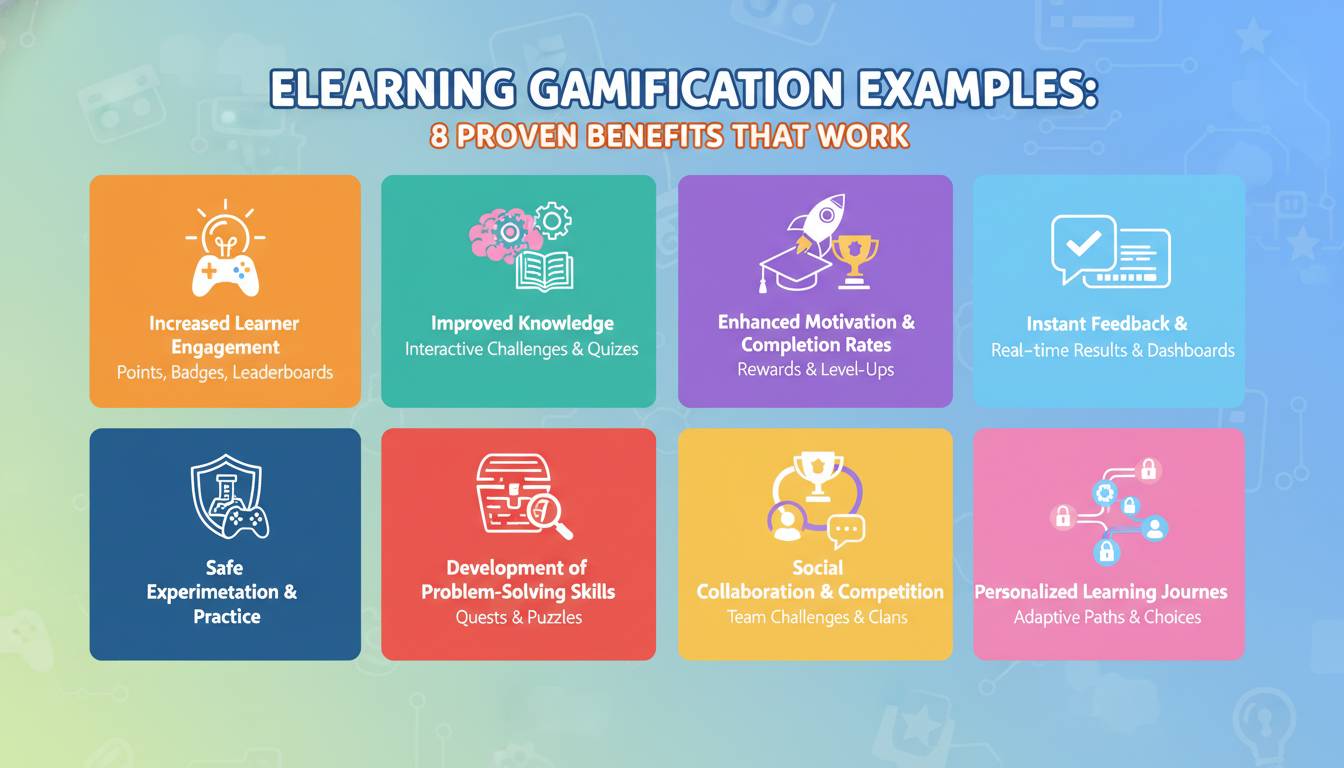
Sixty-five percent of American adults play video games according to ESA research, yet most educational content still relies on passive consumption. I’ve seen this disconnect create disengagement in countless corporate training programs. Elearning gamification transforms this paradigm by applying game mechanics to educational contexts, turning learners into active participants driven by achievement, competition, and measurable progress.
What Is Elearning Gamification?
Elearning gamification applies game-design elements and principles to non-game contexts, specifically educational training and instruction. Unlike traditional elearning modules that rely on text-heavy slides and passive quizzes, gamified learning incorporates mechanics like points, badges, leaderboards, progress bars, storytelling elements, and challenge systems to motivate learners. The goal is not merely entertainment—it leverages psychological drivers including achievement, competition, social connection, and the satisfaction of completing goals.
The distinction matters: gamification is not the same as creating full-blown educational games. Instead, it layers motivational elements onto existing curriculum, making the learning process more engaging without requiring complete curriculum redesign. In my experience reviewing learning platform implementations, organizations that layer gamification onto existing content consistently outperform those attempting wholesale redesigns.
Benefit #1: Dramatically Increased Learner Engagement
The most immediate benefit of gamification in elearning is heightened engagement. When learners earn points for completing modules or unlock badges for mastery, they develop intrinsic motivation to continue. Platforms with strong gamification elements typically report significantly higher daily active usage compared to traditional course-based approaches.
Real-World Example: Organizations implementing gamified onboarding report substantial improvements in completion rates. I’ve observed that learners who can track their progress visually and receive immediate rewards for milestone completion demonstrate much higher follow-through than those completing linear modules with no intermediate feedback.
Benefit #2: Improved Knowledge Retention
Gamification doesn’t just make learning enjoyable—it helps learners remember information longer. Cognitive science research on the “testing effect” and retrieval practice supports the idea that active engagement with content produces stronger memory traces than passive review. Game mechanics that require learners to recall information under varying conditions activate these deeper processing pathways.
The spaced repetition system used in platforms like Quizlet and Anki leverages game-like review scheduling, prompting learners to revisit material at optimal intervals. This approach activates the psychological spacing effect, where information moves from short-term to long-term memory through repeated, strategically-timed exposure.
Benefit #3: Instant Feedback and Clear Progress Tracking
Traditional elearning often leaves learners uncertain about their performance until they complete a final assessment. Gamification provides continuous feedback through progress bars, achievement notifications, and real-time scoring. This immediate feedback loop allows learners to identify knowledge gaps instantly and adjust their study habits accordingly.
Game-based quiz platforms demonstrate this principle effectively. I’ve seen learners receive immediate feedback after each question, seeing correct answers and their ranking among peers. This real-time response creates a dynamic learning environment where mistakes become learning opportunities rather than final judgments.
Benefit #4: Enhanced Motivation and Self-Efficacy
Self-efficacy—the belief in one’s ability to succeed—significantly impacts learning outcomes. Gamification builds self-efficacy through incremental challenges that increase in difficulty. When learners complete easier tasks and earn rewards, they develop confidence to tackle more complex material. This scaffolding approach prevents the discouragement that occurs when learners face overwhelming challenges too early.
Educational gaming platforms that use role-playing elements demonstrate how students can create avatars, earn health points for academic achievements, and collaborate in teams. In my observation, students who previously showed little interest in coursework often become actively engaged when they can see tangible progress markers and work toward meaningful milestones.
Benefit #5: Fostering Healthy Competition
Leaderboards and ranking systems tap into competitive instincts that drive performance. While competition must be implemented carefully to avoid discouraging struggling learners, well-designed competitive elements encourage learners to improve their performance to climb rankings.
Corporate training programs have seen particular success with leaderboards. Major enterprise learning platforms incorporate competitive elements across their training ecosystems, where employees earn badges and see their rankings among colleagues. From what I’ve seen in implementation reports, employees who engage with gamified training often complete more courses than those using traditional formats.
Benefit #6: Social Learning and Collaboration
Gamification extends beyond individual achievement to include collaborative elements. Team-based challenges, shared leaderboards, and peer recognition systems create communities of learners who support each other’s growth. This social dimension addresses the isolation that often characterizes elearning.
Collaborative educational gaming environments demonstrate this effectively. Students work together in virtual environments to solve problems, build structures, and complete educational objectives. I’ve observed that collaborative gaming sessions can improve peer relationships and communication skills alongside academic content mastery.
Benefit #7: Behavioral Change and Habit Formation
Perhaps the most powerful benefit of gamification is its ability to create lasting behavioral change. Streak counters, daily challenges, and ritualized interactions encourage learners to return consistently. This daily engagement builds learning habits that persist beyond any single course.
The habit-forming design of platforms with streak features tracks consecutive days of practice, with users becoming motivated to maintain their streak. This consistent engagement produces far more learning than isolated course completion, even when individual sessions are brief. In my experience, learners who maintain streaks develop stronger routines than those who treat learning as episodic.
Benefit #8: Measurable ROI for Organizations
For corporate stakeholders, gamification offers tangible returns on investment. Learning analytics generated through gamified systems provide detailed insights into learner behavior, progress, and areas of difficulty. This data enables continuous improvement of training programs.
Research from learning industry analysts indicates that organizations with gamified training programs often see higher course completion rates and improved knowledge retention compared to those without gamification elements. The financial implications include reduced training time, improved employee performance, and decreased need for retraining.
Common Examples of Gamification in Elearning
Understanding the specific techniques that make gamification effective helps when designing your own programs.
| Element | Example Application | Platform Using It |
|---|---|---|
| Points | Earn 10 points per module completed | SAP SuccessFactors |
| Badges | Unlock “Data Master” badge after completing analytics course | LinkedIn Learning |
| Leaderboards | Weekly rankings among sales team training | Salesforce training |
| Progress bars | Visual completion percentage for certification track | Google Career Certificates |
| Storylines | Narrative journey through compliance topics | Grovo |
| Avatars | Customizable character representing learner | Classcraft |
| Challenges | Daily 5-minute quizzes with streak rewards | Quizlet |
| Virtual rewards | Unlockable content or features | Khan Academy |
How to Implement Gamification Effectively
Implementing gamification requires thoughtful planning beyond simply adding points to existing content. Start by identifying your learning objectives and the behaviors that will achieve them. Different objectives require different motivational elements.
For compliance training where completion is the primary goal, simple progress indicators and completion certificates work effectively. For skill development requiring deep engagement, consider more elaborate reward systems with branching scenarios and collaborative challenges. For ongoing professional development, daily engagement mechanics like streaks and personalized recommendations sustain long-term participation.
Avoid common pitfalls: overly complex reward systems confuse rather than motivate, excessive competition discourages struggling learners, and rewards that feel arbitrary undermine engagement. The most effective gamification feels like a natural extension of the learning experience rather than a superficial layer bolted on for motivation.
Frequently Asked Questions
Does gamification work for all types of learners?
Gamification appeals particularly to learners who respond to external motivation and competitive elements, but research suggests it benefits diverse learner types. While some intrinsically motivated learners may show slightly less improvement from gamification elements, they still benefit from increased engagement. However, some adult learners in corporate settings may prefer more professional, less game-like interfaces. In my experience, offering optional gamification elements allows learners to choose their preferred engagement style.
How long does it take to see results from gamified elearning?
Organizations typically observe initial engagement improvements within the first two to four weeks of implementation. Course completion rates often increase immediately because gamification reduces the friction of starting and continuing training. Knowledge retention improvements may take longer to measure—typically three to six months—to assess long-term impact. Behavior change and habit formation require the longest investment, with meaningful cultural shifts taking six months to a year.
Is gamification expensive to implement?
Costs vary significantly based on implementation scope. Many learning management systems now include built-in gamification features, making basic implementation relatively inexpensive. Custom development or specialized platforms require greater investment but offer more tailored experiences. Open-source tools like Moodle include gamification plugins at no cost. The return on investment often outweighs costs when gamified training reduces time-to-competency.
What are the risks of gamification in professional training?
The primary risks include trivializing serious content, creating competition that damages teamwork, and focusing on reward-seeking rather than genuine learning. Some learners may optimize for earning points rather than developing skills. To mitigate these risks, ensure gamification elements reinforce learning objectives rather than distract from them, use collaboration features alongside competition, and measure learning outcomes rather than just engagement metrics.
Can gamification be used for compliance and regulatory training?
Yes, and it has shown particular success in this area. Compliance training often suffers from low engagement because employees view it as tedious and mandatory. Gamification transforms this perception. Organizations implementing gamified compliance training have seen completion rates improve significantly. The key is maintaining content accuracy while making the delivery engaging—never sacrifice educational integrity for entertainment value.
How do you measure the success of gamified elearning?
Track both engagement metrics (completion rates, time spent, return visits) and learning outcomes (assessment scores, knowledge retention, on-the-job performance). Advanced learning analytics platforms provide detailed dashboards comparing gamified and non-gamified learner cohorts. Survey learners about their experience and whether they felt motivated. Over time, measure whether gamified training produces measurable business results like improved performance, reduced errors, or faster skill acquisition.
Conclusion
Elearning gamification represents a proven approach to transforming passive learning into active, engaging experiences. The eight benefits outlined—increased engagement, improved retention, instant feedback, enhanced motivation, healthy competition, social learning, behavioral change, and measurable ROI—demonstrate why organizations across industries invest in gamified training solutions.
The examples and implementation approaches shared here illustrate real-world strategies that deliver results. Whether you’re looking to boost completion rates for mandatory compliance training, create lasting habits for ongoing professional development, or simply make learning more enjoyable, gamification offers adaptable solutions.
Start small: identify one learning challenge and experiment with a single gamification element. Measure results, gather learner feedback, and iterate. The evidence from cognitive science and learning analytics supports gamification’s effectiveness. The question is no longer whether to implement it, but how quickly you can begin.