

 February 24, 2026
  11 Min
  No Comment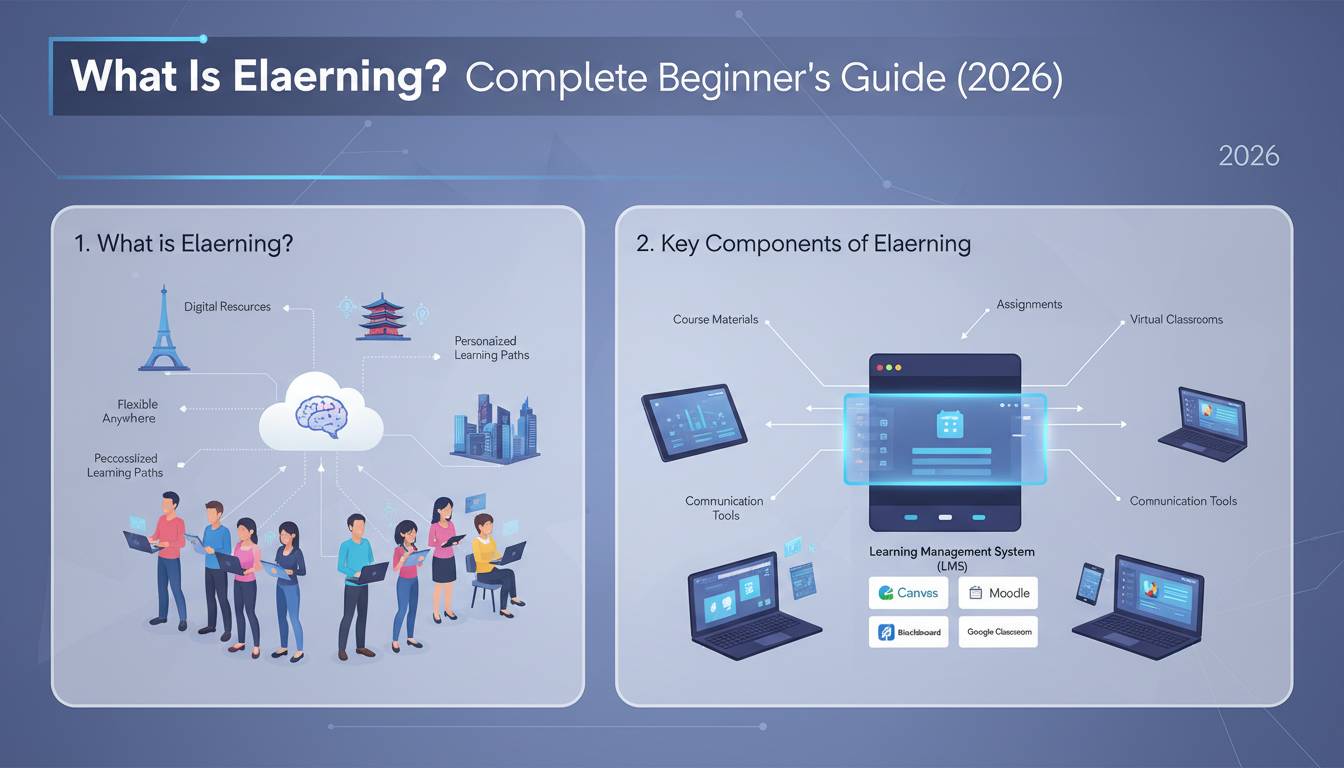
The training session replay sat unwatched in my inbox for three weeks before I deleted it. Then I spent two days in a classroom, traveling across state lines, paying for a hotel, and sitting through material I already knew. That experience taught me why digital learning has fundamentally changed how professionals develop skills. eLearning delivers training and knowledge through digital technology—accessible on computers, tablets, or phones—and lets you learn when it fits your schedule, at your own pace, often from anywhere with internet. This guide covers what eLearning means in 2026, the different types available, why it matters, the tools that make it work, and where it’s headed.
Education and professional training have changed substantially over the past decade. Organizations of all sizes now view eLearning as a strategic imperative rather than a supplementary option. Whether you’re leading a team and need to train employees efficiently, you’re an educator exploring new methodologies, or you want to develop your own capabilities, understanding the fundamentals of eLearning matters in today’s professional landscape.
What Is eLearning? A Clear Definition
eLearning refers to learning delivered through electronic media and devices, typically over the internet. The term encompasses a broad spectrum of activities—from straightforward online courses and video tutorials to virtual classrooms and interactive simulations. What distinguishes eLearning from simply reading a book or watching a video is that the experience is intentionally designed—often incorporating interactive elements, progress tracking, assessments, and collaborative features.
eLearning originated with early computing systems in the 1960s and 1970s, but it became widely adopted in the 1990s when internet connectivity expanded. The medium evolved from basic text and static images to rich multimedia experiences incorporating artificial intelligence, virtual reality, and adaptive learning algorithms. By 2026, eLearning has become an integral component of mainstream education, with even traditional academic institutions incorporating digital learning pathways into their curricula.
Based on my observations working with corporate training departments, eLearning serves distinct purposes across different sectors. Enterprises utilize it for employee onboarding, regulatory compliance training, and skills development. Educational institutions deploy it to extend classroom learning and provide remote learning options. Healthcare organizations rely on it for continuing medical education and patient education initiatives. The versatility of eLearning lies in its capacity for customization and scalability to address specific organizational requirements.
Types of eLearning: Understanding the Categories
eLearning encompasses several distinct modalities, each suited to different objectives, audiences, and contextual constraints. Understanding these categories enables informed decisions about implementation approaches.
Synchronous vs. Asynchronous Learning
Synchronous eLearning occurs in real-time, with learners and instructors interacting simultaneously through video conferencing, live chat, or virtual classroom environments. This format closely mirrors traditional classroom dynamics—participants receive immediate feedback, engage in real-time discussions, and collaborate with peers. The primary limitation is the requirement for all participants to be online concurrently, which creates scheduling challenges across different time zones or繁忙 schedules.
Asynchronous learning provides temporal flexibility, enabling learners to access pre-recorded videos, discussion forums, downloadable resources, and self-paced modules according to their own schedules. Research from the Association for Talent Development indicates that this flexibility contributes significantly to asynchronous eLearning’s popularity among working professionals who must balance learning activities with professional responsibilities. In practice, most effective eLearning programs blend both approaches—live sessions facilitate discussion and community building, while self-paced content supports individual study and knowledge acquisition.
Self-Paced vs. Instructor-Led Online Courses
Self-paced courses grant learners autonomy over their educational journey. Participants can pause, rewind, and review content as needed, allocating additional time to challenging concepts while progressing quickly through familiar material. This approach accommodates diverse learning velocities effectively but demands self-discipline and internal motivation from participants.
Instructor-led online courses operate on predetermined schedules with defined start and end dates. Participants progress through material collectively, with assignments due on specified dates and regular live sessions with instructors. This format provides greater accountability and community but offers less flexibility than self-paced alternatives. Completion rate data from multiple learning platforms suggests that progressing alongside peers positively influences program completion, addressing the motivation challenges that can affect self-directed learning.
Microlearning: Bite-Sized Education
Microlearning delivers educational content in concise, targeted segments—typically ranging from 3 to 10 minutes in duration. Research published in the Journal of Applied Psychology demonstrates that this approach aligns with cognitive load theory and working memory constraints, enabling better knowledge retention compared to extended instructional sessions. A microlearning module might address a single concept, skill, or task, providing just-in-time access to specific information when needed.
The cognitive science foundation underlying microlearning emphasizes that brief, focused sessions integrate more easily into繁忙 schedules and demonstrate superior retention characteristics relative to prolonged presentations. According to a 2024 survey by the eLearning Industry Association, 68% of organizations incorporating microlearning reported improved employee engagement with training materials, with many enterprises now integrating microlearning modules to provide point-of-need access to specific procedural information.
Gamification and Game-Based Learning
Gamification applies game mechanics—including points, badges, leaderboards, challenges, and narrative elements—to educational contexts to enhance engagement. Research published in Educational Technology Research and Development indicates that gamification can improve learning outcomes by increasing time-on-task, providing immediate feedback, and fostering a sense of achievement that reinforces continued engagement.
Game-based learning extends beyond surface gamification by embedding learning objectives within actual games or simulations. These approaches prove particularly effective for training scenarios requiring mastery of complex procedures, development of decision-making capabilities, or acquisition of physical skills necessitating repeated practice. Industries including medical education, military training, and industrial equipment operation have adopted game-based learning extensively for high-stakes skill development.
Blended Learning Approaches
Blended learning combines traditional face-to-face instruction with digital learning activities. Rather than treating these modalities as mutually exclusive alternatives, blended approaches leverage the distinctive strengths of each. Instructors might reserve face-to-face sessions for discussions, hands-on activities, and complex topics benefiting from real-time interaction, while digital components address foundational content delivery, practice exercises, and assessments.
The specific balance between modalities varies substantially based on learning objectives, available resources, and learner preferences. Some programs adopt predominantly online formats (approximately 80% digital) with occasional in-person intensives. Others maintain primarily classroom-based structures supplemented by digital components. The defining characteristic of effective blended learning is intentional design—deploying each modality where it demonstrates greatest instructional effectiveness.
Benefits of eLearning: Why It Matters in 2026
eLearning has experienced substantial growth driven by demonstrated advantages over traditional instructor-led training across numerous performance dimensions. Understanding these benefits assists organizations and individuals in evaluating investments in digital learning infrastructure.
Cost-Effectiveness and ROI
eLearning typically demonstrates significantly lower total cost of ownership compared to traditional classroom training when considering the full cost structure. Eliminated or reduced expenses include travel and accommodation, venue rental, instructor compensation (per session), printed materials, and productivity losses during training time. Once digital content is developed, distribution to unlimited learners incurs minimal marginal cost per participant, making scaling substantially more economically viable.
According to the Brandon Hall Group’s 2024 Learning Technology ROI Study, organizations utilizing eLearning for training delivery achieved an average cost reduction of 53% compared to equivalent in-person programming, with organizations reporting savings ranging from 40% to 70% depending on program scale and complexity. These economic benefits prove most significant for large enterprises with geographically distributed workforces or high-volume training requirements. Initial content development costs can be substantial, making the economic case strongest for programs with large learner populations or extended deployment periods.
Flexibility and Accessibility
Learner autonomy regarding scheduling and location represents the most frequently cited advantage of eLearning. Content accessibility extends across locations and time zones, accommodating work schedules, family responsibilities, and other commitments. This accessibility proves particularly valuable for shift workers, parents with childcare constraints, individuals with physical disabilities affecting travel, and residents of remote areas with limited access to educational institutions.
Modern eLearning platforms support mobile device access, enabling learning during commutes, breaks, or other间歇性可用时段. Data from the 2024 LinkedIn Workplace Learning Report indicates that 58% of employees prefer consuming training content in segments of 10 minutes or less, and 74% report greater likelihood of completing training that accommodates mobile consumption patterns. The ability to pause and resume learning activities accommodates the_interruptions endemic to professional and personal life.
Scalability and Consistency
Digital learning content can be deployed to thousands of simultaneous learners while maintaining instructional consistency. All learners receive identical content and experiences, eliminating variability in teaching style, instructor energy levels, or interpretation that can occur across multiple instructors delivering the same curriculum. This consistency proves particularly critical for organizations requiring standardized knowledge distribution—such as compliance training, safety procedures, or product knowledge across sales teams.
eLearning also enables rapid scaling. When regulatory requirements change, products launch, or procedures update, organizations can modify digital content and immediately distribute revisions to all learners. This responsiveness contrasts sharply with traditional training approaches requiring scheduling coordination, instructor preparation, and physical logistics—typically requiring weeks or months for equivalent updates.
Analytics and Tracking
Digital learning platforms capture granular data regarding learner behavior and performance. Learning management systems generate reports on completion rates, time-on-task, assessment scores, and engagement patterns. This data supports continuous content improvement, early identification of struggling learners requiring intervention, and measurement of training effectiveness against business outcomes.
Adaptive learning systems leverage this data to personalize learning pathways. Learners demonstrating knowledge gaps receive additional support and scaffolding. Those demonstrating mastery can accelerate through familiar content. According to research published in the Journal of Educational Psychology, adaptive learning approaches demonstrate effect sizes approximately 0.4 standard deviations higher than non-adaptive conditions, with AI-powered adaptive systems increasingly driving these improvements across enterprise learning environments.
Key eLearning Tools and Platforms
The eLearning technology ecosystem encompasses diverse solution categories, each serving specific functions in creating, delivering, and managing learning experiences. Understanding these tool categories assists organizations in building effective learning technology infrastructure.
Learning Management Systems (LMS)
A Learning Management System serves as the central platform for organizing, delivering, and tracking learning content. LMS functionality typically includes user account management, course enrollment, progress tracking, assessments, and reporting. Platform options range from straightforward cloud-based solutions appropriate for small organizations to highly customizable enterprise systems offering advanced features including extended enterprise capabilities, detailed analytics, and extensive integration options.
When evaluating LMS options, organizations should assess user capacity requirements, supported content formats, reporting and analytics needs, integration capabilities with existing enterprise systems (HRIS, SSO, content repositories), mobile accessibility, and total cost of ownership including implementation and ongoing support. Many contemporary LMS platforms offer free tiers or trial periods enabling organizations to validate fit before commitment. The optimal LMS depends entirely on specific organizational requirements rather than generalized feature comparisons.
Authoring Tools
Authoring tools enable subject matter experts and instructional designers to create eLearning content without requiring programming expertise. These tools provide templates, interactive element libraries, multimedia integration capabilities, and publishing workflows. Options range from simple quiz builders suitable for basic knowledge checks to comprehensive course development platforms supporting complex interactions, scenarios, and multi-module curricula.
Selection criteria typically include content format requirements, technical proficiency of content creators, and compatibility with target LMS platforms. Some organizations employ different authoring tools for different content types—using specialized tools for compliance training, scenario-based learning, or video production respectively. Others standardize on single platforms for consistency and reduced learning curves across content development teams.
Video Conferencing and Virtual Classrooms
Video conferencing platforms have become essential infrastructure for live eLearning, enabling real-time instruction, group discussions, and virtual workshops. Beyond basic video call functionality, dedicated virtual classroom platforms offer learning-specific features including breakout rooms, interactive whiteboards, polling and surveys, hand-raising queues, and session recording with searchable transcripts.
Facilitator proficiency significantly influences live online session effectiveness. Research from the International Society for Technology in Education indicates that facilitators trained in online engagement techniques achieve substantially higher participant satisfaction and learning outcomes compared to those simply replicating in-person lecture approaches in virtual environments. Organizations investing in virtual classroom technology should correspondingly invest in facilitator development to realize platform potential.
Assessment and Quiz Tools
Assessment tools enable creation of quizzes, tests, surveys, and other evaluative instruments. Contemporary platforms support diverse question formats including multiple choice, true/false, matching, ordering, fill-in-the-blank, and interactive scenario-based items. Common features include randomized question pools, configurable time limits, immediate feedback options, and detailed analytics on learner performance patterns.
Effective assessment design extends beyond simple knowledge recall to evaluate higher-order thinking skills including application, analysis, and synthesis. Scenario-based questions, case studies, and performance-based assessments more accurately predict workplace application of learned competencies. Mature eLearning programs typically incorporate multiple assessment modalities throughout learning pathways to comprehensively evaluate learner competency development.
How to Get Started with eLearning
Initiating an eLearning initiative—whether as an individual learner pursuing professional development or as an organization implementing training infrastructure—requires thoughtful planning and realistic expectations regarding implementation timelines and resource requirements.
For Individual Learners
Individual learners should begin by clarifying specific learning objectives. What knowledge or competencies do you aim to develop? How will applied