
 March 7, 2026
  7 Min
7 Min  No Comment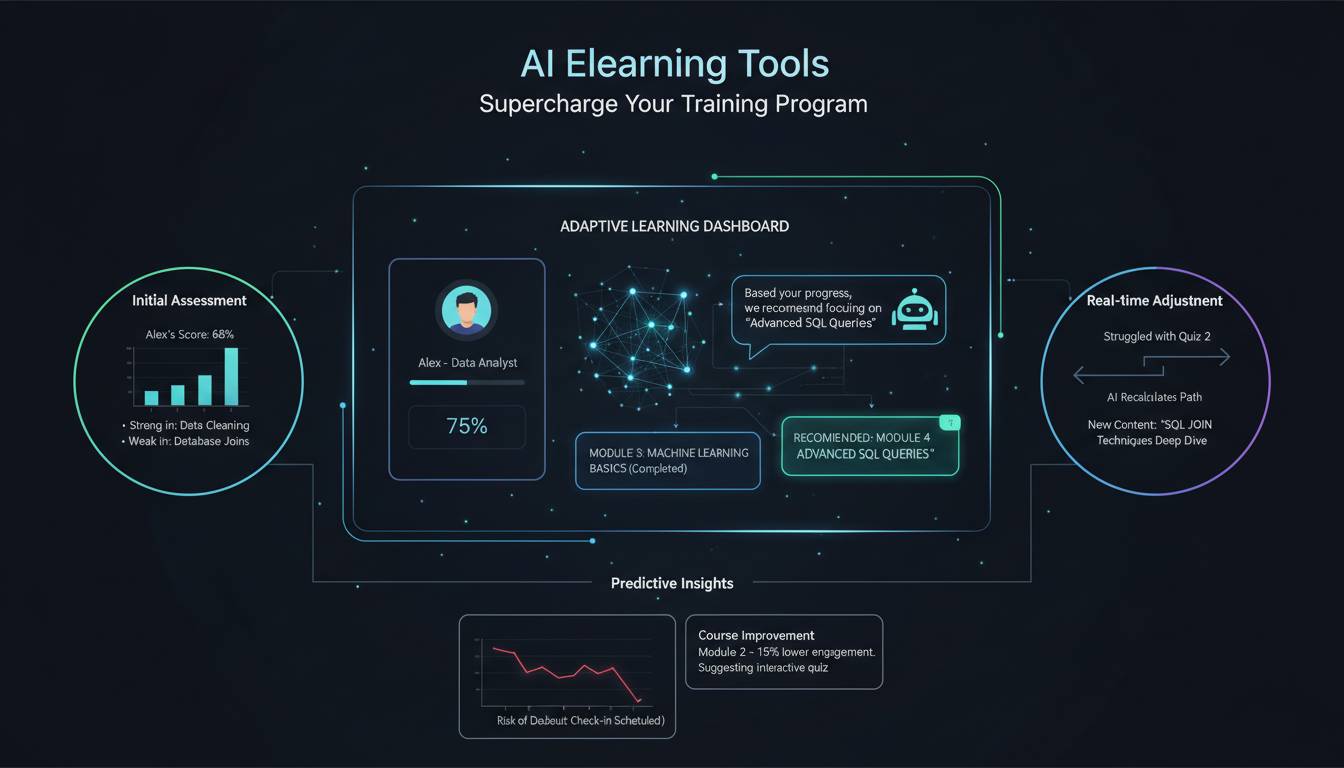
Artificial intelligence has become a regular part of how training gets built and delivered. Organizations in corporate training, higher education, and K-12 are using AI tools to create more personalized learning experiences while cutting down development time. This guide looks at the most useful AI eLearning tools available now, what they do, and how they can improve your training program.
The Rise of AI in eLearning
AI has moved past experimental pilots into mainstream educational technology. The global eLearning market continues to grow as businesses and schools embrace digital tools. Machine learning, natural language processing, and adaptive systems now power everything from automated content generation to learner analytics.
Instructional designers and training managers need to produce engaging, personalized content faster. Traditional course development taking weeks or months doesn’t work anymore in fast-moving industries where skill requirements change quickly. AI tools help by automating repetitive tasks, generating customized learning paths, and providing feedback that was hard to scale before.
Generative AI in learning management systems represents a shift in how educational content gets created and delivered. These tools don’t replace human instructors—they augment them, letting professionals focus on strategy while AI handles content generation, assessment scoring, and progress tracking.
AI Content Creation Tools
Content creation takes most of the time in eLearning development. AI writing assistants help generate course materials, scenario scripts, and interactive dialogue systems. They use language models trained on educational data to produce content that fits learning objectives.
ChatGPT and similar conversational AI let instructional designers quickly prototype learner interactions and visualize how students might engage with branching scenarios. Jasper AI and Copy.ai work well for marketing training, compliance documentation, and product knowledge courses with consistent tone across modules.
Quiz generators like Quizgecko and AutoQuiz turn existing documents, PDFs, and web content into assessments in minutes. They analyze text to find key concepts and create multiple-choice questions, true/false items, and fill-in-the-blank exercises that test comprehension.
For multilingual training programs, AI translation and localization tools save significant time. DeepL and Google Cloud Translation integrate with authoring systems to deliver translations that keep the original instructional intent. This helps multinational companies deploy consistent training across different regions.
AI Video and Media Tools
Video remains the most effective medium for online learning, but production complexity often slows course development. AI video tools now let teams create professional visual content without extensive technical skills or expensive equipment.
Synthesia and HeyGen use AI avatars that generate presenter videos from text scripts. Organizations can create consistent on-screen instructors who deliver content in multiple languages without traditional video shoots. Avatars can match organizational branding and learner demographics.
Descript and Opus Pro offer smart video editing that cuts post-production time. Automated transcription, filler word removal, and visual enhancement features let teams quickly refine raw footage. Screen recording tools with AI annotation highlight cursor movements and clicks for polished software training demos.
Eleven Labs and Murf AI produce studio-quality voiceovers from text, supporting fast iteration of audio content. These tools work well for creating multiple course versions for different skill levels or adding audio explanations to visual materials. The ability to regenerate narration quickly supports iterative design based on learner feedback.
AI Assessment and Quiz Tools
Assessment is a critical part of learning design, but traditional testing often doesn’t give meaningful insight into learner understanding. AI assessment platforms now offer evaluation capabilities beyond simple question-response.
Teachable AI platforms like Century and Carnegie Learning provide intelligent tutoring systems that adapt to individual learners in real-time. These systems analyze response patterns to find knowledge gaps, adjust difficulty, provide hints, and recommend supplementary resources. The continuous feedback helps learners progress at appropriate rates with personalized support.
Gamified assessment platforms use AI to create engaging evaluations that maintain motivation. Quizizz and Kahoot! use adaptive algorithms that change question sequencing based on performance, keeping appropriate challenge levels. Analytics dashboards give instructors detailed insight into class-wide understanding.
AI proctoring solutions address integrity concerns in remote testing. ProctorU and Examity use machine learning to detect unusual behavior during online exams, flagging potential cheating for human review while minimizing false positives. These systems let organizations confidently deliver high-stakes assessments in distributed learning environments.
AI Analytics and Personalization Tools
Understanding how learners interact with course materials and finding improvement opportunities requires solid data analysis. AI analytics platforms turn raw learning data into useful insights for instructional design decisions.
Learning record stores (LRS) with AI analysis process xAPI data from multiple touchpoints to generate comprehensive learner profiles. These systems find engagement patterns, content effectiveness metrics, and completion trajectories that traditional reporting misses. Predictive analytics identify learners at risk of falling behind, enabling intervention before knowledge gaps grow.
Adaptive learning engines like Knewton and Smart Sparrow create personalized learning paths based on demonstrated competency and preferences. These platforms analyze interaction data to determine optimal content sequencing, presenting materials that address individual gaps while speeding through mastered concepts.
AI recommendation systems suggest relevant supplementary materials, peer connections, and professional development opportunities. By analyzing engagement patterns across organizational learning platforms, these tools surface resources matching career development goals and emerging skill requirements.
Implementation Considerations
Successfully integrating AI eLearning tools requires planning and change management. Organizations must evaluate technical requirements, including LMS compatibility, single sign-on, and data security. Vendor selection should consider scalability, support availability, and alignment with learning objectives.
Training for instructional designers and subject matter experts matters significantly. While AI tools reduce technical barriers, effective use requires understanding appropriate use cases, quality assurance processes, and ethical considerations around AI content. Professional development should address prompt engineering, output evaluation, and refinement workflows.
Data privacy and compliance need attention, especially in regulated industries. Organizations should establish clear policies on data retention, AI training opt-outs, and transparent communication about how AI systems use learner information. Vendor contracts should specify data handling and compliance certifications.
Future Trends
AI in eLearning will continue getting more sophisticated, further changing educational delivery. Generative AI advances keep improving content quality, reducing human editing needs. Multimodal AI systems integrating text, video, audio, and interactive elements will enable richer learning experiences.
Immersive technologies including VR and AR will increasingly use AI-powered personalization, creating adaptive experiences that respond to learner behavior in real-time. Natural language interfaces will make learning platforms more accessible through conversational interactions.
The role of instructional designers will keep evolving toward strategic oversight of AI-assisted creation. Professionals who develop expertise in AI tool use, quality assessment, and ethical implementation will be positioned to lead organizational learning transformation.
Frequently Asked Questions
What are the best AI tools for creating eLearning content?
Top AI content creation tools include ChatGPT for scripts and scenarios, Jasper AI for marketing and compliance training, and Quizgecko for rapid assessment generation. The best choice depends on your specific use case, content type, and integration needs.
How is AI used in eLearning today?
AI applications include content generation, adaptive learning paths, automated assessment, predictive analytics, and personalized recommendations. Machine learning algorithms analyze learner behavior to optimize content delivery timing, difficulty, and supplementary resource suggestions.
What are the benefits of implementing AI in training programs?
AI implementation delivers faster development cycles, personalized learning at scale, consistent content quality, better analytics, and improved engagement through adaptive interactions. Organizations see significant efficiency gains in course development and measurable improvements in completion rates.
How do I choose the right AI tool for my organization’s needs?
Check LMS compatibility, scalability, data security, ease of use, and alignment with training objectives. Pilot several tools with representative content before committing to enterprise deployment. Evaluate output quality and workflow integration.
Will AI replace instructional designers?
AI augments rather than replaces instructional designers by automating repetitive tasks and generating initial drafts. Human expertise remains essential for strategic curriculum design, quality assurance, cultural sensitivity review, and complex scenario development.
Are AI-generated educational materials reliable?
AI-generated content requires human review for accuracy, appropriateness, and alignment with learning objectives. While AI tools produce quality initial drafts, professional oversight ensures correctness, brand consistency, and pedagogical effectiveness before learner deployment.