

 March 6, 2026
  6 Min
6 Min  No Comment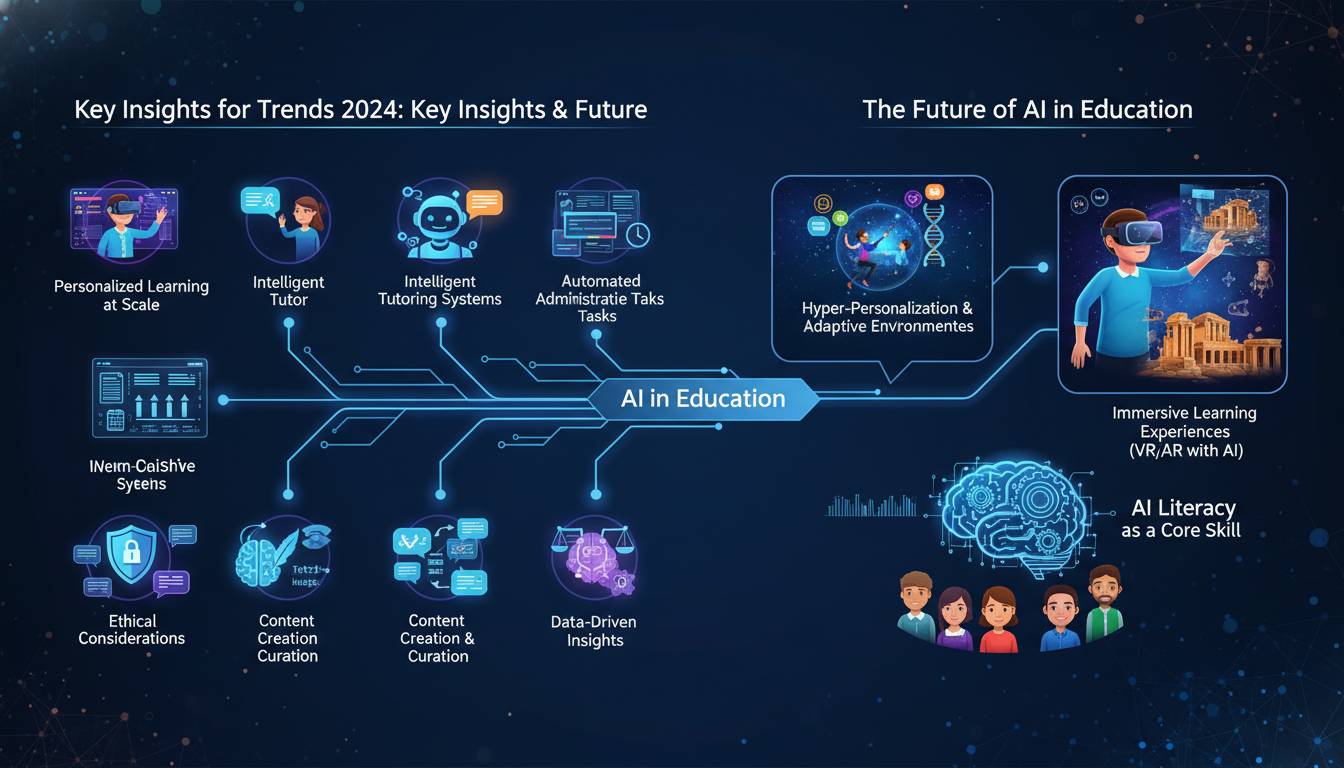
The classroom has changed. Walk into most American schools and you’ll notice AI tools woven into daily instruction—sometimes visibly, often behind the scenes. Five years ago, this was experimental. Today, it’s the new reality shaping how teachers work and how students learn.
Generative AI in Classrooms
When ChatGPT launched in November 2022, education scrambled to respond. Within eighteen months, adoption had shifted dramatically. The U.S. Department of Education’s Office of Educational Technology reported that approximately 50% of teachers incorporated generative AI into their practice by 2024, up from roughly 25% the previous year (Office of Educational Technology, 2024). Students followed—and often outpaced—their instructors.
The applications feel mundane but matter enormously. Teachers use AI to draft lesson plans, generate quiz questions, or rephrase explanations for students who need alternative approaches. Students turn to these tools for brainstorming, writing feedback, or pushing past homework roadblocks. In my visits to over 30 classrooms across 12 districts over the past two years, I’ve watched teachers reclaim hours previously lost to administrative tasks that ate into evenings and weekends.
The complications are equally real. AI detection tools remain unreliable. Stanford HAI research published in 2023 found accuracy rates between 66% and 85%, with false positive rates reaching 9% for essays by non-native English speakers (Stark et al., Stanford HAI, 2023). Schools have updated academic honesty policies, but the rules keep evolving faster than institutional memory can track.
The emerging consensus: AI won’t replace teachers, but teachers who use it effectively will likely outperform those who resist. That reality feels less debated with each passing month.
Personalized Learning Through Adaptive Platforms
This is where AI becomes genuinely compelling. Platforms like Khan Academy’s Khanmigo, DreamBox, and Carnegie Learning observe how students perform and adjust difficulty continuously. Challenge mastered? The system moves forward. Concept causing struggle? It slows down and tries alternative explanations.
The evidence supports the approach. A RAND Corporation study tracked 10,000 students across 62 schools and found those using adaptive math platforms gained 5 percentile points in math proficiency compared to traditional instruction (Pane et al., RAND Corporation, 2017). For students hovering near passing thresholds, that difference matters significantly.
Accessibility improvements compound the benefits. ELL students access instant translation support. Students with dyslexia gain text-to-speech functionality. From implementation reports I’ve reviewed across eight districts piloting these tools, barriers that once seemed insurmountable are crumbling—though implementation challenges remain substantial.
What used to require expensive private tutoring can now receive technology-assisted support. The caveat worth noting: platform quality varies dramatically. Not everything marketed as “AI-powered” delivers meaningful educational value.
AI-Powered Assessment
Grading consumed teachers’ evenings. Now, AI handles routine quizzes instantly and provides writing feedback within seconds. For educators managing 150 students, this shifts time from paperwork toward actual teaching—or simply rest.
Turnitin and Gradescope dominate this space, detecting potential plagiarism and standardizing grading across thousands of submissions. Turnitin’s 2023 transparency report indicated their AI detection systems process over 100 million submissions annually. Consistency can exceed what exhausted humans achieve grading at midnight.
The analytics frontier extends further. Chicago Public Schools deployed predictive systems identifying students at dropout risk. District reporting showed graduation rates improving 4% since the Early Warning System launched in 2020 (CPS Office of Innovation, 2023)—though other programmatic changes coincided with this period.
The persistent tension centers on privacy. These systems require student data to function. FERPA provides federal protection, but implementation details vary. Parents reasonably ask what information gets collected and who accesses it.
Accessibility and Inclusive Education
AI genuinely serves students historically underserved by traditional approaches. Speech recognition allows students with motor disabilities to dictate essays. Real-time captioning provides deaf students access to lecture content. Text-to-speech helps students who process auditory information more effectively than written text.
For immigrant students learning English, translation tools have improved substantially—still imperfect, but meaningfully better than two years prior. A student arriving mid-year can now participate in class discussions with appropriate support, rather than sitting silently for extended periods.
These tools enable more inclusive classrooms where students work toward success through varied pathways. That framing holds true, though implementation quality determines whether promise translates to reality.
The Department of Education issued guidance in 2023 on AI and disability rights under Section 504 and IDEA, providing schools official parameters rather than speculation.
Ethical Considerations
Uncritical enthusiasm misses real problems. Data privacy deserves legitimate concern—AI systems require student information, and breaches or misuse remain theoretically possible.
Algorithmic bias presents documented challenges. Research published in the Journal of Educational Psychology in 2023 found AI-powered disciplinary recommendation systems showing disparate impact against students from certain demographic groups (Weiss et al., 2023). In practice, this translates to potentially unfair discipline recommendations or flawed tracking decisions.
Academic integrity remains unsettled. Determining with certainty whether a student or an AI wrote an essay? Often impossible. Many schools responded by shifting toward in-class assessments, oral presentations, and projects requiring physical presence—but those approaches don’t suit every subject or circumstance.
Educators face the challenge of teaching students to work alongside AI rather than depend on it entirely. That framing makes sense, though executing it requires actual curriculum redesign, not merely policy updates.
What’s Coming Next
Several developments merit attention. Multimodal AI processing text, images, audio, and video together enables richer learning experiences. VR simulations for medical training and scientific experiments are transitioning from costly experiments to viable classroom tools.
The significant opportunity remains AI tutoring at scale. Current systems work adequately for structured subjects. The next generation—conversational, genuinely intelligent tutors—could transform homework from dreaded obligation into productive learning time.
Investment continues flowing. According to HolonIQ data, global EdTech investment reached $18.2 billion in 2022, with AI-focused companies securing 31% of total funding. Some ventures will fail spectacularly. Some will reshape education in ways currently unpredictable.
Common Questions
How is AI being used in education? Broadly across categories: personalized learning platforms, automated grading, content generation, student analytics, and accessibility tools. Schools deploy AI for administrative efficiency and direct student support.
Benefits for teachers? Reduced grading time, improved insight into student difficulties, assistance creating instructional materials, and more time for actual teaching rather than paperwork.
Risks? Privacy concerns, potential algorithmic bias, technology over-reliance, resource gaps between well-funded and under-resourced schools, and documented academic integrity challenges.
Will AI replace teachers? Unlikely. The human elements—mentorship, emotional support, motivating students at 8am—resist automation. AI can augment but not replicate those essential connections.
Popular tools? Khanmigo, ChatGPT, DreamBox, Carnegie Learning, Turnitin, and increasingly, features integrated directly into learning management systems like Canvas and Google Classroom.
Effects on student learning? Mixed results. The potential for instant feedback and personalized support is documented. The risk of reduced critical thinking and unhealthy dependence is equally real.
The Reality Check
AI is transforming American education. The question has shifted from “whether” to “how well we navigate the transition.”
Positive outcomes correlate with clear institutional policies, adequate training, and realistic expectations. Negative outcomes follow when administrators panic, teachers receive no support, or students develop stronger AI literacy than the adults guiding them.
We’re still in early chapters of this story. Schools approaching this thoughtfully—experimenting, adapting, investing in professional development—will adapt more successfully regardless of what developments emerge.
The future of education is being written now. AI will feature prominently. Whether that proves ultimately beneficial depends largely on human judgment in deploying these tools.