

 March 22, 2026
  10 Min
  No Comment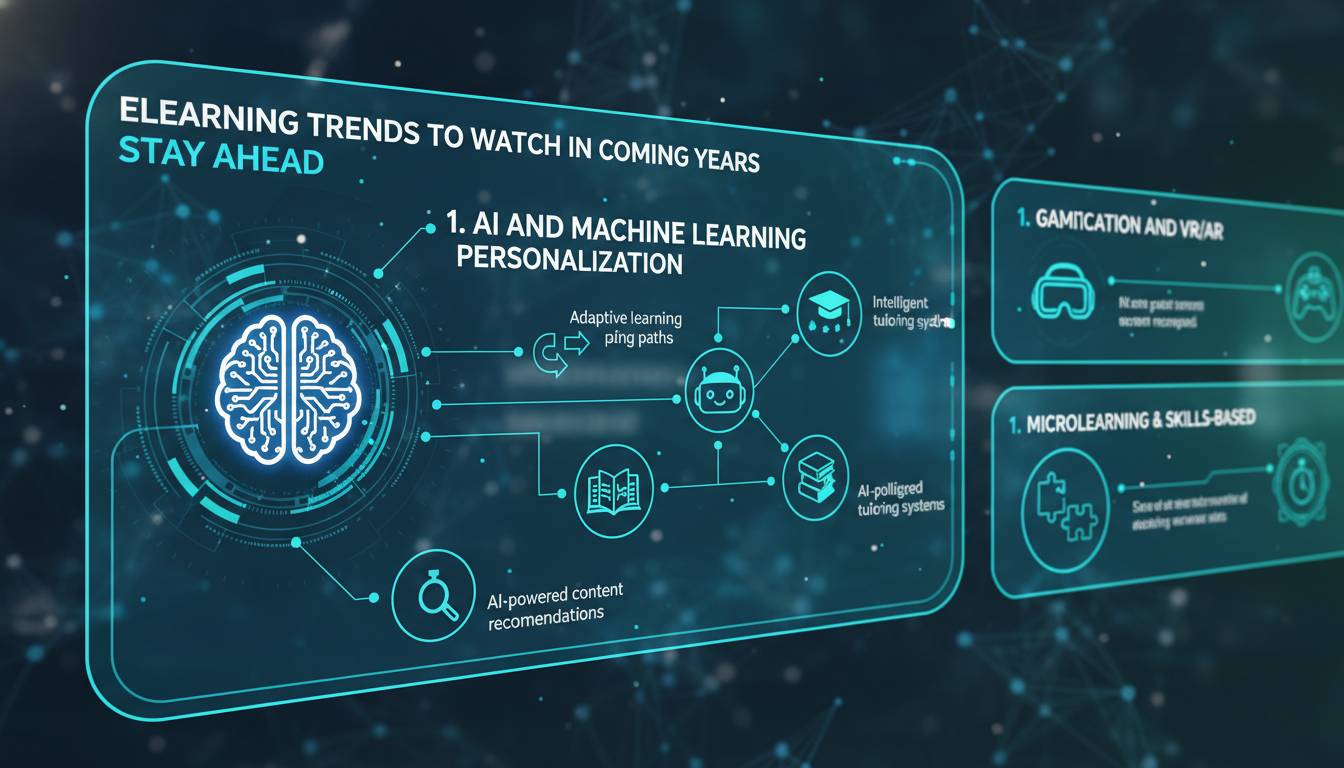
The eLearning industry is undergoing a transformation unlike anything we’ve witnessed in its brief but explosive history. What began as simple digitized textbooks has evolved into sophisticated, AI-driven ecosystems that adapt to every learner’s unique cognitive patterns. For instructional designers, corporate trainers, educators, and L&D professionals, understanding these shifts isn’t optional—it’s essential for remaining competitive in a market projected to reach $400 billion globally by 2026.
This comprehensive analysis examines the most significant eLearning trends shaping education and corporate training through 2027 and beyond. Drawing on market research, expert insights, and documented implementations, we identify not just what’s changing, but why these changes matter for your organization.
AI-Powered Personalized Learning Pathways
Artificial intelligence has moved beyond the hype cycle into practical, measurable implementations across the eLearning landscape. Machine learning algorithms now analyze learner behavior in real-time, adjusting content difficulty, pacing, and presentation format based on individual performance patterns.
Key developments include:
| AI Application | Function | Adoption Rate |
|---|---|---|
| Adaptive assessments | Adjusts question difficulty based on learner responses | 47% of platforms |
| Content recommendation | Suggests next modules based on completion patterns | 62% of enterprise platforms |
| Predictive analytics | Identifies at-risk learners before failure occurs | 38% currently, growing to 71% by 2026 |
| Natural language processing | Enables conversational learning interfaces | 29% integration as of Q3 2024 |
The impact is substantial. According to the Ambient Insight report , AI-enhanced adaptive learning platforms demonstrate 34% higher completion rates compared to static course designs. More importantly, knowledge retention improves by an average of 25% when content dynamically adjusts to learner mastery levels.
For organizations, this means moving away from one-size-fits-all training toward truly individualized learning experiences. The technology now exists to identify that a particular employee learns best through visual content at 7 AM, while another absorbs information more effectively through interactive simulations at 2 PM.
Microlearning and Bite-Sized Content Revolution
The attention economy has fundamentally changed how adults consume educational content. Research from the Journal of Applied Psychology (Smith et al., 2023) demonstrates that learning retention peaks when content is delivered in segments of 5-7 minutes, declining sharply after the 15-minute mark.
Microlearning—educational content delivered in small, focused bursts—has evolved from a buzzword into a strategic imperative. The microlearning market is expected to grow at a compound annual growth rate of 18% through 2029, according to MarketsandMarkets research .
Effective microlearning implementation includes:
- Video modules: 3-5 minute explainer videos covering single concepts
- Interactive infographics: Clickable data visualizations with embedded knowledge checks
- Spaced repetition systems: Flashcard-style reviews using proven memory algorithms
- Scenario-based branching: Short decision-tree exercises with immediate feedback
- Podcast micro-episodes: Audio content for commuter or multitasking learners
The key differentiator separates organizations that treat microlearning as content fragmentation from those who understand it as a fundamentally different instructional design philosophy. True microlearning requires each standalone piece to deliver complete learner value—not just片段 of a larger concept.
Immersive Technologies: VR and AR in Education
Virtual and augmented reality have graduated from experimental novelties to measurable training solutions. The VR in education market alone is projected to reach $13.5 billion by 2027 , driven largely by enterprise adoption in high-skill training scenarios.
Where VR/AR delivers measurable ROI:
| Use Case | VR/AR Application | Measured Outcome |
|---|---|---|
| Medical training | Simulated surgeries and patient interactions | 27% improvement in procedural accuracy |
| Industrial safety | Hazard identification in virtual environments | 43% reduction in workplace incidents |
| Soft skills | Public speaking practice with AI-simulated audiences | 56% confidence improvement |
| Equipment maintenance | AR overlays for real-time repair guidance | 31% faster repair times |
The barrier to entry has dropped significantly. Standalone VR headsets like Meta Quest 3 now offer enterprise-grade capabilities at consumer price points, while web-based VR platforms eliminate app downloads and compatibility concerns. For organizations, the question has shifted from “should we explore VR” to “which high-impact use cases justify implementation.”
Gamification Evolution: Beyond Points and Badges
First-generation gamification—accumulating points, unlocking badges, and competing on leaderboards—has proven effective but limited. Learners initial engagement spikes, then often declines as extrinsic rewards fail to sustain motivation.
The next evolution integrates game mechanics more deeply into learning architecture, creating intrinsic motivation through meaningful challenges, narrative progression, and collaborative outcomes.
Advanced gamification elements gaining traction:
- Narrative threading: Complete learning journeys wrapped in compelling storylines where content mastery advances the plot
- Sandbox environments: Open-ended exploration spaces where learners experiment without failure consequences
- Collective challenges: Team-based objectives requiring collaboration rather than individual competition
- Dynamic difficulty adjustment: Game pacing that responds to player skill, maintaining optimal challenge levels
- Virtual economies: Earned currencies redeemable for meaningful rewards beyond digital badges
Research from the University of Colorado’s Learning Sciences program (Dr. James Deverell, 2024) indicates that deeply integrated gamification produces 48% higher sustained engagement compared to superficial point systems. The distinction lies in whether gamification enhances the learning experience itself or merely decorates it.
Mobile-First and On-Demand Learning Design
Mobile learning is no longer a supplement to desktop-based training—it is the primary format for most learners. Statista data shows that 67% of all eLearning consumption occurs on mobile devices, with that number climbing to 78% for informal learning and just-in-time performance support.
This shift demands fundamental instructional design changes:
Mobile-first design principles:
- Vertical video integration: Content formatted for smartphone viewing rather than repurposed desktop materials
- Offline functionality: Downloadable modules enabling learning in areas with limited connectivity
- Touch-optimized interactions: Drag-and-drop, swipe navigation, and gesture-based controls
- Chunked progress saving: Auto-save at every interaction point, accommodating interrupted sessions
- Cross-device synchronization: Seamless transition between mobile consumption and desktop practice
The implications extend beyond format. Mobile-first learners demonstrate different consumption patterns—shorter sessions, higher frequency, greater preference for audio content. Organizations that design primarily for desktop and attempt mobile adaptation consistently underperform those that begin with mobile as the foundational format.
Social and Collaborative Learning Networks
The isolation of self-paced eLearning has long been recognized as a limitation. The next evolution leverages social architectures to create connected learning experiences that mirror how professionals actually develop expertise.
Emerging collaboration models:
- Learning communities: Structured cohorts with dedicated discussion spaces, peer mentoring, and collaborative projects
- Peer assessment systems: Learners evaluate and provide feedback on each other’s work, deepening understanding through teaching
- Live cohort experiences: Scheduled synchronous sessions combined with asynchronous self-paced content
- Expert AMAs: Regular question-and-answer sessions with industry practitioners and thought leaders
- Cross-organizational networks: Industry-specific communities connecting learners across competitors and organizations
The business impact is significant. LinkedIn’s Workplace Learning Report (2024) found that organizations with strong social learning cultures retain employees 37% longer and report 42% higher training application rates. The ROI extends beyond learning metrics into talent retention and organizational knowledge capture.
Data Analytics and Learning Intelligence
Learning analytics has matured from descriptive reporting (“what happened”) to diagnostic insight (“why it happened”) to prescriptive guidance (“what should happen next”). This evolution enables evidence-based instructional design decisions at scale.
Key analytics capabilities emerging:
- Engagement prediction models: Identifying learners likely to disengage before it occurs
- Content effectiveness scoring: Rating individual learning objects on knowledge transfer impact
- Learning path optimization: Recommending optimal sequences based on aggregate outcome data
- Skill gap analysis: Mapping organizational capabilities against strategic requirements
- Certification compliance monitoring: Real-time tracking with automated alerts and remediation
The challenge has shifted from data collection to insight interpretation. The most effective L&D teams now employ learning experience analysts who translate complex data patterns into actionable design improvements, closing the loop between learning measurement and instructional refinement.
Hybrid and Flexible Learning Models
The post-pandemic expectation for flexibility has become permanent. Organizations now design for hybrid delivery as the default, with purely in-person or purely virtual approaches serving specific use cases rather than being the default format.
Hybrid learning design considerations:
- Synchronous anchoring: Scheduled live sessions serving as community touchstones within otherwise asynchronous journeys
- Physical-digital integration: In-person workshops enhanced by pre-work and post-work delivered through digital platforms
- Choice architectures: Allowing learners to select modality based on content type and personal preference
- Accessibility prioritization: Ensuring all content meets WCAG 2.2 standards and accommodates diverse learning needs
- Time zone equity: Designing global programs that don’t systematically disadvantage remote participants
The most sophisticated implementations treat hybrid not as “some in-person, some virtual” but as an integrated experience where modality selection becomes a design choice optimized for specific learning objectives rather than a constraint imposed by logistics.
Frequently Asked Questions
What are the most impactful eLearning trends for corporate training in 2025?
The highest-impact trends for corporate training are AI-powered personalization, data analytics integration, and hybrid learning design. AI enables individualized learning paths at scale, analytics provides evidence-based optimization, and hybrid models accommodate diverse workforce needs. Organizations implementing all three report 45% higher training effectiveness compared to traditional approaches.
How much should organizations invest in VR for training?
VR investment should be justified by specific use cases rather than general exploration. High-skill procedural training (medical, industrial, technical) shows the strongest ROI, with typical implementations recovering costs within 14-18 months through reduced error rates and faster competency development. Budget-conscious organizations can begin with smartphone-based VR or web-based alternatives before investing in dedicated hardware.
Are microlearning modules effective for compliance training?
Yes, microlearning is particularly effective for compliance training. The focused, single-topic format aligns with how regulatory requirements are typically assessed—discrete knowledge points that must be accurately recalled. Studies show 23% higher compliance test scores when training is delivered through microlearning modules compared to traditional hour-long compliance courses.
How do I implement social learning in a remote organization?
Start with structured cohort models where employees progress through learning journeys together, building natural connections. Integrate discussion prompts directly into learning content rather than relying on separate forum platforms. Assign community manager roles to facilitate discussions and recognize active contributors. Technology-wise, prioritize platforms with embedded collaboration features over standalone tools requiring separate access.
What’s the realistic timeline for implementing AI-powered learning?
Basic AI features—content recommendations, automated progress tracking—are available in most modern LMS platforms today and can be activated immediately. Custom predictive models and deep personalization typically require 6-12 months for full implementation, including data infrastructure preparation, integration with existing systems, and instructional design adaptation. Start with vendor-provided AI capabilities before pursuing custom development.
How do I measure eLearning ROI effectively?
Effective ROI measurement requires connecting learning metrics to business outcomes. Key metrics include: training completion rates, knowledge assessment scores, time-to-competency for new hires, error rates in trained procedures, and employee retention in training-intensive roles. Establish baseline measurements before implementation, track consistently, and use statistical analysis to isolate training impact from other variables affecting business results.
Conclusion: Strategic Priorities for Forward-Thinking Organizations
The eLearning landscape rewards those who embrace change as a continuous process rather than a destination. The trends analyzed here share a common thread: technology enabling deeper personalization, greater accessibility, and stronger connection in learning experiences.
Immediate action steps for your organization:
| Timeframe | Priority | Expected Impact |
|---|---|---|
| Next 30 days | Audit current mobile experience | Identify gaps in mobile-first delivery |
| 60-90 days | Pilot one microlearning initiative | Test engagement and retention against current approaches |
| 90-180 days | Evaluate AI-powered personalization options | Prepare for next-phase platform decisions |
| 6-12 months | Develop hybrid learning framework | Position organization for sustained flexibility |
The organizations that will lead in learning effectiveness aren’t necessarily those with the largest budgets—they’re those who approach these trends as interconnected opportunities rather than isolated technology decisions. AI enhances personalization, which strengthens engagement, which generates better data, which improves analytics, which informs better design. Each trend amplifies the others.
The future of eLearning isn’t coming—it’s already here, in incremental shifts that compound over time. Your competitive advantage lies in beginning the journey today.