

 February 7, 2026
  4 Min
4 Min  No Comment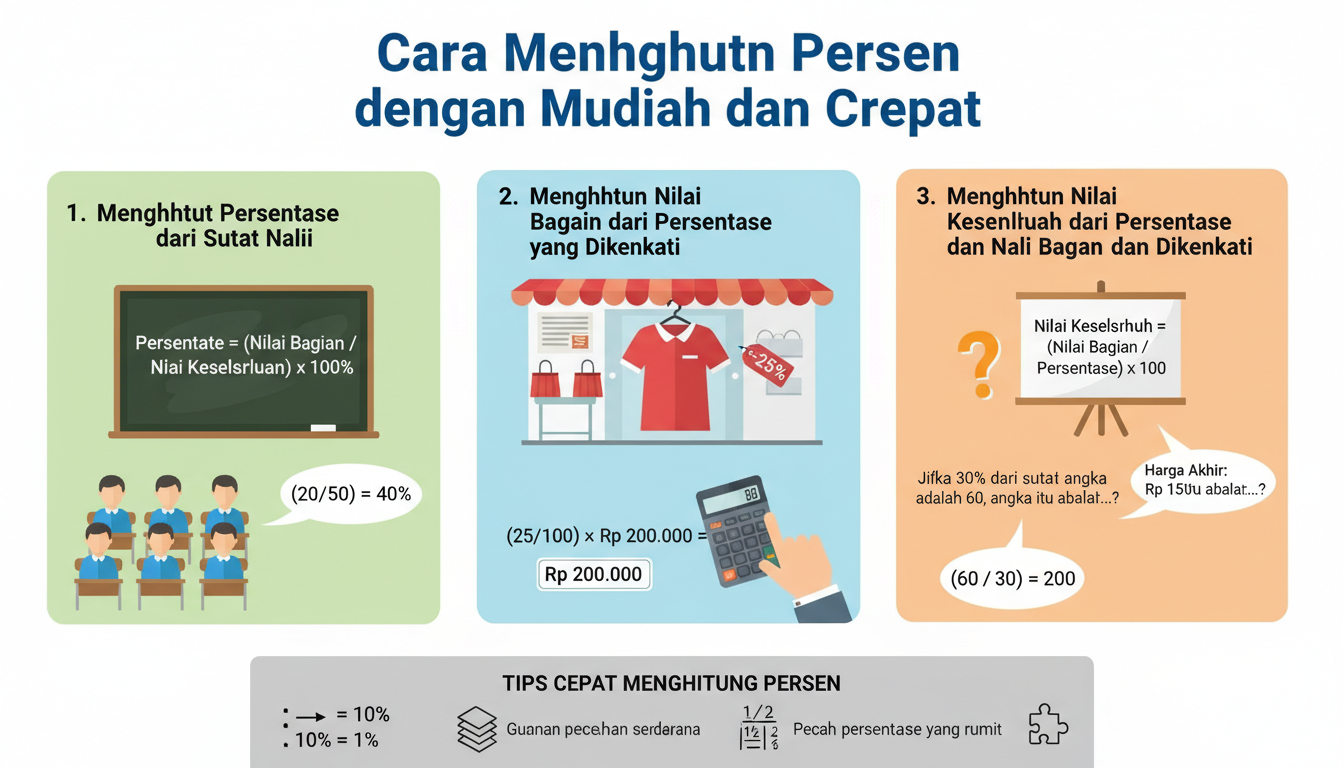
Calculating percentages—cara menghitung persen—is one of those everyday math skills that sneaks into our lives more often than we realize. Whether figuring out discounts, understanding survey results, or planning budgets, percentages bridge numbers with real-world decisions. This guide aims to simplify, humanize, and maybe even entertain the process—complete with a few imperfect quirks meant to mirror real conversation. Let’s navigate this math journey together—mistakes and all.
What Is Percentage and Why It Matters
At its core, percentage comes from the Latin per centum, meaning “per hundred” . The percent (%) indicates how much of something exists out of 100. It’s a universal shorthand that helps compare apples to oranges in a way that’s easy to understand.
In real life, percentages pop up everywhere—from student grades and sale tags to investment returns and statistical insights . Grasping how to calculate them can transform confusion into clarity, and uncertainty into confidence.
Basic Formula: The Go-To Tool for Calculating Percentages
Let’s start with the foundational formula that underpins most percentage calculations:
Percentage (%) = (Part / Whole) × 100%
Pretty straightforward, yet wildly powerful. For instance, if you ate 3 out of 4 slices of pizza, that’s (3 ÷ 4) × 100% = 75% . Simple, but essential.
To flip the scenario—say you know the percentage and total, but want to find the part—the formula adjusts:
Part = (Percentage / 100) × Total
And if you only have the part and percentage and need the total:
Total = Part / (Percentage / 100)
These flexible formulas are especially handy in everything from budgeting to sales analysis .
Smart Mental Tricks to Do It Faster
Sometimes you just want a quick estimate—no calculator, no fuss. Here are some mental shortcuts:
- 10% trick: Shift the decimal one place left. For 250, that’s 25. Double it for 20%, triple it for 30% .
- 1% trick: Shift two places left. For 250, that’s 2.5. Handy for smaller tweaks or finer estimates .
- Fraction shortcuts: Committing common fractions to memory turns tough percentages into easy wins:
- ½ = 50%, ¼ = 25%, ¾ = 75% .
- Swap trick: Curious about 20% of 50? You can instead calculate 50% of 20—same result, often easier to compute .
- Splitting percentages: Breaking a tricky number into easier bits—for example, 47% = 50% − 3% —helps simplify mentally .
These tricks could turn what feels like “math anxiety” into quick, intuitive answers.
Going Beyond: Increase, Decrease & Reverse Percentage
Percentage Increase or Decrease
Want to know how much something changed in percentage terms? Use this:
Change (%) = ((New Value − Old Value) / Old Value) × 100%
If you went from $50 to $60, that’s ((60 − 50) ÷ 50) × 100% = 20% increase . Same logic applies for decreases: negative result means drop .
Reverse Calculation
If something costs $120 after a 20% markup, the original price was $120 ÷ 1.2 = $100 . Handy when dissecting sales or discount pricing.
Applying Percentages in Real Situations
Let’s make it concrete:
- Retail discounts: A dress priced at Rp200,000 with a 30% discount is calculated as 0.3 × 200,000 = Rp60,000 off. Final price? Rp140,000 .
- Finance: Invested Rp10,000,000; it grows to Rp11,500,000 in a year. Return: ((11,500,000 − 10,000,000) ÷ 10,000,000) × 100% = 15% .
- Surveys: 750 out of 1,000 respondents like a product — that’s 75% satisfaction .
- Personal stats: Out of 50 questions, 40 are correct: (40 ÷ 50) × 100% = 80% score .
In each case, the same screw-simple formula applies, yet context shifts how you think about it. Imperfect, but powerful—like life itself.
Expert Insight
“Mastering percentage calculations isn’t just about math—it’s about turning numbers into context, decisions, and clarity.”
— A Numeracy Education Specialist
Common Mistakes & How to Avoid Them
Even with clear formulas, errors still happen. Here’s a quick list:
- Thinking percentages over 100% are impossible—actually, they’re normal when something more than doubles .
- Adding discounts directly—a 20% plus 10% discount isn’t 30%. Discounts apply sequentially .
- Decimal confusion—0.5 is 50%, not 0.5% .
- Basing 10% on the wrong total—10% of 200 is 20, but of 500 is 50—similar label, different result .
- Rounding without reason—especially on financial calculations, small rounding can skew real meaning .
Even seasoned pros trip over these—just watch for them.
Conclusion: Your Takeaways
Calculating percentages isn’t mystical—it’s logical, flexible, and everywhere. The core formula, mental shortcuts, and application examples turn math into insight. It’s human-friendly, imperfect at times, but that’s where real understanding grows. Keep practicing and soon you’ll do it without even thinking about it.
FAQs
-
What’s the easiest way to find a percentage of a number?
Identify the part and total values, then apply: (Part ÷ Total) × 100%. It’s the go-to method for most calculations. -
How do I calculate a percentage change between two numbers?
Use: ((New − Old) ÷ Old) × 100%. It works for both increases and decreases. -
Can percentages be over 100%?
Absolutely. If something more than doubles—say, profit from $100 to $250—you’re looking at a 150% increase. -
Is a 20% + 10% discount equal to 30%?
No—each discount is applied one after the other. For example, first reduce by 20%, then another 10% of the new total, not the original. -
How can I quickly estimate percentages mentally?
Use tricks: 10% is one-tenth, 1% is one-hundredth. Combine easily for mental math—like 15% = 10% + 5%.
That’s it—a hopefully friendly, slightly imperfect, and practical dive into cara menghitung persen.
