
 February 7, 2026
  6 Min
6 Min  No Comment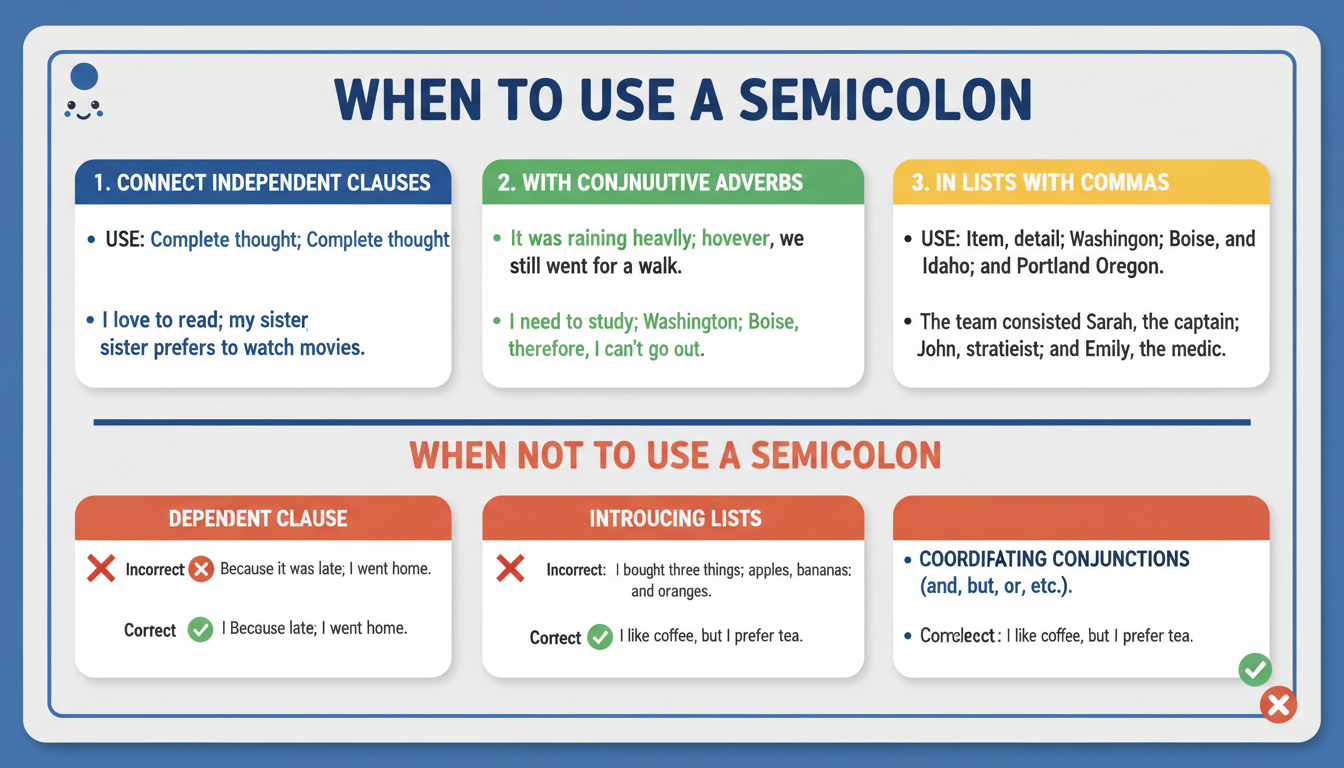
Let’s get a bit real: semicolons can feel fancy, intimidating, or even archaic—and I won’t lie, I’ve occasionally stared at one of my own sentences thinking, “Why on earth is that there?” But in truth, when used with the right subtlety, semicolons bring a rhythm and clarity that neither commas nor periods quite capture. They’re the middle ground—longer than a comma’s gentle pause, but softer than a full stop .
Despite modern trends leaning away from semicolons—like the notable decline in English-language book usage from around 1 in every 205 words in 2000 to just 1 in 390 words today —they’re still alive and kicking for writers who appreciate nuance. Let’s explore when to use one, when not to, and why they still matter in polished, professional writing.
When to Use a Semicolon: The Core Rules
Linking Independent Clauses with Grace
The primary—and most satisfying—job of a semicolon is to bridge two independent clauses that are closely related—for instance:
- I studied all night; I nailed the presentation.
Each clause could stand on its own, but the semicolon adds a deliberate, smooth connection . This approach works best in more thoughtful or reflective writing—when you want the ideas to resonate together without jolting with a full stop.
Brandeis University reinforces this:
“Use a semicolon when you link two related independent clauses with no connecting words.”
I am going home; I intend to stay there.
Before Conjunctive Adverbs and Transition Words
Sometimes, a little adverb like however, therefore, or moreover steps in to add nuance, tension, or transition. Here a semicolon neatly introduces that shift:
- The rain was relentless; however, our picnic stayed joyful.
Style guides recommend placing a semicolon before such transitions and a comma right after—clear, tight, and intentional .
Sorting Complex Lists with Precision
Lists packed with commas can quickly turn into puzzles. That’s where semicolons become life-savers:
- The team includes Mark, the strategist; Jane, the analyst; and Lee, the designer.
This keeps each item distinct and readable—especially in formal contexts or technical writing rich in detail.
When It’s About Rhythm (Less Common, but Stylistically Valid)
Sometimes semicolons are used less for grammar and more for effect—to slow a sentence just enough, or to create a quiet emphasis:
- She looked at the horizon; it called to her longing in a way no sky ever had.
This is more poetic, more writerly—but absolutely part of a semicolon’s expressive toolkit .
When Not to Use a Semicolon: Avoid These Pitfalls
Never Before Dependent Clauses
Semicolons don’t belong when one clause depends on the other. For example:
- Incorrect: Although I was tired; I pressed on.
- Correct: Although I was tired, I pressed on.
Dependent clauses still need that guiding comma, not the separative weight of a semicolon.
Skip It When a Coordinating Conjunction Is Already Doing the Job
Coordinating conjunctions like and, but, and so typically pair with commas—not semicolons—unless the first clause is cluttered with commas already:
- Incorrect: We called; but they never answered.
- Correct: We called, but they never answered.
Though there are exceptions (e.g., long, comma-packed clauses), those require delicate judgment.
Not a Replacement for Colons
Using semicolons to introduce lists or explanations? Nope, that’s what colons are for:
- Incorrect: I have one wish; for peace.
- Correct: I have one wish: for peace.
Real-World Examples & Writerly Context
Example 1: Brainstorming Email
I’ve reviewed your draft; it’s strong overall. However, we may need stronger data support in the second section.
Here the semicolon connects two related thoughts, then transitions into a conjunctive adverb to deepen the critique with however.
Example 2: Travel Itinerary
Our itinerary includes Rome, Italy; Florence, Italy; and Venice, Italy.
List items include embedded commas—semicolons keep things clear. A common scenario in planning emails or blog posts .
Example 3: Personal Reflection (More Stylistic)
The road was quiet; dusk draped the world in muted gold. I slowed my footsteps; evening felt like a gentle promise.
Functions beyond grammar—semicolons here help pace those reflections, almost letting readers breathe in the scene.
Why Semicolons Matter Despite a Trend Toward Simplicity
Even though semicolon use has sharply declined—from one every 205 words in 2000 to just one in 390 in recent books—it’s not dead yet . Many writers still value its ability to link closely tied ideas while avoiding sentence sprawl.
Students and casual writers often struggle: one study found over half lacked confidence or understanding when using semicolons . But for professionals—journalists, editors, academics—a well-placed semicolon signals precision and confidence. It’s subtle, often invisible—but valuable when you want to convey clarity and elegance.
“Semicolons… help your sentence stay clear and correct.”
– Grammar Guru
Conclusion: Semicolons in Practice
Semicolons aren’t relics—they’re deliberate tools. Use them to link two independent but related thoughts, to frame transitions with care, to untangle dense lists, or for soft rhetorical flair. But don’t force them in where commas, conjunctions, or periods do the job better. In writing, clarity wins—and a semicolon that earns its place makes a subtle mark of precision.
FAQs
1. When is a semicolon better than a comma?
Use a semicolon when you’re connecting two related full sentences without a conjunction—or when you need to separate list items that themselves contain commas. It’s a stronger pause than a comma but softer than a period.
2. Can you use semicolons with words like “however” or “therefore”?
Absolutely. Put a semicolon before, and a comma after these conjunctive adverbs—e.g., We were ready; however, the train was delayed.
3. Should semicolons replace colons before a list?
No. Colons introduce lists or expansions. A semicolon is only for linking independent clauses or clarifying complex lists.
4. Why are semicolons less common today?
Trends toward simplicity and short sentences have decreased their use. Some influential authors even discouraged them, leading many writers (especially students) to avoid semicolons altogether.
5. Are semicolons necessary in writing?
Not always—but they’re helpful tools. When used thoughtfully, they bring precision and rhythm. When overused or misplaced, they can feel heavy or confusing.
6. Can semicolons give a pause that’s more than a comma but less than a period?
Exactly. That’s their middle-ground power. They let ideas breathe together without the abrupt stop of a period—perfect for when two thoughts are connected yet distinct.
