
 February 7, 2026
  6 Min
6 Min  No Comment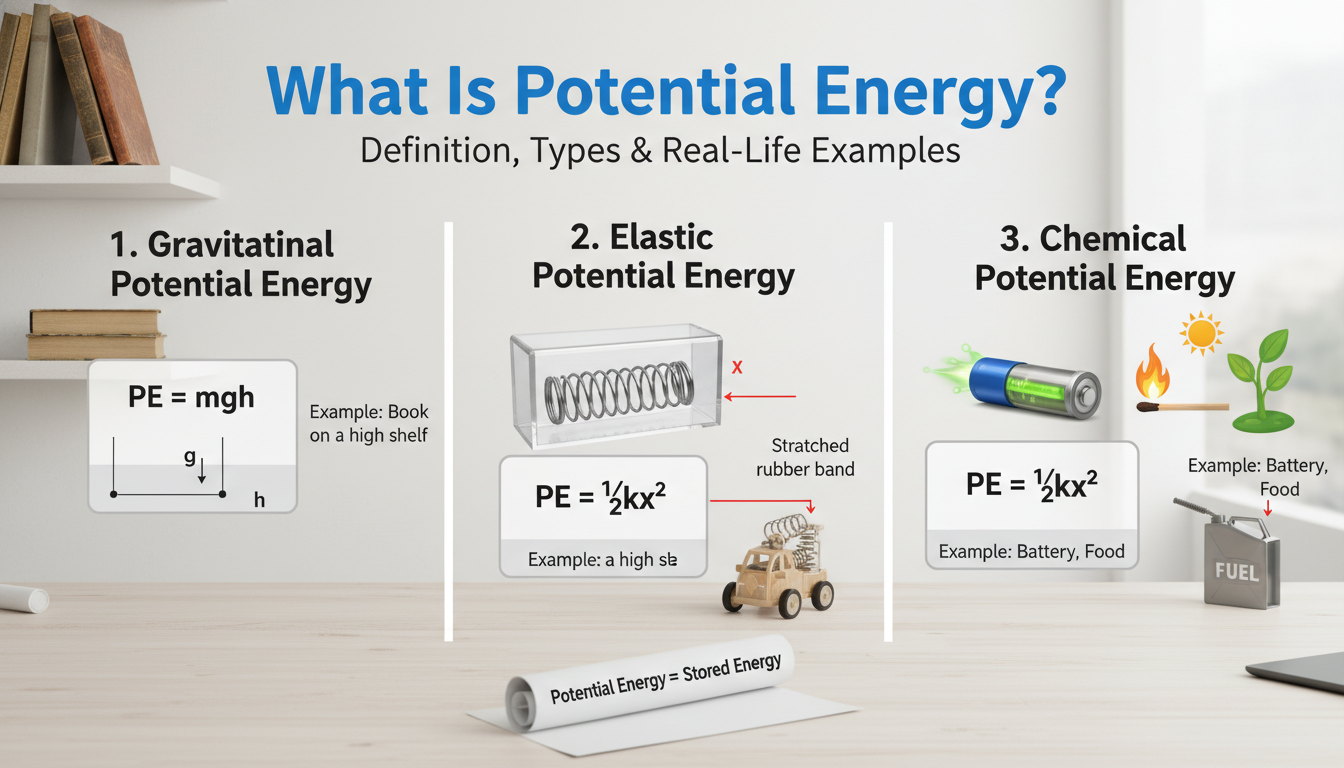
Imagine holding a book on a shelf—seemingly still, yet harboring an energy that could set things in motion. That’s the essence of potential energy, an invisible force ready to spring into action. Agreed, it’s a bit counterintuitive at first, but that’s what makes uncovering its real-world nuances rather enjoyable—like realizing the energy in our own routines is more storied than meets the eye.
Why It Matters
Potential energy isn’t just a physics term laced with equations—it’s how our world stores energy in waiting. From a roller coaster poised at the top of a track to the chemical bonds in your morning coffee, this concept underpins transformation and utility in countless contexts. And honestly, understanding it feels oddly empowering.
The Basics: What Makes Potential Energy Tick
Potential energy is the energy stored within a system based on its configuration, position, or state—ready to be converted into work when unleashed. It’s the opposite of kinetic energy, which is energy already in motion.
This energy exists because forces—like gravity or a compressed spring—hold parts of a system in specific arrangements. When that arrangement shifts, the energy shifts too. Gravitational potential energy, for instance, depends on how high an object is above the ground; elastic potential energy depends on how much something is stretched or compressed.
A key point: potential energy is relative. It depends on your choice of reference—lifting a ball out of a hole, for example, stores more energy than lifting it from ground level, even if the difference in height is the same.
Types of Potential Energy: More Than Just Height
Gravitational Potential Energy
Everyone’s favorite—leaning into gravity. An object lifted to a height stores energy per the formula PE = mgh, where m is mass, g is gravitational acceleration, and h is height.
Water held behind a dam or a coaster at a peak are classic real-life examples.
Elastic Potential Energy
Stored when materials like springs or rubber bands are stretched or compressed. The energy is calculated via U = ½ kx²—k being the spring constant, x the displacement.
Think of a bow drawn back, ready to launch an arrow, or a trampoline surface awaiting a jump.
Chemical Potential Energy
Locked within chemical bonds, waiting for a trigger to release. Examples include battery cells, gasoline, or food—convertible into heat, motion, or work through reactions.
Electric Potential Energy
Charged objects wield energy thanks to electrostatic forces. The work needed to assemble a system of charges from infinity defines this energy storage.
Capacitors in your phone, voltage in circuits—real-world electric potential energy at play.
Nuclear Potential Energy
The energy bound inside atomic nuclei, released through fission or fusion. Stars like our Sun burn hydrogen via fusion, converting mass into enormous energy.
Other Forms (Just to Stretch the Thinking)
- Intermolecular Potential Energy: Energy from molecular arrangements, relevant in chemical processes.
- Strain Energy: Technical term for elastic energy, particularly in materials science contexts.
- Thermodynamic Potentials: Abstract energy measures in thermodynamics, useful for characterizing system states.
Real-World Applications: Energy in Everyday Life
Diving into examples brings these concepts from textbooks to our daily context—sometimes surprisingly. And hey, real life is full of imperfect, messy instances, which makes it all the more relatable.
Riding the Roller Coaster (and Beyond)
At the top of the track, a coaster car holds gravitational potential energy that converts spectacularly into kinetic energy during the descent—yes, this thrills the soul.
Water, Power, and Pumps
Hydropower uses gravitational potential energy. Water stored high behind dams flows down through turbines, spinning them to produce electricity. It’s energy conversion at its finest—even if some is lost to friction and turbulence.
Springs, Toys, and Gizmos
A compressed spring in a toy stores elastic potential energy. Release it, and suddenly the toy is animated—charming and technically neat.
A Glance at Everyday Chemistry
Gasoline in a car? Chemical potential energy. That dinner you’re eating? Potential energy your body will later harness. It’s the quiet, consistent flow that powers modern life.
Speed, Elevation, and Gravity
Think of a parked car on a hill or a cyclist at the top of a slope—gravity is waiting. Upon release, potential energy transitions into kinetic energy, showcasing elegant physical dynamics.
Why Understanding Potential Energy Matters
-
Engineering and Innovation
Designing roller coasters, dams, or propulsion systems relies on harnessing potential energy effectively. -
Energy Storage Solutions
From pumped-storage hydroelectricity to advanced battery systems, potential energy is key to storing energy sustainably. -
Education and Awareness
Grasping these principles helps students and citizens recognize resource use and conservation—from powering homes to fueling cars. -
Scientific Exploration
Fields like astrophysics, materials science, and chemistry all depend on understanding how energy is stored and released.
“Potential energy is the stored capacity of a system to do work. Recognizing its different forms—from gravitational to chemical—reveals how the universe—and everyday tech—operates behind the scenes.”
— Thoughtful reflection from a physics educator
Wrapping Up: What You Should Keep in Mind
Potential energy is a silent powerhouse—stored in height, in springs, in atoms, and in charges. It’s a versatile concept that connects the dots between physical position, system configuration, and the ability to perform work. Whether launching a spacecraft, storing energy, or enjoying a theme park ride, potential energy is that hidden player making it happen.
Next time you see a drawn bow, a lifted weight, or a charged battery, think of the energy lying in wait—and the world shifts ever so slightly when you do.
FAQs
What’s the difference between potential and kinetic energy?
Potential energy is stored, waiting to be released. Kinetic energy is energy in motion—what results after potential energy is converted.
Why is potential energy relative?
It depends on a reference point. The stored energy changes based on the chosen baseline—for example, how high you lift an object relative to a reference height.
Can potential energy be negative?
Yes. In some contexts—like gravity at certain points—potential energy can be negative depending on the reference chosen. It’s still about relative measurement.
How does mass impact gravitational potential energy?
Greater mass means more stored energy at a given height, because energy scales with mass (PE = mgh).
Why are there so many types of potential energy?
Different forces and fields (gravity, elasticity, electric charge, nuclear forces) store energy in distinct ways, so each gives rise to a unique form of potential energy.
Where do I see potential energy every day?
In everyday phenomena—like a drawn bow, water behind a dam, a stretching spring, or even in the food you eat. Potential energy is quietly everywhere around us.
