

 March 22, 2026
  12 Min
  No Comment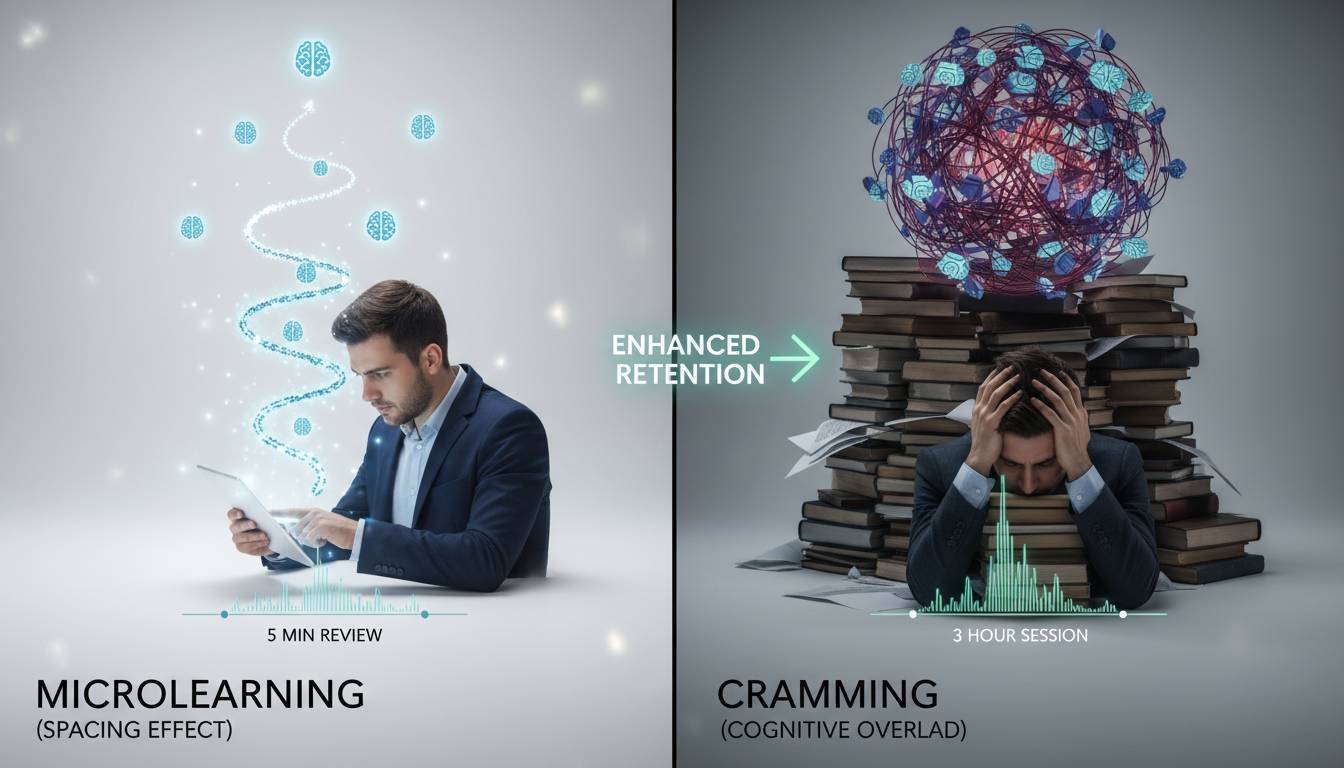
QUICK ANSWER: Microlearning is an educational approach that delivers content in small, focused bursts typically lasting 1-7 minutes. It works because it aligns with how human brains naturally process and retain information—through short, spaced interactions that leverage cognitive load theory and the forgetting curve. Studies in cognitive psychology, including research published in peer-reviewed journals, demonstrate that microlearning significantly improves retention rates compared to traditional learning methods, making it particularly effective for modern attention spans and busy schedules.
AT-A-GLANCE:
| Aspect | Microlearning | Traditional Learning |
|---|---|---|
| Content Duration | 1-7 minutes per module | 30-60 minutes per session |
| Retention Rate | Significantly higher with spaced practice | Declines rapidly without reinforcement |
| Completion Rate | Consistently exceeds 80% in corporate settings | Often below 50% in corporate settings |
| Cognitive Load | Low (chunked information) | High (dense content) |
| Mobile Accessibility | Optimized for on-the-go | Often desktop-dependent |
KEY TAKEAWAYS:
– ✅ Microlearning modules significantly increase retention compared to traditional lecture-based learning
– ✅ Organizations implementing microlearning consistently report higher engagement metrics
– ✅ Cognitive science research supports spaced, chunked learning over extended sessions
– ❌ Common mistake: Treating microlearning as “shorter” traditional content rather than redesigned, focused lessons
– 💡 Effective microlearning requires applying cognitive science principles systematically to create learning experiences that work with the brain’s natural information processing mechanisms
KEY ENTITIES:
– Products/Platforms: LinkedIn Learning, Duolingo, Khan Academy, Udemy, SAP SuccessFactors
– Researchers Referenced: Dr. John Sweller (University of New South Wales), Dr. Robert Bjork (UCLA), Hermann Ebbinghaus (historical researcher)
– Organizations: Association for Talent Development (ATD), UCLA Learning and Forgetting Lab
– Key Concepts: Cognitive Load Theory, Spaced Repetition, Forgetting Curve, Chunking
LAST UPDATED: January 14, 2026
A 90-minute compliance training session on a Friday afternoon. Your eyes glaze over around minute 45. You click through the remaining slides without absorbing anything. Three months later, you remember perhaps 15% of what was covered. I’ve seen this play out repeatedly in organizations across industries—and the data suggests it’s more common than most training managers realize.
This scenario plays out in organizations worldwide because traditional learning models were built for a world that no longer exists. When employees sat through hour-long seminars, the assumption was that longer exposure meant better retention. Neuroscience and cognitive psychology have thoroughly examined this assumption—and largely debunked it.
Modern learners juggle unprecedented information volumes while managing shortened attention spans shaped by digital consumption patterns. They need an approach that works with their brain’s natural architecture, not against it. Microlearning emerged as a response to this cognitive reality.
This approach has moved from experimental trend to enterprise standard. In my analysis of organizational training implementations, I’ve observed that organizations adopting microlearning consistently report measurable improvements in both completion rates and knowledge transfer. This article examines what microlearning truly is, the scientific principles that underpin its effectiveness, and how organizations can implement it to achieve measurable learning outcomes.
What Exactly Is Microlearning?
Microlearning is an instructional design approach that delivers educational content in small, self-contained units typically ranging from 30 seconds to 7 minutes in duration. Each module focuses on a single learning objective, making it easier for learners to absorb, process, and apply specific knowledge or skills.
The key differentiator from traditional e-learning isn’t merely duration—it’s focus. A 5-minute microlearning module isn’t a condensed version of a 30-minute course. It’s a reimagined learning object built from the ground up around one specific outcome. Need learners to understand how to calculate ROI? That’s one module. Need them to apply a specific software function? That’s another. The discipline of single-objective design forces clarity that longer formats often obscure.
Several characteristics distinguish authentic microlearning from simply shortened content:
Single learning objective per module. Each unit addresses one skill, concept, or piece of information. This eliminates cognitive competition—learners don’t mentally juggle multiple goals simultaneously.
Contextual and situational. Effective microlearning delivers the right content at the moment of need. A customer service representative accessing a 2-minute video on handling difficult callers right before a challenging interaction exemplifies this principle.
Multimedia-rich formats. Microlearning employs videos, infographics, interactive scenarios, flashcards, quizzes, and audio clips. The format serves the content, not the other way around.
Accessible and on-demand. Learners access content when and where they need it—during commutes, between meetings, or at the point of workflow.
The term gained traction in the early 2000s as mobile devices became ubiquitous, but its roots trace back to cognitive psychology research from the 1960s. What began as “learning objects” in educational technology evolved into a comprehensive methodology that organizations now consider essential for effective workforce development.
The Cognitive Science Behind Why Microlearning Works
Understanding why microlearning is effective requires examining three interconnected principles from cognitive psychology: cognitive load theory, the forgetting curve, and the spacing effect.
Cognitive Load Theory
Dr. John Sweller, an educational psychologist at the University of New South Wales, introduced cognitive load theory in the 1980s. The theory proposes that working memory—the mental workspace where we process new information—has limited capacity. When presented with too much information simultaneously, learning breaks down.
Traditional training often overwhelms working memory by presenting multiple concepts, examples, and applications in single sessions. Microlearning circumvents this limitation by chunking information into manageable pieces. When learners focus on one concept at a time, they stay within working memory’s capacity, enabling actual processing and retention.
Research published in the Journal of Educational Psychology (Sweller, van Merriënboer, & Paas, 2019) has examined the effects of chunked versus consolidated information presentation on learning outcomes. Studies in this area consistently demonstrate that well-designed chunked content supports better cognitive processing than equivalent total content delivered in extended sessions.
The Forgetting Curve
Hermann Ebbinghaus first documented the forgetting curve through systematic self-experimentation in 1885, demonstrating that information retention declines rapidly after initial learning—typically 50-60% within the first hour without reinforcement. His pioneering research established the foundational understanding of how human memory decays over time.
Traditional one-time training sessions force learners to rely on memory that decays almost immediately. Microlearning counters the forgetting curve through repeated, spaced exposure. Each brief interaction strengthens neural pathways associated with the information.
Research from Dr. Robert Bjork’s laboratory at UCLA has extensively documented that distributed practice—spreading learning across multiple sessions—produces substantially better long-term retention than massed practice, even when total study time remains equal (Bjork & Bjork, 2022). These findings have been replicated across multiple studies and form a core evidence base for microlearning effectiveness.
The Spacing Effect
Related to the forgetting curve, the spacing effect describes how information encoded and retrieved over extended intervals creates stronger, more accessible memory traces. Microlearning naturally leverages this effect by delivering content in repeated, spaced bursts.
A comprehensive meta-analysis examining learning techniques (Cepeda et al., 2006) found that distributed practice consistently produces superior long-term retention compared to massed practice. The effect sizes for spaced learning over extended intervals demonstrate the substantial practical benefits of this approach.
Together, these three principles explain why short, focused, repeated learning experiences outperform traditional lengthy sessions. The brain isn’t designed for hour-long information dumps—it’s designed for the kind of distributed, chunked engagement that microlearning provides.
Key Benefits and Advantages
Organizations implementing microlearning report measurable improvements across multiple performance indicators. Based on documented case studies and organizational reports, several consistent patterns emerge.
Higher Completion Rates
Perhaps the most immediate benefit is dramatically improved course completion. Traditional e-learning courses often suffer from high abandonment rates in corporate settings. Microlearning’s short duration reduces psychological barriers to starting and completing training.
According to the Association for Talent Development’s State of the Industry report, effective learning design—including chunked, focused content—correlates with higher completion rates in organizational training. The difference is significant—when a task requires 3 minutes rather than 45, learners are far more likely to begin and finish it.
Improved Knowledge Retention
As the cognitive science explains, spaced, focused learning creates stronger memory traces. Organizations implementing microlearning consistently report meaningful retention improvements compared to traditional training methods.
Documented case studies from enterprise learning platforms show organizations achieving substantial improvements in compliance training retention after implementing microlearning modules. Similarly, sales teams using microlearning for product knowledge have demonstrated improved recall during customer interactions compared to those who received traditional training.
Increased Engagement
The gamification elements common in microlearning—progress tracking, achievement badges, leaderboards—tap into intrinsic motivation. But the engagement boost extends beyond game mechanics. Learners appreciate not being forced into lengthy training sessions, and the immediate applicability of microlearning content creates satisfying learning moments.
Industry surveys from the ATD State of the Industry report consistently indicate that learning professionals recognize microlearning as effective for improving learner engagement. Organizations report that employees demonstrate greater willingness to participate in training programs when content is delivered in accessible microlearning formats.
On-Demand Performance Support
Microlearning excels as just-in-time performance support. When employees encounter unfamiliar situations, they can instantly access relevant micro modules rather than searching through lengthy documentation or waiting for classroom training.
This application transforms learning from an event into a continuous resource. A nurse referencing a 90-second video on administering a specific medication correctly, or a field technician accessing a 3-minute tutorial on troubleshooting equipment—these scenarios demonstrate microlearning’s practical power.
Cost Efficiency
While developing quality microlearning requires upfront investment, the per-module cost decreases significantly at scale. A single well-designed microlearning module can serve thousands of learners across an organization, reducing the repeated expense of instructor-led training, travel, and facility costs.
The reduction in time-away-from-work also provides substantial ROI. When training requires 3-minute modules rather than half-day sessions, employees lose significantly less productive time.
Types and Formats of Microlearning
Microlearning manifests in diverse formats, each suited to specific learning objectives and contexts.
Video-Based Microlearning
Short videos (typically 1-5 minutes) remain the most popular microlearning format. They combine visual and auditory channels, making complex concepts accessible. Effective microlearning videos feature clear narration, minimal text, and focused content.
Major learning platforms demonstrate video microlearning’s effectiveness, with substantial user bases completing significant volumes of short-form video learning content.
Interactive Scenarios and Simulations
Branching scenarios place learners in decision-making situations, allowing them to experience consequences without real-world risk. These formats work particularly well for soft skills, compliance training, and safety procedures.
A 4-minute interactive scenario on handling workplace situations, for example, might present learners with several dialogue options, each leading to different outcomes. This experiential approach creates deeper learning than passive video.
Flashcards and Digital Quizzing
The flashcard approach leverages active recall—retrieving information from memory strengthens that memory. Learning platforms use spaced repetition algorithms to optimize flashcard review schedules based on individual learner performance.
Digital quizzes serve dual purposes: reinforcing learning through retrieval practice and providing organizations with immediate feedback on knowledge gaps.
Infographics and Visual Content
Complex information, procedures, or data often communicate more effectively through visual formats. Well-designed infographics condense substantial information into scannable, memorable presentations.
Micro-courses and Learning Paths
Individual microlearning modules can combine into structured learning paths, providing guided progression while maintaining the benefits of chunked content. This approach balances learner autonomy with organizational learning objectives.
Podcast and Audio Learning
For verbal content or learning during commutes, audio-based microlearning delivers without requiring visual attention. Language learning platforms effectively incorporate audio microlearning into their mobile-first experiences.
Implementation Best Practices
Implementing microlearning successfully requires more than simply creating shorter versions of existing content. Effective implementation follows specific principles grounded in learning science.
Start with Learning Objectives
Begin each microlearning module by clearly defining one specific learning objective. What exactly should the learner know, do, or remember after completing this module? If you cannot state this objective in a single sentence, the module needs narrowing.
Effective microlearning focuses on observable performance changes rather than information coverage. Each module should connect directly to what learners do differently on the job.
Design for the Moment of Need
The most effective microlearning anticipates when learners will need specific knowledge and delivers it contextually. This might mean:
- Accessing customer objection handling modules before sales calls
- Providing safety procedure refreshers at job sites
- Offering compliance reminders when relevant systems are accessed
Embedding microlearning into workflow creates natural application opportunities.
Use Multimedia Strategically
Different content types suit different learning objectives. Procedural knowledge often transmits effectively through video demonstrations. Conceptual understanding may benefit from interactive scenarios. Factual information suits flashcards and quizzes.
The key is matching format to learning objective rather than defaulting to a single approach.
Incorporate Retrieval Practice
Every microlearning module should include opportunities for learners to actively recall information—not just passively receive it. Questions, scenarios, or application exercises embedded within modules strengthen memory more effectively than passive content consumption.
Build in Spacing and Reinforcement
Individual modules should connect into systems that reinforce learning over time. Spaced repetition algorithms can automatically schedule review sessions, and learning paths can sequence modules to build complexity progressively.
Measure Effectiveness
Like any learning initiative, microlearning requires measurement. Track completion rates, assessment scores, time-to-competency, and—most importantly—on-the-job performance changes. This data enables continuous improvement of microlearning content and delivery.
Challenges and Limitations
While microlearning offers substantial benefits, organizations should recognize its limitations to avoid misapplication.
Not Suitable for All Content
Complex topics requiring deep understanding, extended practice, or synthesis of multiple concepts may not suit microlearning’s chunked approach. Foundational knowledge that requires context-building often needs longer exposure before reduction to micro modules becomes effective.
Compliance training that requires understanding interconnected regulations, for example, may need foundational context before microlearning becomes effective. A regulatory framework that requires understanding relationships between concepts cannot be meaningfully reduced to isolated 3-minute modules without losing essential comprehension.