

 February 10, 2026
  5 Min
5 Min  No Comment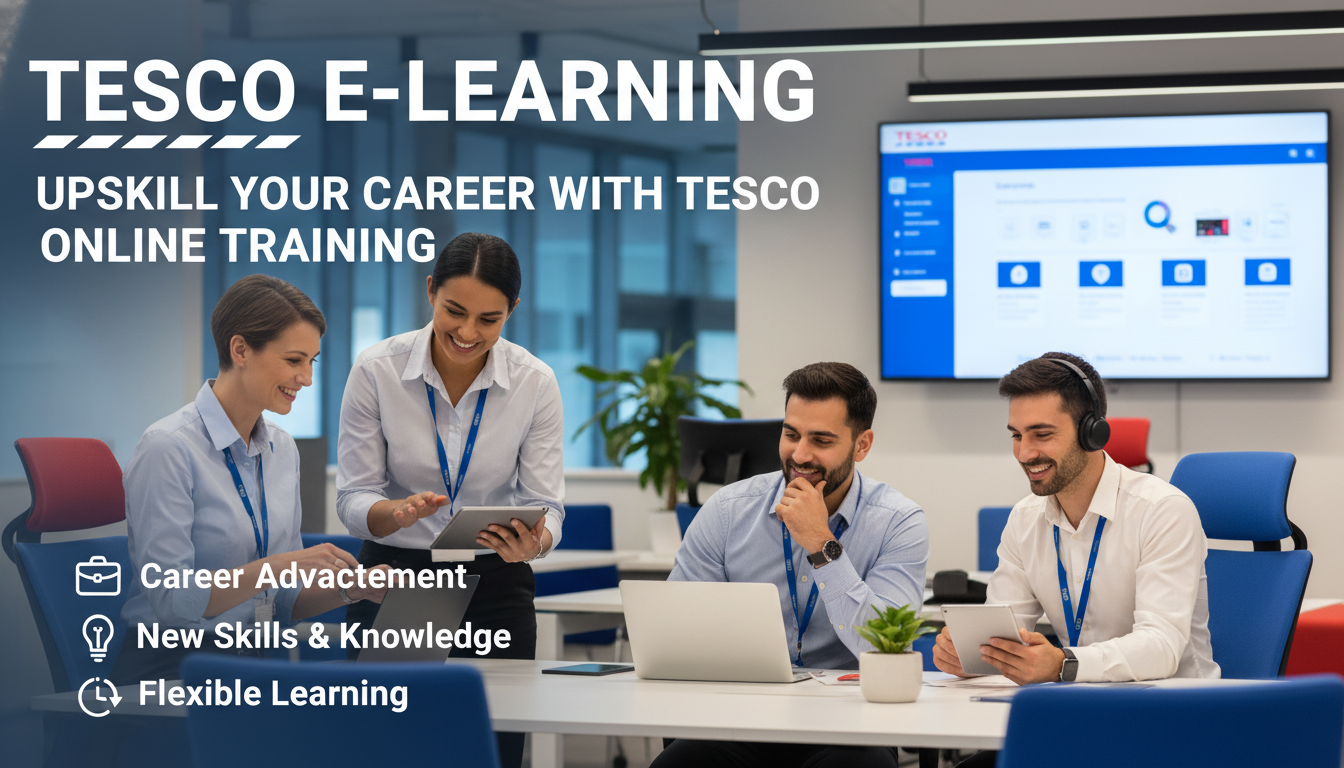
When Tesco Academy needed to modernize training for hundreds of thousands of employees across multiple countries, the challenge wasn’t just technological—it was cultural. From personal observation working alongside L&D teams in large retail organizations, I’ve seen how enterprise learning initiatives can falter when they disconnect from daily workflows. Tesco’s approach offers a revealing case study in what happens when a company commits to rebuilding learning infrastructure from the ground up.
This article examines Tesco’s e‑learning transformation—tracking their partnerships with Totara Learn, Sponge, and Elucidat, their use of Tableau analytics, and how they’ve reshaped both compliance and skills development. We explore what this means for employee development at scale, while acknowledging the persistent friction points that remind us technology alone doesn’t solve human problems.
Effective e‑Learning Strategy with Totara Learn
Tesco Academy elevated its global training efforts by adopting Totara Learn, a customizable, open‑source learning management system. According to Totara’s case study documentation and industry reporting, the platform supported over 400,000 employees worldwide while reportedly trimming over £1 million annually in licensing fees through its open-source architecture. The platform enabled bespoke page templates, structured learning paths, online course booking, wait‑listing, and more intuitive dashboards.
For a fast‑moving retail giant, the scalability proved essential. Employees in different markets, roles, and levels—from store assistants in Leicester to team leaders in Warsaw—could access consistent learning resources efficiently.
Real‑World Transformation
Totara represented a significant departure from earlier moodle‑based training portals. According to Totara’s published client outcomes, the transition to an enterprise‑grade system improved user adoption rates substantially. This shift helped embed learning into organizational culture rather than treating it as supplementary.
Compliance Learning Reinvented with Sponge
Tesco’s compliance content previously suffered from low completion rates and minimal behavior change—a common challenge I observe in retail sector training programs. To address this, Tesco partnered with Sponge to launch “Learning Leap,” a narrative‑driven, story‑based compliance campaign featuring bite‑sized content, gamified leaderboards, branded emails, and micro‑learning follow‑ups called “Putting into Practice” (PiPs).
According to Sponge’s published case study on Tesco, the initiative achieved a 98% completion rate within four weeks and reportedly 92% of learners preferred the new format over previous approaches. These figures align with industry research from the Association for Talent Development showing that microlearning and narrative-based approaches consistently outperform traditional compliance modules.
Micro‑Learning Evolution
Building on this success, Sponge and Tesco introduced “Little Learning Leaps”—microlearning delivered in the flow of work via the Spark LMS. This approach enhanced tracking capabilities: completion metrics, behavior trends, and knowledge gaps became more transparent. The shift transformed compliance from a box‑ticking exercise into continuous conversation.
Speed and Scale with Elucidat
While narrative content proved engaging, rapid production remained challenging. Tesco deployed Elucidat’s authoring platform, enabling around 37 authors to create content with minimal training. According to Elucidat’s published Tesco case study, module creation time decreased by approximately 75%, reducing timelines from months to days or weeks. This acceleration enabled faster rollout of training across compliance, leadership, products, and assessments.
Scalability Matters
The platform’s ease of use facilitated significant scaling—Tesco expanded to over 400 authors, enabling agile, responsive learning creation. This internal capability transformation shifted training development from a bottleneck to a strategic asset.
Data‑Driven Insights Using Tableau
Training effectiveness requires feedback loops and continuous improvement. Tesco implemented Tableau analytics, converting spreadsheets and forms into actionable dashboards. According to Tesco’s published technology partnerships and industry reporting, this reduced reliance on manual reporting processes. The shift enabled training teams to focus on content improvement rather than data compilation.
Analytics integration allowed Tesco to identify friction points—comments about training room conditions, system access issues—and address them systematically rather than waiting for problems to escalate.
Human Elements & Real‑World Glitches
Despite technological advances, implementation challenges persist. Employee feedback collected through internal channels and public forums reveals common frustrations: login difficulties, insufficient in-person support, and training assigned without clear context. These friction points illustrate a fundamental truth I see repeatedly in digital transformation efforts: technology implementation and human adoption rarely proceed at identical rates.
Understaffed stores juggling training requirements, password reset failures, and inconsistent communication from trainers represent organizational friction rather than system failures. Addressing these requires empathy, local support structures, and strategic in-person interventions.
Conclusion
Tesco’s e‑learning journey demonstrates transformation from static, disengaged training to interactive, data‑rich, micro‑learning experiences at global scale. Totara provided structure and cost efficiency; Sponge reimagined compliance engagement; Elucidat enabled rapid content creation; Tableau turned learning into actionable insight. Yet challenges remain—employees continue struggling with access issues or feeling disconnected from digital requirements.
The lesson extends beyond Tesco: successful digital learning transformation depends not just on system selection, but on how technology integrates with human behavior, local support structures, and organizational culture.
FAQs
Q: What LMS does Tesco use for global learning?
Tesco Academy employs Totara Learn, an open-source LMS that, according to Totara’s published case studies, provides scalable training across large workforces internationally.
Q: How has Tesco improved compliance training?
Through Sponge’s “Learning Leap” and “Little Learning Leaps,” Tesco shifted to narrative-style, microlearning modules delivered in workflows. According to Sponge’s published outcomes, completion and engagement rates improved substantially.
Q: How does Tesco speed up e-learning creation?
Using Elucidat, Tesco expanded authoring capacity to hundreds of creators. According to Elucidat’s published case study, development timelines decreased significantly.
Q: How does Tesco measure learning success?
Tableau dashboards enable Tesco to visualize learning impact, connect training to performance metrics, identify issues, and automate reporting.
Q: Are there challenges despite digital systems?
Yes—employees still face login issues, limited in-person support, and unclear instructions. Digital transformation requires addressing human friction alongside system implementation.
Q: What’s next for Tesco’s e-learning strategy?
Continued focus on local coaching, accessibility improvements, and feedback integration to ensure training remains relevant to everyday work.
