
 February 7, 2026
  5 Min
5 Min  No Comment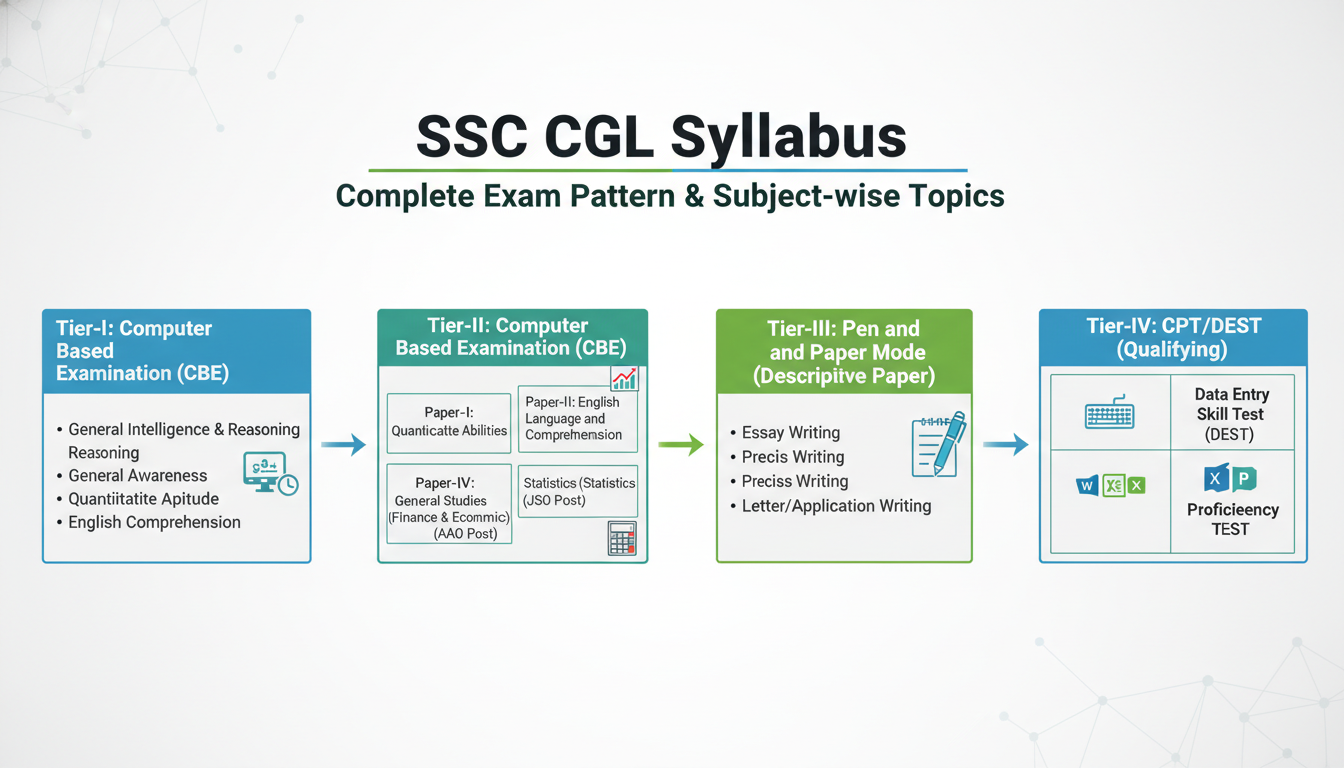
The SSC CGL (Combined Graduate Level) 2025 remains one of the most competitive government recruitment exams in India—offering a gateway to Group B and C posts across ministries and departments. Staying human-ish here, let’s chat. You’ve probably felt the syllabus info scattered, tough to pin down—totally relatable. So, this piece tries to stitch together the pattern, tier-wise breakdown, and must-know topics into one semi-coherent roadmap, as one does when juggling dozens of tabs in preparation frenzy.
Understanding the SSC CGL 2025 Exam Structure
Exam Tiers and Progression
There are two main hurdles in this journey:
- Tier I (Preliminary): A screening stage, purely qualifying. You need to clear it to move forward. Marks remain relevant only for cut-offs, not merit.
- Tier II (Mains): The final battleground. It evaluates your real skills across multiple disciplines—and determines if you get a post.
That’s the anatomy. Keep it in mind as we go into patterns and topics.
Tier I: Breaking Down the Preliminary Exam Pattern
Quick Snapshot of Format
Four sections, one hour total, 100 questions equal 200 marks:
- General Intelligence & Reasoning — 25 questions, 50 marks
- Quantitative Aptitude — 25 questions, 50 marks
- English Comprehension — 25 questions, 50 marks
- General Awareness — 25 questions, 50 marks
Negative marking applies—usually 0.50 marks per wrong answer.
What Topics Should You Watch Out For?
Understanding key topics helps you focus.
General Intelligence & Reasoning often includes:
– Analogies
– Coding-Decoding
– Number Series
– Syllogism, Visual puzzles, Direction sense, Embedded figures
Quantitative Aptitude typically covers:
– Number systems, Profit & Loss, Time & Work, Ratio & Proportion
– Geometry (Mensuration), Trigonometry, DI (Bar chart, Pie chart)
English Comprehension includes:
– Vocabulary, Grammar, Error spotting, Synonyms/Antonyms
– One-word substitution, Active/Passive voice, Cloze tests, Reading comprehension
General Awareness spans:
– Indian History, Culture, Geography
– Polity, Economic Scene, Current Affairs, Science, Books & Authors, Important Days
Chapter-Wise Weightage (Approximate)
Based on past Tier-1 trends (2024 analysis), focus should tilt toward:
– Geometry (~4 questions per shift)
– Data Interpretation (~4)
– Trigonometry (~2–3)
– Profit & Loss (~2)
This isn’t exact, but good to orient around.
Tier II: Digging Into the Mains Exam Pattern & Topics
Paper I – Compulsory for All
We structure it as follows:
| Section | Questions | Marks | Time |
|———————————-|———–|——-|—————|
| Mathematical Abilities | 30 | 90 | ~1 hour |
| Reasoning & General Intelligence | 30 | 90 | combined |
| English Language & Comprehension | 45 | 135 | ~1 hour |
| General Awareness | 25 | 75 | — |
| Computer Knowledge Test | 20 | 60 | 15 minutes |
| Data Entry Speed Test (DEST) | Qualifying | — | 15 minutes |
Paper II – Only for JSO or Statistical Investigator Applicants
- Statistics: 100 questions, 200 marks, 2 hours
That’s your Tier II schematic. NEXT up: topic drill-down.
Paper I: Subject-Wise Insights
Mathematical Abilities & Reasoning
Math topics include those from Tier I with added complexity:
– Advanced geometry (3D shapes), trigonometric identities, equations, lines/angles
Reasoning may stretch into:
– Venn diagrams, classification, critical thinking, symbol analogies
English & Comprehension
Almost parallel to Tier I—but with longer passages, more inference; mix of comprehension and grammar.
General Awareness
Broader: Economic policies, science developments, general policy, historical events—similar themes, greater depth.
Computer Knowledge & DEST
Basic computer operations (OS, MS Office, internet, cybersecurity basics, email, networking protocols), and practical typing/data entry speed.
Paper II: Statistics Topics
For those applying to statistical posts, this includes:
– Data tabulation, presentation, central tendency, dispersion, correlation, regression
– Probability, distributions, sampling, time series, ANOVA, inference, index numbers
Real-World Examples & Trends
It seems geometry and data interpretation remain trustable banking spots for scoring, while IAS aspirants often note that GK and GA portions can skew tricky with surprise current affairs. As one aspirant noted on Reddit:
“In maths, I don’t think they will ask Statistics and probability… but still to be on safer side, make sure you cover these topics. Mensuration (3D), Algebra and Trigonometry good questions.”
A peer-shared 10-week prep plan points to smart batching:
Master basics and revise formulas daily… Weeks 5–6 focus on Trigonometry, Mensuration (2D & 3D basics). Work in phases, use mocks later.
These reflect grounded advice—pragmatic, adaptable, with human imperfections.
Conclusion
To wrap it up:
- Tier I is fast-paced, four subjects, 60 minutes, high fluency required.
- Tier II is broader—adds computer aptitude, speed tasks, plus optional statistics if eligible.
- Think geometrical topics, data practice, vocabulary, current affairs and basic computer usage as your core.
- Strategy matters: plan, revise, practice, adjust—and yes, include buffer for mental fatigue.
Stick to this format, mix mocks, track weak spots, and you’ll sail better than guesswork alone. Best of luck—sincerely root for your success.
FAQs
Q: How many tiers are there in SSC CGL 2025?
There are two main stages: Tier I (preliminary screening) and Tier II (mains), with Tier II splitting into a compulsory Paper I and an optional Paper II for statistical roles.
Q: Does Tier I score count toward final selection?
No—Tier I acts as a qualifier. The real merit is decided based on Tier II performance.
Q: What are the most high-yield topics in Tier I math?
Geometry, Data Interpretation, Trigonometry, and Profit & Loss tend to appear frequently. Other arithmetic fundamentals like percentages and ratio also matter.
Q: What’s included in the Computer Knowledge section of Tier II?
Expect questions on basic hardware, OS, MS Office, internet/email usage, cybersecurity threats, networking essentials, and shortcuts.
Q: Who needs to prepare for the Statistics paper in Tier II?
Only candidates applying for Junior Statistical Officer or Statistical Investigator Grade-II posts need to attempt Paper II—others skip this section.
Q: Is negative marking the same for both tiers?
Typically, Tier I deducts 0.50 for wrong answers. Tier II may vary slightly in deduction patterns depending on the section, so check notifications—but aim for accuracy across the board.
