

 March 19, 2026
  12 Min
  No Comment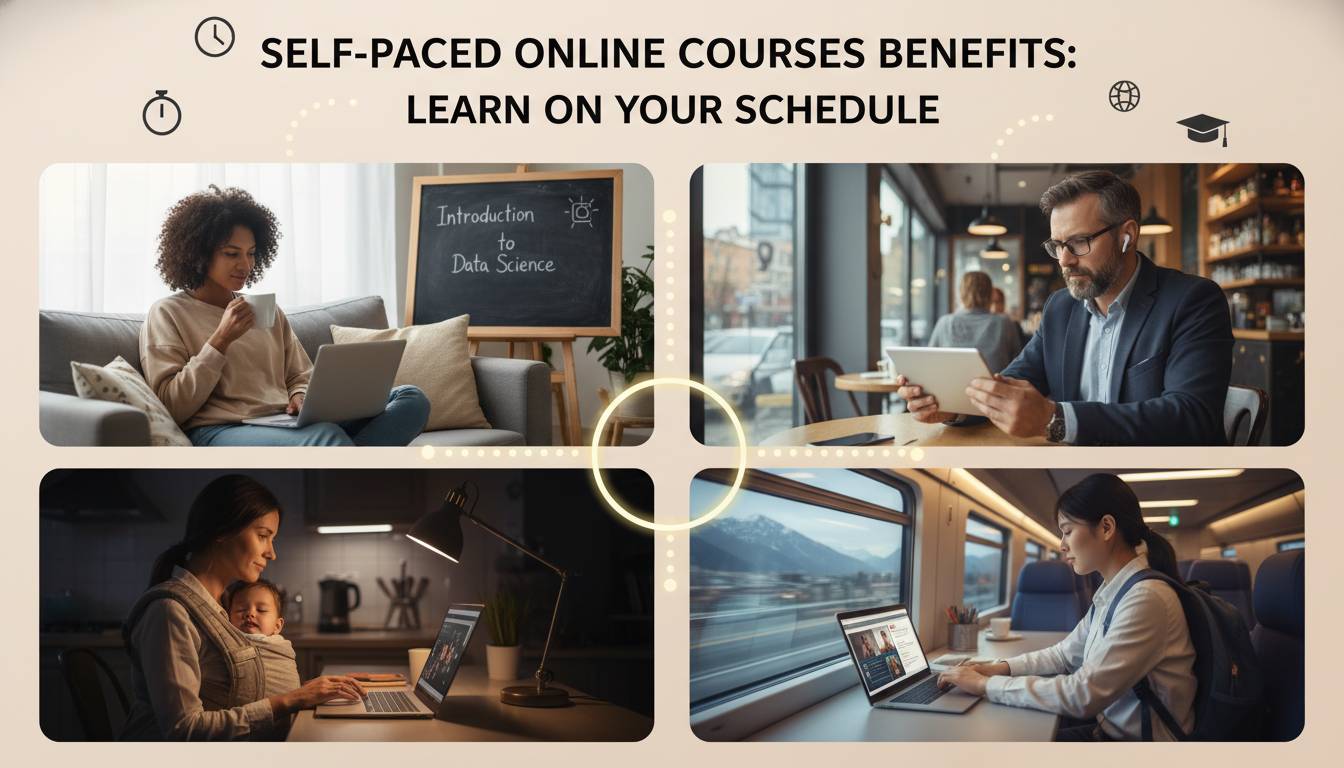
The global e-learning market reached $250 billion in 2022 and continues growing at 14% annually, driven largely by learners seeking flexibility that traditional education cannot provide. Self-paced online courses have emerged as the dominant format for professionals, students, and lifelong learners who need to acquire new skills without sacrificing work or family commitments. Unlike scheduled cohort-based programs, self-paced courses empower learners to control when, where, and how quickly they consume content—creating a personalized educational experience that adapts to individual circumstances rather than forcing students to conform to rigid timelines.
This comprehensive guide explores the multifaceted benefits of self-paced online learning, examining how this educational model transforms skill acquisition, career development, and personal growth while addressing common challenges learners face and strategies to maximize success.
Understanding Self-Paced Learning: A New Educational Paradigm
Self-paced online courses represent a fundamental shift from teacher-centered to learner-centered education. In this model, course materials remain accessible 24/7, allowing students to progress through modules at their own speed—whether that means accelerating through familiar concepts or spending additional time on challenging topics. This contrasts sharply with traditional classroom settings and even synchronous online programs where the instructor sets the pace, often leaving some students behind while others feel held back.
The infrastructure supporting self-paced learning has matured significantly over the past decade. Modern learning management systems (LMS) now offer video lectures, interactive quizzes, downloadable resources, discussion forums, and progress tracking dashboards. Leading platforms like Coursera, Udemy, LinkedIn Learning, and edX have refined the self-paced model, incorporating adaptive learning technologies that adjust content difficulty based on learner performance. Research from the Online Learning Consortium indicates that self-paced courses consistently achieve completion rates 15-20% higher than time-bound alternatives when learners have clear milestones and autonomy over their schedule.
The psychological foundation underlying self-paced learning rests on self-determination theory, which identifies autonomy, competence, and relatedness as essential drivers of motivation. When learners control their pace, they experience greater ownership of the educational process, leading to improved engagement and information retention. A 2021 study published in the Journal of Educational Psychology found that students in self-paced mathematics courses demonstrated 23% better long-term retention compared to traditionally-paced counterparts, primarily because they could revisit difficult concepts before moving forward.
Financial Advantages: Quality Education Without Breaking the Bank
The cost structure of self-paced online courses delivers substantial savings compared to traditional degree programs and even live online bootcamps. While a typical master’s degree costs $30,000-$120,000, comprehensive self-paced certificate programs from reputable institutions often range from $100-$2,000. This dramatic cost differential democratizes access to high-quality instruction from world-class instructors and universities that previously would have been financially inaccessible to many learners.
Beyond direct tuition costs, self-paced learning eliminates numerous indirect expenses that accumulate in traditional educational formats. Students save on transportation costs, which average $2,000-$4,000 annually for commuters, as well as expenses related to campus parking, meals purchased away from home, and childcare during class time. The flexibility to learn during existing free moments—during commutes, lunch breaks, or after children bedtime—transforms previously unproductive hours into educational opportunities without additional opportunity costs.
For employers, self-paced professional development programs offer ROI advantages that justify investment in employee learning. Companies report saving 40-60% on training costs by switching to self-paced online modules while achieving equivalent or superior skill acquisition outcomes. A 2023 LinkedIn Workplace Learning Report found that 94% of L&D professionals believe self-paced learning is either as effective or more effective than instructor-led training for technical skill development, with the added benefits of scalability and consistency across distributed workforces.
Flexibility and Time Freedom: Learning Fits Your Life
The defining characteristic of self-paced online courses—the ability to learn on your own schedule—addresses the most common barrier to continuing education: time constraints. Working professionals, parents, caregivers, and anyone managing multiple responsibilities find that self-paced courses accommodate their lives rather than demanding life accommodate the course. A parent returning to the workforce can study during infant nap times. A healthcare worker can complete modules between shifts. A small business owner can progress through a marketing course during slow periods—without missing live sessions or falling behind peers.
This flexibility extends beyond mere scheduling convenience to accommodate individual chronobiology and peak cognitive performance periods. Research in cognitive science demonstrates significant variation in optimal learning times among individuals—some concentrate best in early morning while others perform cognitively better in evening hours. Self-paced courses allow learners to align study sessions with their personal peak performance windows, enhancing comprehension and retention. Night owls can access content at 2 AM; early risers can begin at 5 AM—neither format penalizes those whose natural rhythms differ from conventional class schedules.
The geographical flexibility inherent in online learning adds another dimension of convenience. Learners access course materials from anywhere with internet connectivity, eliminating the need to relocate or commute to attend physical classes. This proves particularly valuable for individuals in rural areas, those with mobility limitations, or anyone living far from institutions offering relevant programs. The barrier of distance that historically limited educational options has effectively dissolved for self-paced online learners.
Personalized Learning Experience: Your Pace, Your Path
Self-paced education enables true personalization that rigid curricula cannot provide. Every learner enters a course with unique prior knowledge, learning preferences, and specific goals. Traditional classroom settings force all students through identical content at identical speeds—inevitably creating boredom for some and confusion for others. Self-paced courses solve this mismatch by allowing learners to accelerate through familiar material and linger on genuinely challenging concepts.
This customized approach proves especially valuable in technical fields where prerequisite knowledge varies widely among learners. A software developer with years of experience can skip introductory programming modules and focus on advanced architectural patterns. A beginner starting from zero can build foundational knowledge systematically without feeling lost in advanced discussions. The same course effectively serves both learners by letting each navigate their optimal path.
Modern self-paced platforms increasingly incorporate adaptive learning technologies that further personalize the experience. These systems analyze learner performance on quizzes and assessments to recommend specific modules, adjust difficulty levels, and identify knowledge gaps requiring additional attention. While not replacing human instruction entirely, these technologies extend personalization capabilities beyond what any single instructor could provide to a classroom of students.
The ability to replay, pause, and review content represents another powerful personalization feature. In traditional lectures, complex explanations occur once—miss them and you either accept the gap or seek additional help. Self-paced video content allows learners to pause and process difficult concepts, rewind and rewatch explanations, and review material multiple times until understanding solidifies. This反复 learning approach aligns with cognitive science research demonstrating that distributed practice and repeated exposure significantly improve long-term retention.
Career Advancement and Skill Development
The rapid pace of technological change has compressed skill half-lives across industries, making continuous learning essential for career sustainability. Professionals who fail to update their competencies risk obsolescence as employers adopt new tools, processes, and methodologies. Self-paced online courses provide the most practical pathway for working professionals to acquire in-demand skills without quitting their jobs or interrupting career momentum.
Industry recognition of online credentials has strengthened considerably, particularly from major platforms partnering with employers to develop relevant curricula. Certificates from Google, Amazon Web Services, Meta, IBM, and similar technology leaders signal genuine competency to hiring managers. LinkedIn’s research indicates that 76% of hiring managers consider online certifications valuable when evaluating candidates, with some roles prioritizing demonstrated skill completion over traditional credentials.
The breadth of available subjects enables career pivots that would otherwise require expensive retraining programs. Someone working in marketing can complete data analytics courses to transition into analytics roles. A teacher can learn instructional design to move into corporate training. A sales professional can develop technical product management skills. Self-paced courses lower the barrier to cross-industry movement by providing accessible pathways to new competencies.
Professional development through self-paced learning also supports career advancement within current organizations. Employees who proactively develop skills signal initiative and growth potential to supervisors. Internal mobility data from multiple Fortune 500 companies shows that workers who complete relevant online certifications are 30% more likely to receive promotions than comparable peers who do not invest in continuous learning.
Overcoming Common Challenges in Self-Paced Learning
While self-paced online courses offer tremendous benefits, honest acknowledgment of their challenges enables prospective learners to prepare effectively. The primary obstacle for most students involves motivation and self-discipline. Without external deadlines or cohort accountability, procrastination can derail even the most well-intentioned learners. Research consistently shows that approximately 85% of MOOC (Massive Open Online Course) participants never complete their enrolled courses, with lack of self-regulation identified as the primary cause.
Successful self-paced learners develop strategies to address this motivation gap. Setting specific weekly goals, creating dedicated study schedules, and establishing accountability mechanisms—whether through study groups, mentors, or public commitments—substantially improve completion rates. Many platforms now offer optional deadline structures and reminder systems that provide scaffolding for learners who want flexibility but benefit from gentle external structure.
Another challenge involves the absence of immediate feedback and the potential for knowledge gaps to accumulate unnoticed. In traditional classrooms, instructors observe confusion and provide real-time clarification. Self-paced learners must develop self-assessment skills and proactively identify areas requiring additional attention. Engaging with discussion forums, completing all practice exercises, and testing knowledge through self-administered quizzes helps learners gauge their understanding before moving forward.
Technical barriers, while diminishing, still affect some learners. Reliable internet access remains essential for video-heavy courses, and some participants struggle with the digital literacy required to navigate learning platforms effectively. Most platforms now offer mobile applications with offline download capabilities, addressing connectivity limitations for learners in areas with inconsistent service.
Maximizing Your Self-Paced Learning Success
Approaching self-paced courses with effective strategies dramatically improves outcomes. Before beginning any course, clearly define your learning objectives and how the acquired skills will serve your goals. This purpose clarity sustains motivation through difficult moments and helps you prioritize content aligned with your objectives over optional supplementary material.
Time blocking—scheduling specific periods for learning and treating these appointments as non-negotiable—proves more effective than hoping to find time opportunistically. Research on intention implementation suggests that pre-commitment to specific study times doubles the likelihood of follow-through compared to unstructured intentions. Even 15-30 minute focused sessions, consistently applied, accumulate to substantial progress over weeks and months.
Active learning techniques significantly enhance retention compared to passive video consumption. Taking notes, summarizing concepts in your own words, teaching material to others, and applying learned skills through projects transforms information into usable knowledge. The Feynman Technique—explaining concepts simply as if teaching someone else—reveals gaps in understanding that passive review would miss.
Finally, leverage community resources that successful self-paced learners engage with regularly. Discussion forums connect learners facing similar challenges. Study groups provide accountability and collaborative learning benefits. Office hours, when available, offer direct access to instructor expertise. These social elements transform what could be isolating learning experiences into connected communities supporting mutual growth.
Frequently Asked Questions
How do self-paced courses compare to live online courses in terms of learning outcomes?
Research indicates that well-designed self-paced courses often achieve equivalent or superior learning outcomes compared to live synchronous courses. A meta-analysis published in the Review of Educational Research found no significant difference in student performance between self-paced and instructor-led formats, with self-paced learners sometimes outperforming due to ability to review material and learn during optimal personal hours. The key factor is course design quality rather than delivery format.
Are self-paced online course certificates valued by employers?
Employer acceptance of online course certificates has grown substantially, particularly for certificates from recognized platforms and industry partners. Certificates from Google, AWS, Meta, and similar major companies carry significant weight. However, value varies by industry and specific role—technical certifications in cloud computing, data science, and digital marketing are widely recognized, while academic-field certificates may carry less weight than traditional degrees in some sectors.
How long does it typically take to complete a self-paced course?
Completion time varies dramatically based on course depth, learner prior knowledge, and available time commitment. A foundational course might require 10-20 hours total, while comprehensive certificate programs requiring 40-100+ hours span several months. Self-paced flexibility means some learners complete courses in days while others take months—there’s no enforced timeline forcing acceleration or causing stress.
Can I really learn complex technical skills through self-paced courses?
Yes, thousands of professionals have successfully transitioned into technical roles through self-paced learning. Platforms like freeCodeCamp, Udemy, and Coursera have produced numerous graduates who secured software engineering, data science, and cybersecurity positions. Success requires dedication, structured learning paths, and building portfolio projects demonstrating competency—but the educational content quality matches what traditional programs provide.
What happens if I struggle with course content in a self-paced format?
Self-paced courses actually provide superior support for struggling learners compared to time-constrained formats. You can pause, rewind, and rewatch explanations as many times as needed. Most platforms offer discussion forums where you can ask questions, and many courses include supplementary resources explaining concepts from different angles. The lack of pressure to keep pace with others allows you to thoroughly master each topic before progressing.
How do I stay motivated when learning alone without classmates or deadlines?
Successful self-paced learners employ various motivation strategies: setting personal deadlines, joining online study communities, tracking progress visually, rewarding milestone achievements, and maintaining focus on their ultimate goal. Many platforms now offer optional “deadline mode” features that add structure for learners who want accountability. Connecting your learning to concrete career or personal objectives provides intrinsic motivation that sustains effort over time.