
 February 7, 2026
  7 Min
7 Min  No Comment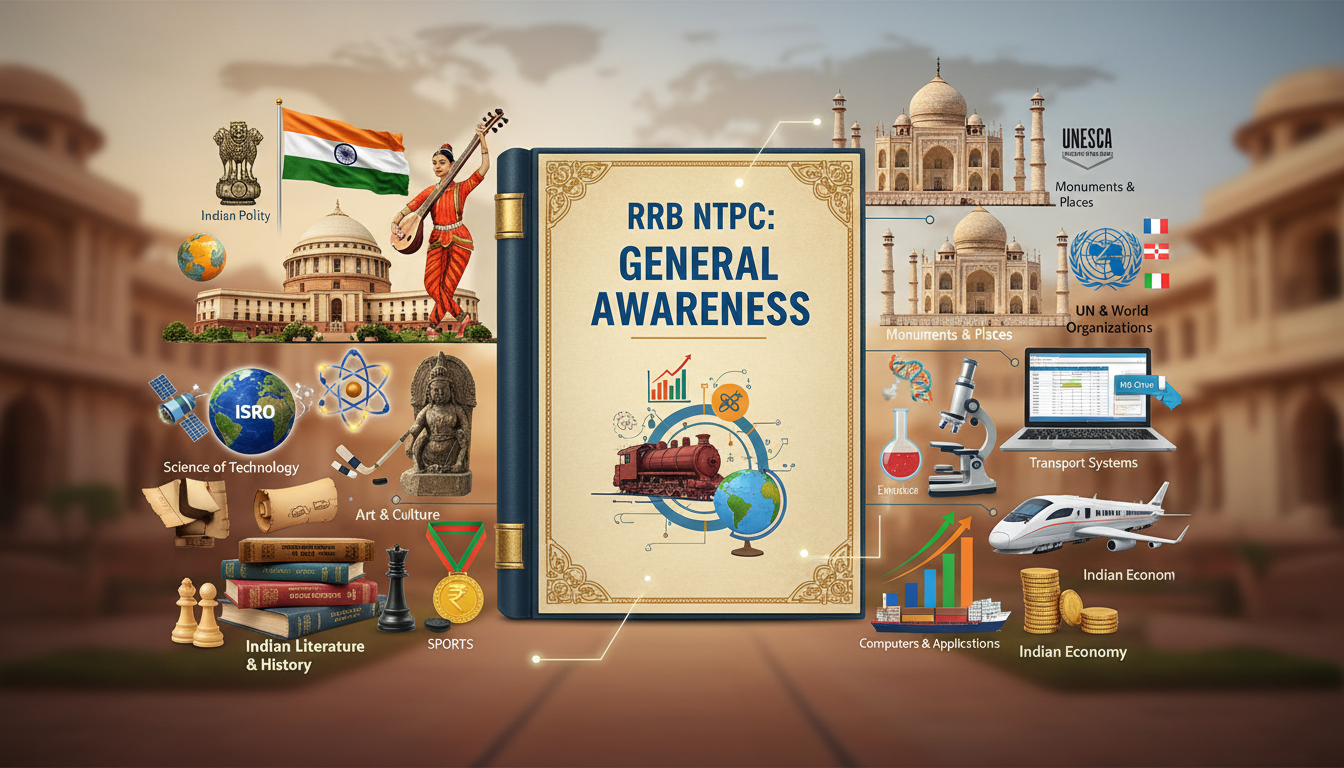
Understanding the RRB NTPC Syllabus is like stepping into a familiar but slightly mysterious territory—where the vast landscape of subjects meets the twisty paths of exam patterns. Most candidates approach it with a mix of anticipation and confusion, wondering, “Where do I start?” or “Which topics carry more weight?” Especially because the Indian railway exam is known to pull you in every direction—quant, reasoning, general awareness… you name it. Let’s unravel it step by step, while keeping things human (imperfectly polished, perhaps, but honest).
RRB NTPC Overview and Exam Structure
Diving into the Railway Recruitment Board (RRB) NTPC (Non-Technical Popular Categories) scheme, the structure is divided into two broad stages:
Phase 1: CBT (Computer Based Test) Stage-I
This stage typically carries a total of around 100 marks, and it’s usually broken down into three general areas:
– General Awareness (GA)
– Mathematical Ability
– Reasoning and General Intelligence
The flow is usually something like quant here, GA there, and reasoning scattered in between—which sometimes throws people off balance, especially novices.
Phase 2: CBT Stage-II
This second round, again of 100 marks, reinforces similar pillars, but it’s often tougher—questions might be trickier or more analytically demanding. Subjects remain largely the same, but the difficulty ramps up, preparing, as it were, for whatever the final selection test might present.
Subject-Wise Breakdown
General Awareness: Beyond the Basics
This section is usually the wild card—covering current affairs, Indian geography, history, polity, economy, science, and sometimes even sports and culture. In practice, GA can surprise you more than math sometimes; guess why? Because it’s so unpredictable.
- History typically includes broad themes like the independence movement and modern India, but sometimes throws curveballs like obscure princely states or lesser-known art movements.
- Polity and governance cover Indian Constitution frameworks, fundamental rights, and roles of institutions like the RBI or Election Commission.
- Economy focuses on major schemes, budget highlights, and basic concepts like inflation or GDP growth—though it’s always helpful to think in general terms rather than rote numbers.
Mathematical Ability: Core is King
Expect arithmetic (percentage, ratio, time & work, time & distance), algebra, geometry basics, number systems, and data interpretation. But don’t let that sound too bland—some questions can be sneaky with multi-step reasoning, so practicing under pressure helps.
Tips for Math prep:
- Prioritize accuracy over speed early on; it’s easier to build speed once accuracy’s in place.
- Use shortcut strategies in time-bound mock scenarios.
- Incorporate rough work even when reviewing—to visualize steps.
Reasoning and General Intelligence: The Puzzle Playground
This part tests pattern recognition, critical thinking, and ability to decode sequences or relationships.
Subtopics include:
– Coding-decoding, analogies
– Direction sense, blood relations
– Syllogisms, statements and conclusions
– Series and pattern series
On any given day, railways might twist your logic with a brainteaser like “Which statement follows?” or an unseen pattern—so adaptability is your armor.
Strategic Study Flow
1. Mapping Your Weak Spots
Start with a full-length mock test. Be honest. Which section tanks your score—GA, math, or reasoning? Own that and plan accordingly, because—for instance—many aspirants underestimate GA till D-day, but it’s often a deal-breaker.
2. Structured Study Blocks
Break your prep into chunks:
– GA: daily reading of credible sources, maybe just 20–30 minutes. Rotate between current affairs, general science, polity.
– Math & DI: choose one topic per day (like ratio or geometry) and practice both easy and tricky problems.
– Reasoning: one sub-topic per session; start with simpler analogies, move to combined reasoning sets.
3. Interleaved Practice
Alternate subjects during a study session. For instance, after a GA reading, switch to reasoning for 20 minutes; then math. Keeps the brain from zoning out, and improves mental flexibility.
4. Timed Mocks and Analysis
Always simulate exam conditions: fixed time, minimal breaks. Post-test, deeply analyze—but don’t just look at what you got wrong; ask why. Was it a concept gap, misread, or careless slip? Fixing that pattern matters more than random corrections.
“Mastery in these railway exams doesn’t come from rote learning—it comes from understanding not just ‘what’ but ‘why.’ That insight helps anticipate patterns, not just respond to them.”
Real-World Example: Aman’s Preparation Journey
Consider Aman, a graduate with steady but not stellar marks. He struggled with GA but had a flair for reasoning.
He started by dedicating one hour daily to current affairs (reading summaries rather than long articles), then pivoted to solving logic puzzles. Over weeks, he switched priorities—when GA improved, he focused more on math accuracy. By interspersing timed full mocks between topic-specific practice, he tracked progress and adjusted weak areas dynamically. The result? His accuracy rose, and on test day, he breezed through sections he once dreaded.
Subject Weightage — Approximate Balance
Though exact percentages shift over different RRB releases, you can think in terms of:
– GA: roughly ~30–35%
– Mathematics: close to ~35–40%
– Reasoning: around ~25–30%
These aren’t rigid—some years Reasoning gets a heavier tilt. So always stay adaptable.
Overcoming Common Pitfalls
Overloading GA
Yes, GA’s vast—but trying to memorize every current affairs report doesn’t work long-term. Instead, focus on themes: major schemes, constitutional amendments, general science headlines. Recall patterns—like increased mentions of digital governance in recent years, or specific economic reforms.
Relying on Shortcuts Alone
Tricks help, but they can falter under twisty phrasing. Balancing shortcut use with conceptual depth ensures you don’t get tripped when a question’s disguised.
Ignoring Past Trends
Always glance through previous years’ papers. They’re not gospel, but they highlight repeated topics—like, say, coding-decoding frequently pairs with blood relations, or that Indian polity questions lean towards fundamental rights, not arcane constitutional articles.
Conclusion
In the grand expanse of the RRB NTPC syllabus, it’s not about mastering every nook but building depth in your weak zones while keeping flexibility in your strengths. Tailor your study blocks, interweave subjects, simulate real tests, and most importantly, reflect—why did that slip happen? Adjust. Over time, those small corrections compound into real growth.
FAQs
What are the main subjects in RRB NTPC syllabus?
The syllabus centers on three key sections: General Awareness, Mathematical Ability, and Reasoning & General Intelligence. Stage-I and Stage-II tests cover similar areas, though Stage-II typically demands deeper analytical skills.
How should I balance my preparation time among subjects?
Begin with a diagnostic mock to identify weaker sections. Separate study blocks—like dedicated daily GA reading or math practice—and then interleave subjects in sessions to boost adaptability and retention.
Are shortcut tricks reliable for exam preparation?
Shortcut strategies are useful for quick solves, but over-reliance can backfire if question wording is tricky. Blend tricks with conceptual understanding to handle diverse formats confidently.
How often should I take full-length mock tests?
Try a full mock test at least once a week once you’re mid-prep; earlier, perhaps then and now one every two weeks. Analyze not just mistakes but their causes—carelessness, concept gaps, time pressure—and course-correct.
Can general awareness be improved with minimal time?
Yes—focused reading on key current affairs, major schemes, and polity/economy headlines in short daily doses can steadily improve retention. It’s more about consistent themes than exhaustive coverage.
What’s the best way to analyze mock test errors?
After a mock, categorize errors: conceptual gaps, miscalculations, misreading, or time-induced mistakes. Then target those with specific drills—like revisiting basics, practicing under timed pressure, or careful reading exercises.
