

 February 9, 2026
  5 Min
5 Min  No Comment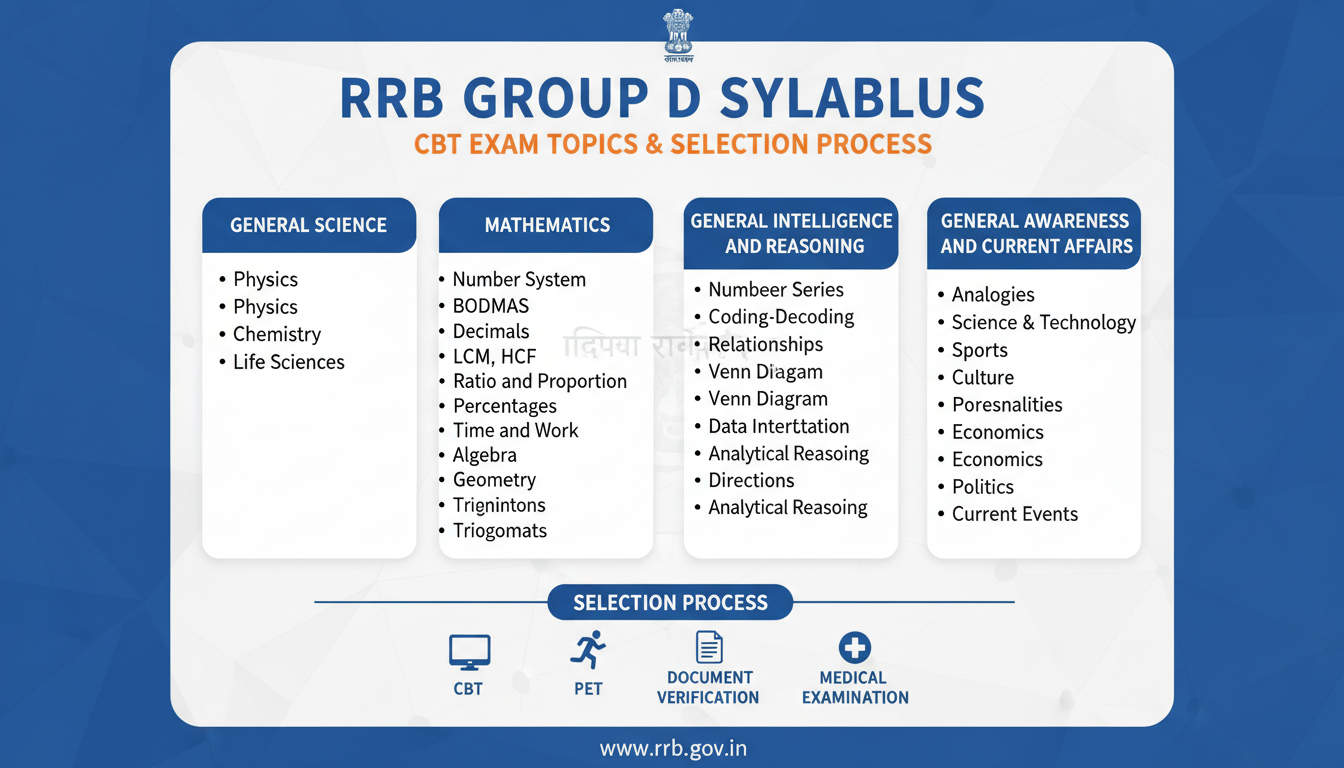
If you’re looking for the RRB Group D Syllabus 2025 PDF with CBT topics and the selection process—it’s all right here. The syllabus includes four subjects—Mathematics, General Intelligence & Reasoning, General Science, and General Awareness & Current Affairs—with 100 questions in 90 minutes, and a four-stage selection process.
What’s in the RRB Group D 2025 CBT?
The Computer-Based Test (CBT) is the first gateway in the RRB Group D recruitment journey. It’s designed to test basic proficiencies across several core areas. Here’s a breakdown of what to expect:
Exam Fundamentals
- Duration: 90 minutes (extended to 120 minutes for PwBD candidates with scribes) .
- Question count: 100 multiple-choice questions, each worth 1 mark .
- Negative marking: 1/3 mark deducted for every wrong answer .
- Sectional breakdown:
- General Science – 25 questions
- Mathematics – 25 questions
- General Intelligence & Reasoning – 30 questions
- General Awareness & Current Affairs – 20 questions .
Scoring threshold: Minimum qualifying marks differ by category—UR/EWS need roughly 40%, while OBC, SC, and ST need around 30%. PwBD candidates may get a slight relaxation if vacancies fall short .
What Topics Make the Cut?
Here’s a smart, subject-wise rundown for what’s actually important:
Mathematics Highlights
Includes core arithmetic and more:
– Number systems, fractions, decimals, LCM/HCF
– Ratio & proportion, percentages, average
– Speed, time & distance; time & work; pipes & cisterns
– Profit & loss; simple & compound interest
– Mensuration (2D/3D); elementary statistics
– Geometry, trigonometry, algebra basics, calendar & clock, BODMAS, age calculation .
Reasoning & Intelligence
Expect puzzles and logic tests like:
– Analogies, classification, series (number/alphabet)
– Coding-decoding, syllogisms, data interpretation
– Venn diagrams, direction sense, relationships
– Statement conclusions/arguments, puzzles, blood relations, seating arrangements .
General Science (10th-grade level)
Focuses on:
– Physics: motion, laws, energy, light, sound, electricity, heat, magnets
– Chemistry: matter, atoms, reactions, acids/bases/salts, periodic table, carbon compounds
– Biology: anatomy, reproduction, heredity, environment, ecosystems, cell basics .
General Awareness & Current Affairs
Encompasses both static and fresh topics:
– History, geography, Indian polity, economy, culture, art
– Indian and world affairs, current events (recent months), science & technology, sports, important personalities, government schemes, environment, awards, abbreviations .
High-weightage focus areas include percentages, time & work, puzzles, series, human body, energy, currents & modern GK trends .
The Full Selection Ladder: Beyond CBT
Passing CBT opens the door to these next steps:
- Physical Efficiency Test (PET)
Qualifying only (doesn’t add to score). - Men: Lift and carry 35 kg for 100 meters within 2 minutes; run 1000m in 4 minutes 15 seconds .
-
Women: Lift and carry 20 kg for 100 meters within 2 minutes; run 1000m in 5 minutes 40 seconds .
-
Document Verification (DV)
Submission of essential documents to verify eligibility. -
Medical Examination
Ensures physical fitness as per job requirements.
Successful navigation through these stages—CBT, PET, DV, and medical exam—completes the selection process .
Strategic Prep Tips
Here’s how to approach the study stage:
- Start with the syllabus. Break it down subject-wise and understand topic weightage.
- Prioritize high-yield items like percentages, coding-decoding, current affairs, basic science.
- Use mock tests and past papers to train accuracy and speed.
- Update yourself daily by reading news and following credible sources.
- Review basics repeatedly—a short daily revision helps more than cramming.
- Balance speed with caution—guessing costs you marks due to negative marking.
Human Tip: The Exam Journey Isn’t Perfectly Linear
You’re likely juggling life, work, and prep—here’s some honest advice:
– Set daily mini-goals, like finishing 20 reasoning puzzles or revising a math chapter.
– Make flashcards for GK, or use apps for quick revisions on the move.
– Study in short bursts—30–40 minutes, then take a break—helps retention.
– Practice simulated mock tests under timed conditions; this preps you mentally.
– Use mistakes as fuel: analyse weak spots, revisit them with fresh perspective.
Final Thoughts
The RRB Group D Syllabus 2025 PDF covers four main areas—Maths, Reasoning, Science, GK—packed into a 100-question, 90-minute CBT, followed by PET, document checks, and a medical exam. Smart planning, pacing yourself, and focusing on high-scoring topics offer the best way forward.
FAQs
What is the RRB Group D CBT structure?
It’s a 90-minute online test with 100 MCQs across Maths, Reasoning, General Science, and General Awareness. Each correct answer gives 1 mark; wrong answers carry a ⅓ mark deduction.
Which topics should I prioritise?
Go for percentages, time & work, puzzles, coding-decoding, current affairs (recent months), human body, motion, energy & GK areas.
What exactly is the selection process?
The stages are CBT → PET (qualifying physical test) → Document Verification → Medical Exam.
Are there minimum marks to pass CBT?
Yes. You need around 40% for UR/EWS and 30% for OBC/SC/ST, with possible PwBD relaxations if seats stay vacant.
What’s the PET criteria?
For men: lift 35 kg for 100m in 2 min + run 1000m in 4 min 15 sec. For women: lift 20 kg similarly + run 1000m in 5 min 40 sec.
How to prepare effectively?
Stick to the syllabus, target high-weightage areas, practice mocks under timed conditions, revise regularly, and track current events daily.
With focus, decent pace, and smart strategy, acing RRB Group D is well within reach.
