

 February 11, 2026
  6 Min
6 Min  No Comment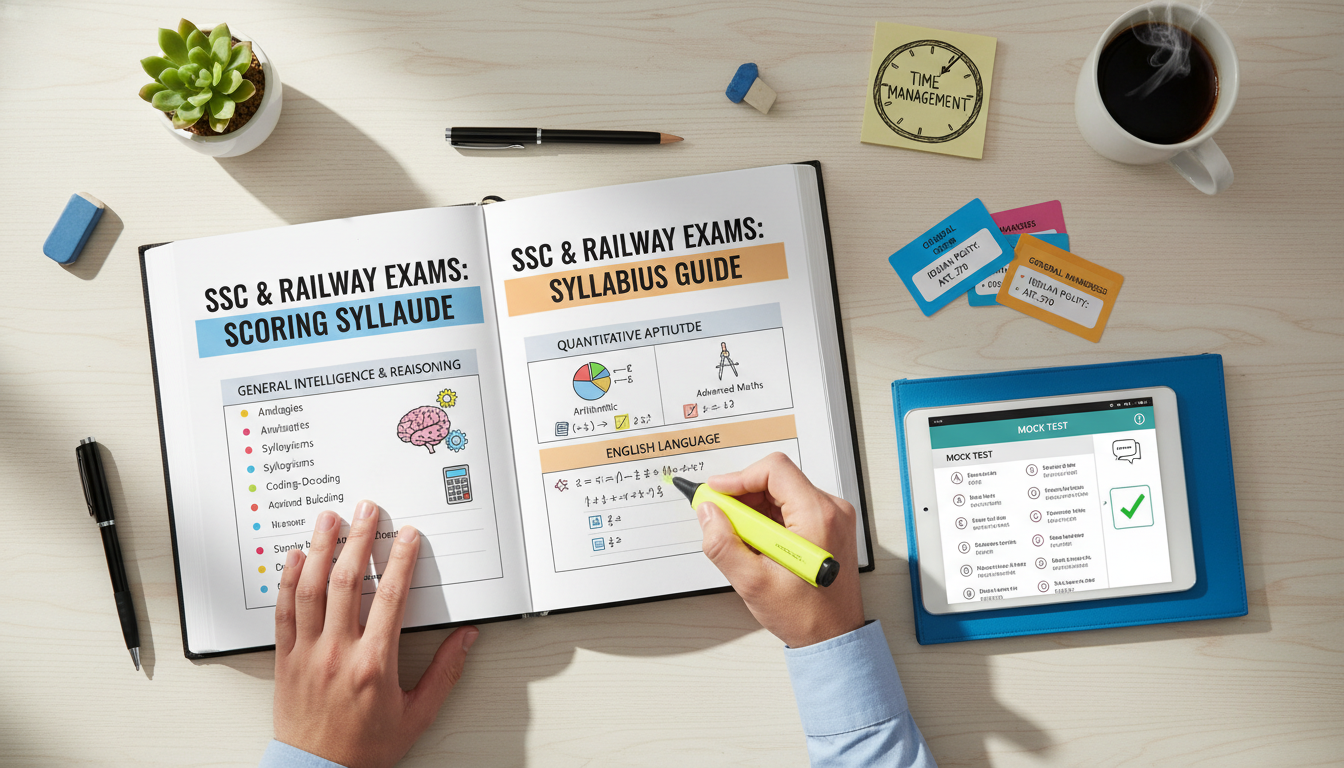
The Most Scoring Syllabus topics for SSC and Railway Exams 2025 include high-yield areas like Arithmetic problem-solving, English grammar and vocabulary, Railway-specific aptitude, General Awareness especially static GK, and Data Interpretation. Focus on mastering these will boost scoring potential quickly.
Diving right into it—let’s break down where you can squeeze in the maximum marks with strategic, deliberate focus. No fluff, just the good stuff.
Why These Topics Score More
In both SSC (Staff Selection Commission) and Railway exams, exam-makers also aim to distinguish top candidates efficiently. That means they give a bit more weight to topics that many can’t crack—so mastering them is a fast track to high marks.
Arithmetic topics—like percentages, ratios, time & work—carry numerous questions and are predictable. English sections often lean on grammar and vocabulary, which are straight rules and patterns. Railway-specific sections like speed and distance or trains are repeated year after year, so patterns emerge. And General Awareness is where rote-learning of static GK pays off.
This isn’t magic—it’s strategy.
High-Yield Sections for SSC & Railway Exams
Arithmetic & Quantitative Aptitude
This section is a gold mine. Think:
- Percentages, Averages, Ratio & Proportion
- Time & Work, Pipes & Cisterns
- Speed, Distance, and Trains
- Profit & Loss, Simple & Compound Interest
These chapters appear every year with similar question structures. Master a set of principles and problem templates, and you can solve them faster than most. Practice smartly: learn formulas, apply in timed settings, track time per question, and polish your mental math.
English Language: Grammar & Vocabulary
English frequently trips up aspirants because they overthink. But most questions test basic rules:
- Subject-verb agreement, Active–Passive voice, Error spotting
- Synonyms, Antonyms, Cloze Test
Concentrate on common grammar traps and high-frequency word pairs. A little regular reading—newspapers, articles—can build passive vocabulary surprisingly fast. Don’t sweat uncommon words beyond 12th-level vocabulary.
General Awareness – Static GK
Static General Knowledge is low on curveballs. Think national symbols, historical events, constitutional bodies. You don’t need breaking news—these are facts that rarely shift.
Commit them to memory. Use flashcards or quizzes. A basic hold on geography, Indian polity, awards, and basics of science makes a huge difference. It’s questions with straight answers—no heavy thinking.
Railway-Specific Aptitude: Trains & Operations
Railway exams often add questions on railway-related contexts—train timings, scheduling, time-table based problems. These are niche but predictable. Standard formulas and a few practice sets go a long way. Look for old exam papers—patterns repeat.
Reasoning & Data Interpretation
While these vary, certain sets consistently reappear. Visual puzzles, seating arrangements, tabular DI are often similar across years. Once you locate a good question bank, drill it regularly. Identify themes and patterns—then solve with confidence.
Strategy: Study Smarter, Not Harder
Step 1: Identify High-Weight Topics
List out the mini-syllabus per topic above. Note typical question counts from last year’s papers.
Step 2: Practice with Purpose
Focus practice on the topics already identified. Use timers and track accuracy. Question banks and mock tests are your friends.
Step 3: Review Weak Spots Quickly
When a mistake happens, it’s often a simple rule. Flag it, understand it, then skip ahead. You don’t need to over-study; just correct the habit.
Step 4: Repeat and Retain
Repetition is your ally here. Flashcards for rules and GK. Short daily drills for arithmetic principles. Regularly revisit them to lock them in.
What Being “Most Scoring” Really Means
It’s not just about topics. Being scoring means being efficient. Learn, practice, repeat.
- Know the trick questions—but don’t waste time on outliers.
- Cover high-frequency areas thoroughly.
- Know your own strengths and devote most time to areas that offer big returns.
“Consistent, focused practice on a few topics that recur every year can yield results you wouldn’t expect. It’s about precision, not volume.”
That’s the difference between cramming everything and mastering what matters.
Example: A Week’s Plan to Nail High-Yield Areas
| Day | Focus Area | Goal |
|———|—————————————–|——————————————-|
| Monday | Percentages & Averages | Solve 20 problems in 20 minutes |
| Tuesday | Grammar (Error Spotting, Agreement) | Nail 3 common grammar traps |
| Wednesday | Speed & Distance (Trains included) | Practice 15 time-distance equations |
| Thursday | Vocabulary (synonyms & antonyms) | Learn 20 new high-frequency words |
| Friday | Static GK (National symbols, Constitution) | Memorize 15 key facts |
| Saturday | Reasoning puzzle & DI table | Identify 2 patterns in arrangements |
| Sunday | Mock Test focused on these topics | Time it, review errors, repeat the week |
The idea is a daily bite—not overwhelm.
Bringing It All Together
When you zone in on arithmetic staples, avoid grammar overthinking, memorize static GK, and polish railway-specific patterns, you win more marks per hour. Sure, other topics matter—but let’s be real: they serve as support.
Focus on high-yield areas, practice them over and again. Use real past papers, simulated tests, and quick correction cycles. With that, you’ll be playing the game, not chasing it.
Conclusion
Most scoring syllabus areas—Arithmetic (especially percent, ratio, time/work), English grammar, Vocabulary, Static General Awareness, Railway-specific aptitude, Reasoning puzzles, and DI—give you the most bang for your buck in SSC and Railway Exams 2025. Target these wisely, practice with intent, and let efficiency drive your score higher.
Target the predictable, repeatable, and testable. Stay sharp, stay focused, and let every study minute count.
FAQs
Which sections give the highest marks in SSC and Railway exams?
High-yield sections are Arithmetic (like percentages, time & work), English grammar & vocabulary, Static GK, Railway aptitude (train-related problems), and Reasoning puzzles.
How much time should I spend on Arithmetic versus English?
Divide time based on weightage—but favor Arithmetic for its multiple questions and predictable pattern. Still, short daily grammar drills are helpful for consistent accuracy.
Is learning current affairs necessary for scoring?
Static GK outweighs current affairs in many SSC/Railway papers. So prioritize it, though a brief review of recent major events is useful.
Can mock tests help improve scoring potential?
Absolutely. Mock tests help identify speed, accuracy, and stubborn weak areas—especially in high-yield topics that often repeat patterns.
How often should I revise vocabulary and facts?
Daily flashcard sessions (even 10 minutes) can solidify vocabulary and GK. Short, spaced repetition really sticks.
Is strategic skipping allowed?
Yes. If a topic appears rarely or unpredictably, don’t dwell. Focus on high-return areas and skip low-yield content when time is tight.
