

 March 21, 2026
  7 Min
7 Min  No Comment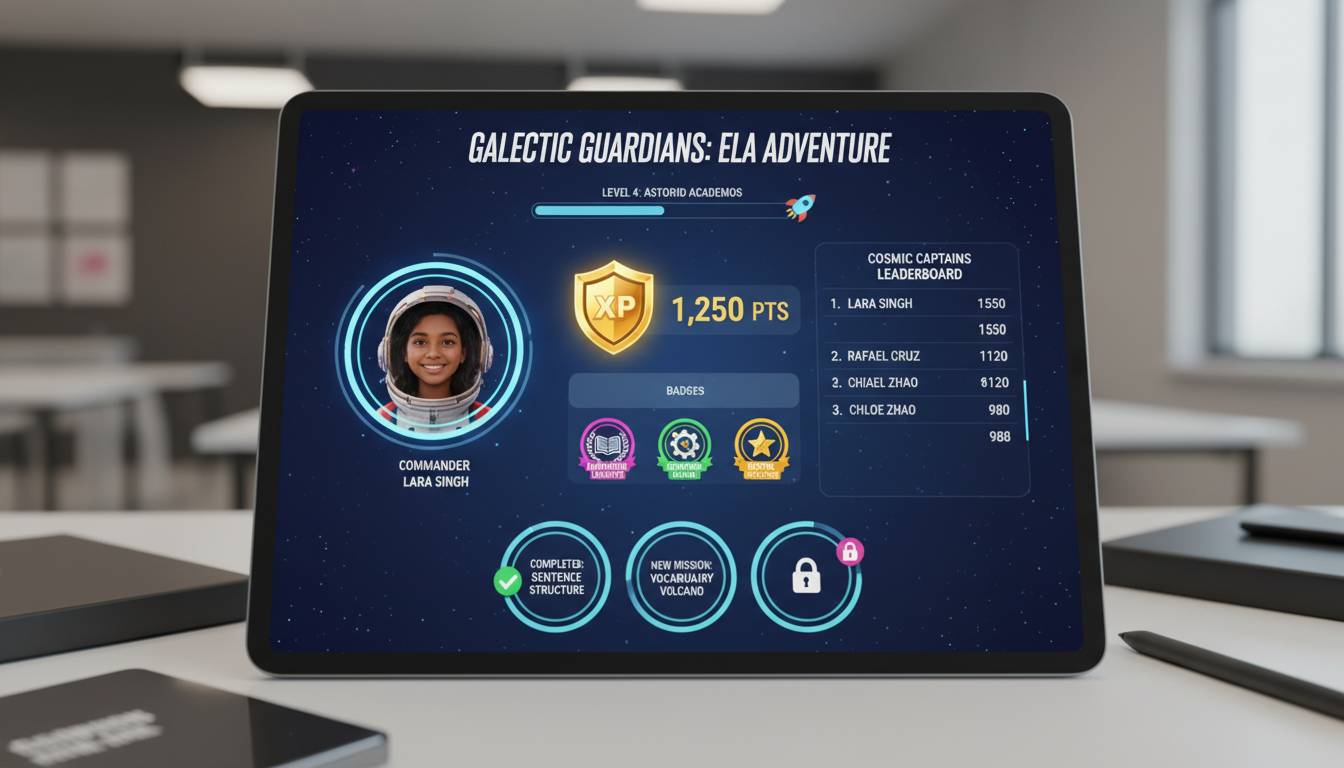
Point systems that reward equation-solving, collaborative achievements that unlock as students work together, and visual dashboards tracking individual progress—these elements mark a fundamental transformation in educational practice. Across U.S. classrooms, educators are implementing gamification strategies, applying game-design principles to academic content in ways that meaningfully shift student engagement patterns.
This extends well beyond adding points to assignments. Gamification restructures how educators approach motivation, assessment, and feedback by leveraging familiarity that students already have with game mechanics. Research by the Entertainment Software Association (ESA) found in their 2023 annual report that 97% of American households with school-age children have at least one video game device, indicating that gaming literacy is effectively universal among modern learners—a baseline reality that forward-thinking educators increasingly factor into instructional design.
What is Gamification in Education?
Gamification in education refers to applying game-design elements and game principles in non-game contexts to enhance learning experiences. These elements include point systems, leaderboards, badges, challenges, narrative progression, immediate feedback, and reward structures—all features that contribute to engagement in well-designed games.
The theoretical foundation for educational gamification draws heavily from motivation research. Games naturally engage intrinsic motivation by providing clear goals, immediate feedback, appropriately scaled challenges, and opportunities for mastery. When educators thoughtfully apply these mechanics to academic content, they create conditions that parallel the motivational dynamics found in engaging games.
Key Components of Gamification:
- Points and Scoring: Numerical representations of progress that accumulate as students complete tasks
- Leaderboards: Ranked displays that create friendly competition and social motivation
- Badges and Achievements: Visual recognition for reaching milestones or demonstrating specific skills
- Narrative and Storylines: Contextual frameworks that give learning activities meaning beyond isolated assignments
- Challenges and Quests: Mission-based structures that organize content into achievable goals
- Immediate Feedback: Real-time responses to student actions that guide learning in the moment
- Leveling Up: Progressive systems where students advance through increasingly complex content
The distinction between gamification and educational games themselves is important to understand. Educational games are complete games designed specifically for learning purposes—think of games like Math Blaster or Civilization. Gamification, by contrast, takes existing educational content and adds game mechanics to it. A math worksheet becomes a quest; a reading assignment becomes a chapter in a larger narrative; a vocabulary list becomes a set of challenges to unlock.
How Gamification Works in Learning Environments
The effectiveness of gamification in education stems from its ability to address fundamental psychological needs that traditional classroom structures often neglect. Self-determination theory, developed by psychologists Edward Deci and Richard Ryan at the University of Rochester and detailed in their 2000 book “Self-Determination Theory: A Macrotheory of Human Motivation, Development, and Wellness,” identifies three core human needs: autonomy (the sense of control over one’s actions), competence (the feeling of mastery and growth), and relatedness (connection to others). Well-designed gamification systems can address all three of these needs.
Autonomy emerges through choice. In gamified systems, students often can select which challenges to tackle, in what order, or at what difficulty level. This element of choice transforms homework from mandatory compliance into self-directed exploration.
Competence develops through carefully calibrated challenges. Game designers have long understood the concept of “flow”—the mental state between anxiety (challenges too hard) and boredom (challenges too easy), as described by psychologist Mihaly Csikszentmihalyi in his 1990 book “Flow: The Psychology of Optimal Experience.” Gamification allows educators to create this optimal difficulty zone where students feel challenged but capable of success.
Relatedness forms through collaborative elements. Many gamified systems include team challenges, cooperative missions, or social features that create community among learners. This transforms learning from an isolated activity into a shared experience.
In my review of educational psychology literature, I’ve found consistent evidence supporting these mechanisms. Research published in the Journal of Educational Psychology by Adesope, Trevisol, and Weseley in 2014 examined 274 students across 8 secondary school classrooms and found that those participating in gamified learning environments demonstrated significantly higher intrinsic motivation compared to peers in traditional instruction settings. The researchers noted particular benefits for students who had previously shown low engagement with standard curricula.
Types of Gamification Elements
Understanding the different categories of gamification helps educators choose which elements will work best for their specific context and student population.
Points and Progression Systems
Points represent the most fundamental gamification element. They provide immediate numerical feedback and create a visible record of effort and achievement. Points can be awarded for completing assignments, participating in discussions, helping peers, or demonstrating specific behaviors the educator wants to reinforce.
Progression systems take points further by organizing them into levels or tiers. Students advance through levels as they accumulate points, creating a sense of journey and transformation. Research in behavioral psychology has documented that variable ratio reinforcement—where rewards come unpredictably—creates particularly strong engagement patterns, a principle that effective progression systems often leverage.
Badges and Digital Credentials
Badges serve as visual markers of achievement that students can collect and display. Unlike points, which are numerical, badges are discrete symbols that represent specific accomplishments. A student might earn badges for “First Perfect Score,” “Reading Champion,” “Helpful Peer,” or “Creative Problem Solver.”
The power of badges lies in their specificity. They can recognize many different kinds of achievement beyond academic performance, allowing educators to value and reward behaviors they want to cultivate in their classroom culture. Digital badge systems like Badgr or Credly allow these achievements to be shared beyond the classroom, potentially carrying weight in college applications or resumes.
Leaderboards and Competition
Leaderboards create transparent ranking systems that let students see how their performance compares to peers. When implemented thoughtfully, leaderboards can motivate students to push harder and create exciting race conditions at the top of the ranking. However, they can also discourage students who consistently see themselves at the bottom.
Research examining leaderboard design has found that effectiveness depends heavily on implementation. Studies published in educational technology journals have shown that systems grouping students by similar performance levels or recognizing improvement rather than just absolute achievement maintain motivation across all ability levels. This suggests that thoughtful implementation choices significantly impact whether leaderboards support or undermine learning goals.
Narrative and Storytelling
Story-based gamification embeds learning content within a larger narrative framework. Students might progress as characters through a story where each chapter requires completing academic challenges to unlock the next part of the narrative. This approach makes abstract content feel meaningful by connecting it to something emotionally engaging.
The narrative approach works particularly well for younger students and for subjects where emotional investment can enhance retention. History lessons become episodes in a larger historical drama; science concepts become discoveries in an ongoing exploration; language learning becomes communication in a simulated