

 March 20, 2026
  11 Min
  No Comment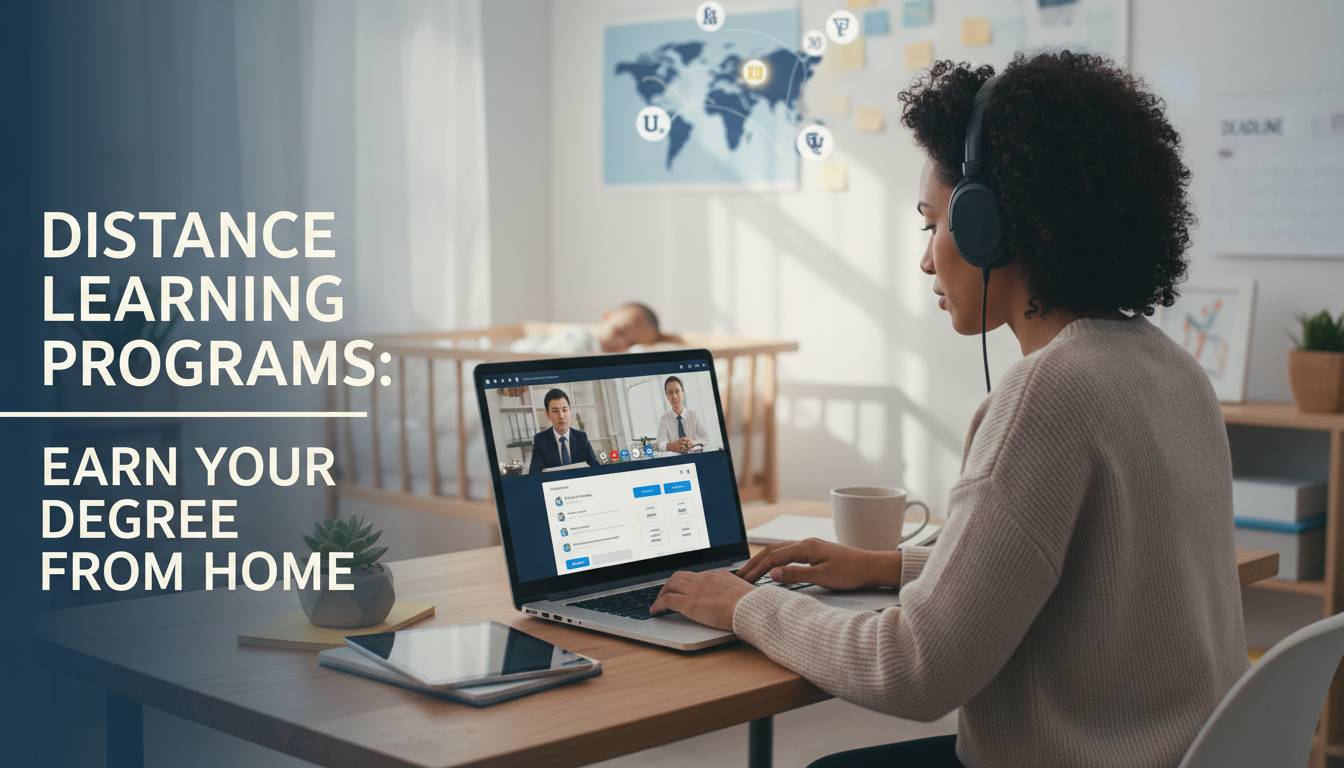
Distance learning programs enable students to earn college degrees, certificates, and professional credentials without attending traditional on-campus classes. These programs deliver coursework through online platforms, video conferencing, and digital resources, allowing learners to study from anywhere with an internet connection. The flexibility makes them particularly attractive to working adults, parents, military personnel, and anyone seeking to advance their education without relocating or quitting their job.
The popularity of online education has grown substantially over the past two decades, with the National Center for Education Statistics reporting that approximately 7.4 million students were enrolled in distance education courses at degree-granting postsecondary institutions in the United States as of 2020. This represents about 35% of all college students, marking a significant shift in how Americans pursue higher education.
What Are Distance Learning Programs?
Distance learning programs are educational offerings delivered primarily or entirely through electronic means, eliminating the need for physical presence in a classroom. These programs range from individual courses to full degree programs spanning multiple years. Students access lectures, assignments, discussions, and examinations through learning management systems such as Canvas, Blackboard, or Moodle.
The delivery methods vary considerably. Some programs use asynchronous learning, where students access pre-recorded materials and complete assignments at their own pace within specified deadlines. Others employ synchronous learning, featuring live video sessions where students and instructors interact in real time. Many programs combine both approaches, offering flexibility while maintaining personal connection.
Accredited distance learning programs must meet the same academic standards as their on-campus counterparts. Regional accreditation remains the gold standard in the United States, with agencies such as the Higher Learning Commission, Middle States Commission on Higher Education, and Western Association of Schools and Colleges evaluating both online and traditional programs using identical criteria.
Types of Distance Learning Programs
The landscape of online education offers several distinct program types, each serving different student needs and learning preferences.
Fully Online Programs require no physical campus attendance. All coursework, discussions, and assessments occur digitally. These programs offer maximum flexibility and appeal to students who live far from campuses or have schedules preventing regular attendance.
Hybrid or Blended Programs combine online coursework with limited on-campus requirements. Students might attend weekend intensives, laboratory sessions, or periodic residencies. This format works well for programs requiring hands-on skill development, such as nursing, engineering, or education.
MOOCs (Massive Open Online Courses) offer free or low-cost individual courses from universities worldwide. Platforms like Coursera, edX, and Udemy host these courses. While MOOCs rarely count toward formal degrees, they provide valuable continuing education and skill development opportunities.
Competency-Based Programs allow students to progress by demonstrating mastery of specific skills rather than spending fixed time in courses. Working adults with significant professional experience often excel in these programs, as they can leverage existing knowledge to accelerate their studies.
| Program Type | Best For | Typical Duration | On-Campus Required |
|---|---|---|---|
| Fully Online | Remote learners, working adults | 2-4 years | No |
| Hybrid | Hands-on learning needs | 2-5 years | Limited |
| MOOC | Skill acquisition, exploration | Varies | No |
| Competency-Based | Experienced professionals | Flexible | No |
Benefits of Earning Your Degree Online
The advantages of distance learning extend far beyond convenience, though flexibility remains the primary draw for most students.
Financial savings represent a significant benefit. Students avoid costs associated with commuting, parking, on-campus housing, and meal plans. Additionally, many online programs charge lower tuition rates than their on-campus equivalents, particularly for out-of-state students who would otherwise pay premium fees.
Career advancement opportunities increase substantially with a college degree. According to the U.S. Bureau of Labor Statistics, workers with a bachelor’s degree earn approximately $1,305 per week on average, compared to $781 for those with only a high school diploma. Online programs allow working professionals to gain credentials without interrupting their income.
Geographic independence enables students to enroll in programs offered by institutions across the country without relocating. A student in rural Montana can earn a degree from a prestigious university in Massachusetts without leaving home, expanding access to quality education regardless of location.
Self-paced learning accommodates different learning styles and life circumstances. Students can review challenging material multiple times, skip ahead when content feels familiar, and schedule study sessions around work and family obligations.
Technology skills development occurs naturally as students navigate learning management systems, video conferencing tools, digital collaboration platforms, and online research databases. These competencies prove valuable in virtually every modern workplace.
How to Choose the Right Distance Learning Program
Selecting an appropriate program requires careful evaluation of several critical factors. Rushing this decision often leads to wasted time, money, and frustration.
Accreditation status must be verified first. Students should confirm that the institution holds regional accreditation and that the specific program has any necessary specialized accreditation. The U.S. Department of Education maintains a database of accredited institutions, and students can verify accreditation through the Council for Higher Education Accreditation.
Tuition and total program cost deserve thorough investigation. Beyond per-credit charges, students should calculate fees, technology costs, textbook expenses, and any required on-campus visits. Financial aid, including federal student loans, remains available for eligible students in accredited online programs.
Student support services vary significantly between institutions. Effective programs offer academic advising, technical support, tutoring services, career counseling, and library access. Students should verify these resources exist and understand how to access them remotely.
Faculty qualifications and class sizes impact learning quality. Instructors should hold relevant academic credentials and professional experience in their fields. Small class sizes facilitate meaningful interaction and personalized feedback.
Graduation rates and job placement statistics provide insight into program effectiveness. While the National Center for Education Statistics tracks graduation rates for online programs, students should seek additional data from institutions directly.
Technology requirements must align with available resources. Students need reliable internet access, compatible devices, and proficiency with basic software applications. Some programs require specific hardware or software purchases.
Accreditation and Quality Considerations
Understanding accreditation proves essential for anyone considering distance education. Without proper accreditation, degrees may not be recognized by employers or eligible for federal financial aid.
Regional accreditation applies to colleges and universities as a whole and represents the most widely recognized form of credentialing. The seven regional accrediting agencies evaluate institutions across multiple dimensions, including academic quality, faculty qualifications, student support services, and financial stability.
National accreditation typically applies to vocational or career-focused institutions. While some nationally accredited programs offer legitimate education, employers and graduate schools often view regional accreditation more favorably.
Specialized accreditation applies to specific programs or departments, such as business schools (AACSB, ACBSP, IACBE), nursing programs (CCNE, ACEN), or engineering programs (ABET). Students in regulated professions should verify their program meets licensing requirements.
The Department of Education requires accredited institutions to demonstrate that online students receive education equivalent to on-campus offerings. This includes qualified faculty, appropriate curriculum, sufficient student interaction, and adequate academic support.
Students should also research student satisfaction data. The Integrated Postsecondary Education Data System and individual university websites provide consumer information, including student retention and completion rates.
Popular Fields of Study for Online Learners
Certain academic disciplines lend themselves particularly well to distance delivery, though online options continue expanding across disciplines.
Business administration remains the most popular online degree category, with programs offering specializations in finance, marketing, human resources, and management. The flexibility suits working professionals seeking advancement or career changes.
Healthcare administration prepares students for leadership roles in hospitals, clinics, insurance companies, and public health organizations. Growth in healthcare sectors nationwide drives strong demand for qualified administrators.
Education programs enable teachers to earn advanced degrees or certification while continuing their careers. Specializations include curriculum design, educational technology, special education, and school administration.
Information technology fields thrive online because practical skills can often be developed through virtual labs and remote software access. Cybersecurity, software development, data analytics, and IT management attract technically inclined students.
Psychology and social work programs prepare students for counseling, research, or community service roles. While clinical positions typically require in-person supervision hours, many foundational courses transfer effectively to online formats.
Criminal justice appeals to those pursuing law enforcement, corrections, security, or legal studies careers. Online formats work well for theoretical coursework, though some practical components may require on-campus attendance.
Challenges and Solutions in Online Learning
Online education presents unique obstacles that prospective students should understand before enrolling.
Self-discipline requirements exceed those of traditional classroom settings. Without scheduled class times, students must create their own study schedules and consistently meet deadlines. Solution: Establish a dedicated study space, create weekly schedules, and use calendar applications to track assignment due dates.
Limited face-to-face interaction can create feelings of isolation and reduce networking opportunities. Solution: Actively participate in discussion forums, join virtual study groups, attend online campus events, and utilize video conferencing when available.
Technical difficulties occasionally disrupt learning. Solution: Maintain backup internet connections, save work frequently in multiple formats, and familiarize oneself with technical support resources before problems arise.
Time management challenges affect many online learners, particularly those balancing work and family responsibilities. Solution: Block dedicated study time on calendars, communicate with employers about educational commitments, and involve family members in scheduling.
Self-motivation maintenance becomes crucial during difficult academic periods. Solution: Set intermediate goals, celebrate achievements, connect with classmates for mutual accountability, and remember long-term career objectives.
The Future of Distance Learning
The online education landscape continues evolving rapidly, driven by technological advances and changing workforce demands.
Artificial intelligence integration promises personalized learning experiences. Adaptive platforms now adjust content difficulty, recommend study materials, and identify knowledge gaps automatically.
Virtual and augmented reality technologies enable immersive learning experiences previously impossible online. Medical students can practice surgical procedures virtually, engineering students can explore 3D models, and history students can tour ancient civilizations.
Micro-credential expansion responds to employer demands for demonstrable skills. Certificate programs, digital badges, and stackable credentials offer targeted training for specific job requirements, complementing traditional degrees.
Global collaboration increases as online programs connect students worldwide. Cross-cultural teamwork prepares graduates for international business environments and expands professional networks geographically.
Employer acceptance of online degrees has grown substantially. A 2021 survey by the Society for Human Resource Management found that 77% of HR professionals considered online degrees equally acceptable as traditional degrees, up from 56% in 2018.
Conclusion
Distance learning programs have transformed from alternative education options into mainstream pathways for degree completion. The combination of accreditation standards, proven outcomes, and technological innovation makes online education a legitimate choice for millions of Americans seeking to advance their careers or change professions.
Prospective students should approach program selection methodically, verifying accreditation, evaluating costs, assessing support services, and confirming alignment with career goals. Those who invest appropriate effort in selection and commit to disciplined study can achieve valuable credentials through distance learning.
The flexibility, accessibility, and increasingly sophisticated delivery methods position online education as a permanent fixture in American higher education. As technology continues advancing and employer acceptance grows, distance learning programs will likely play an even larger role in workforce development and lifelong learning.
Frequently Asked Questions
How long does it take to complete a distance learning degree?
Completion time depends on the program type and student availability. Bachelor’s degrees typically require 4 years of full-time study, though accelerated programs may allow completion in 2-3 years. Master’s programs usually take 1-2 years. Students attending part-time may take longer, and competency-based programs allow flexible timelines based on individual pace.
Can I get financial aid for distance learning programs?
Yes, students enrolled in accredited online programs at eligible institutions can receive federal student aid, including grants, loans, and work-study programs. Eligibility requirements mirror those for traditional programs. Students should complete the Free Application for Federal Student Aid (FAFSA) to determine their aid options.
Are online degrees respected by employers?
Employer acceptance has grown significantly, with most HR professionals now viewing online degrees equivalently to traditional degrees. The key is ensuring your program holds proper regional accreditation. Degrees from accredited institutions in relevant fields carry substantial value, though some employers in traditional industries may still express preferences.
What technology do I need for online learning?
Minimum requirements typically include a reliable computer (desktop or laptop), stable internet connection (broadband recommended), webcam and microphone for video conferencing, and current web browser. Specific programs may require additional software, such as Microsoft Office, statistical programs, or specialized applications. Check with your institution for exact requirements.