
 February 8, 2026
  10 Min
  No Comment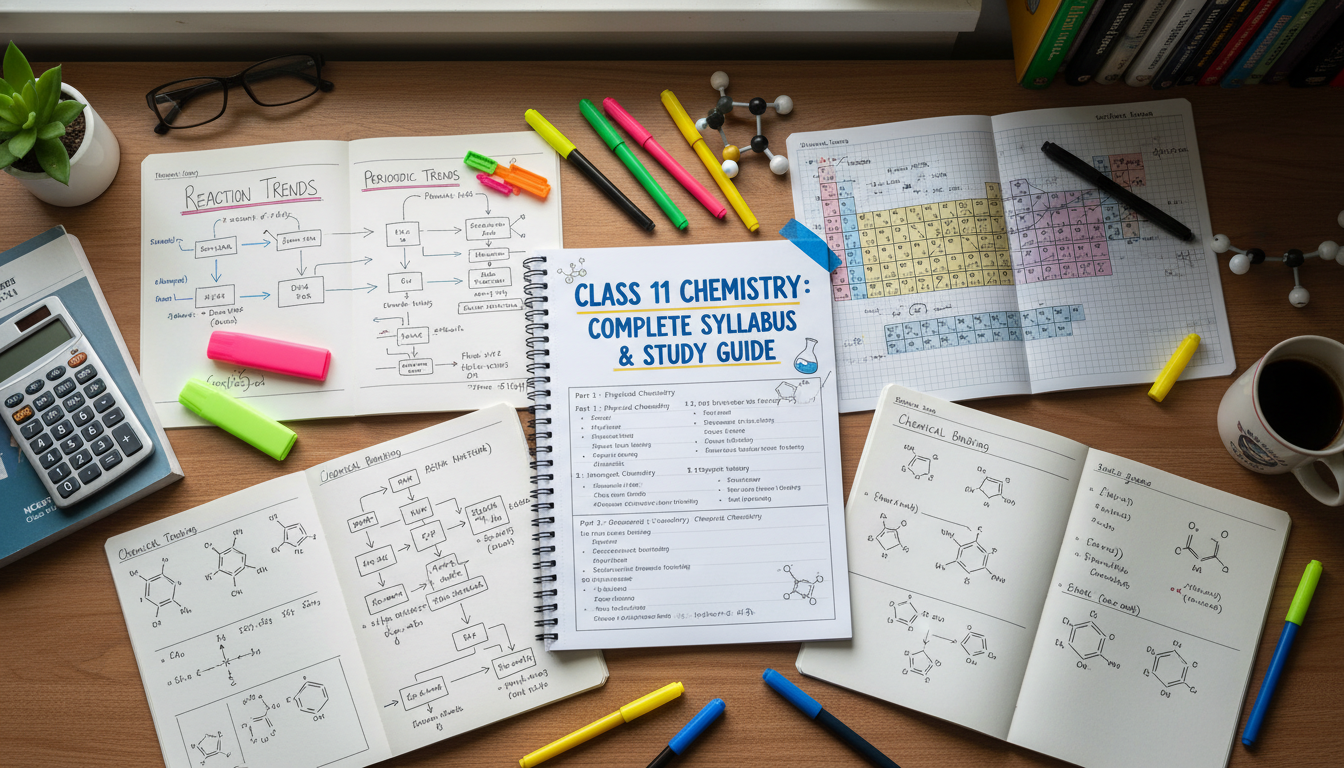
Chemistry Class 11: Complete Syllabus, Notes, and Study Guide—this sounds like a mouthful, right? But oddly, it’s exactly the kind of guide that, well, students both dread and secretly crave. I mean, we all know that first year of high school chemistry can feel like stepping onto another planet. Molee-cular, electron, cell—that’s biology, yes. But here we’re talking periodic tables, stoichiometry, and thermodynamic… whew. Still, there’s something oddly thrilling about cracking the code of atoms. This guide aims to walk that line between friendly conversation—you know, like a teacher rambling a bit, admitting “well, that bit confused me too at first”—and structured, dependable information. You’ll get it all: syllabus walkthrough, practical notes, study strategies, and a pinch of real-world context to keep things grounded.
Understanding the Chemistry Class 11 Syllabus
Overview of Core Topics
To start, the syllabus for Chemistry Class 11 typically divides into three major streams: Physical Chemistry, Inorganic Chemistry, and Organic Chemistry. In many curricula, Physical Chemistry takes the lion’s share with a focus on concepts like mole concept, atomic structure, and thermodynamics. Inorganic Chemistry usually covers the periodic table, chemical bonding, and basic principles. Organic Chemistry introduces the world of hydrocarbons and their functional groups. It’s not just arbitrary division—each branch builds upon the previous one, gently like stacking blocks.
Beyond this structured separation, you might notice overlapping themes—thinking about atomic structure helps when you learn bonding, and that’s handy when entering organic mechanisms. So even though chapters are discrete, they echo and resonate across each other in surprising ways.
Real-World Connection: Why It Matters
Ever wondered why we bother with chemical bonds or stoichiometry? Here’s a quick real-world twist: recognizing how atoms bond is basically understanding how your phone battery or a biochemical process in your body works. The principle of limiting reagent isn’t just for lab—industries from pharmaceuticals to glitter makers rely on efficiency calculations to minimize waste (and cost). So yeah—what feels dry on paper can actually be the key to modern manufacturing, medicine, and even birthday confetti. That alone makes the subject kinda cool, if you give it a shot.
Crafting Effective Notes
Human-Friendly Note-Taking Approach
Let’s be honest—note-taking is as personal as your handwriting. Some folks write in bullet points, others draft flowcharts or doodle really tiny cats in the margin. The trick is consistency and clarity. A mix of headings (for structure), short bullet lists (for quick recall), and occasional mini-diagrams helps cement ideas. For instance, sketching the electron configuration visually instead of just writing “1s² 2s²…” makes it stick.
Equally, don’t shy away from jotting down the “aha!” moments—or the questions. If you ever think “Wait, why does this gas expand when heated?”, write that down. That curiosity trace can lead to deeper understanding later. And, of course, color coding—maybe periodic trends in blue, formulas in red—isn’t mandatory, but boy, isn’t it fun when you flip through vibrantly organized notes?
Sample Section: Mole Concept
- Definition: amount of substance in terms of Avogadro’s number (roughly 6 × 10²³ particles).
- Key formula: moles = mass (g) / molar mass (g/mol).
- Tip: Always double-check units—tons of mistakes come from misreading grams vs. kilograms.
- Real-world example: Dosage calculation in medications—dose often measured in moles of active compound, not just weight. That ensures therapeutic effect without overdose.
“Getting the mole concept right is like getting the currency when travelling abroad – if you mix dollars with euros by mistake, you’re going to overspend or the shop will laugh at you.”
That playful comparison—while a bit cheeky—drives home how careful you need to be.
Study Strategies That Actually Work
Breaking Down the Workload
If you jumped straight into memorizing every formula and reaction, you might flame out fast. Instead, chunk the syllabus. Start with Physical Chemistry—maybe spend a week or two locking down basics like mole concept, atomic structure, and chemical energetics. Then shift to Inorganic, exploring periodicity and bonding over another week. Finally, dedicate time to Organic basics before layering: think hydrocarbon naming, isomerism, and functional groups.
This gives your brain time to process each area, then reinforce through repetition and interconnecting ideas. And yes, don’t try to swallow the whole thing in one go—your brain, like a wise old librarian, benefits from sorting one section at a time.
Active Practice Over Passive Reading
Reading through theory can feel safe—but it’s passive. Better to challenge yourself with questions or small experiments. For example:
- Solve end-of-chapter problems related to thermodynamics.
- Draw Lewis structures for different elements and ions.
- Look up safe home experiments, like crystallizing salt or testing pH using cabbage juice, just to reinforce observation skills.
The goal is to engage with the content from different angles—not just through reading, but by writing, drawing, and doing. That triple approach boosts retention, like three legs on a sturdy stool instead of two wobbly ones.
Common Pitfalls and How to Avoid Them
Mixing Up Concepts
Students often confuse related but distinct ideas—like endothermic vs. exothermic reactions, or atomic radius trends vs. ionic radius. When going over notes, it helps to explicitly highlight contrasting ideas:
- Endothermic: absorbs heat, e.g., melting ice.
- Exothermic: releases heat, e.g., combustion.
Similarly, for atomic vs. ionic radius, drawing quick comparative arrows across the periodic table can be more helpful than a sentence of text. Visual cues clear up the mental fog.
Overloading Without Reinforcement
It’s tempting to read several chapters back-to-back, particularly if you’re behind schedule. But without timely revision, even solid reading fades. Regular quick recaps—even five minutes per topic, periodically—go a long way. Think of it like a “chemical memory booster” dose: morning flashcards, evening skim through your summary notes, and a weekly self-test. Consistent, low-intensity practice beats one marathon cramming session that leaves you jittery and forgetting by morning.
Integrating Real-World Examples and Context
Industry and Research Tie-Ins
Chemistry is everywhere—take the world of green energy. Understanding redox reactions and electron transfer is central to battery development. Organic chemistry insights drive pharmaceutical innovation—identifying how a small molecular tweak can vastly alter a drug’s effectiveness. Even water treatment and agriculture lean on inorganic compounds and their reactions. When students see that what seems abstract (like acid-base titration) connects directly to clean drinking water, it flips from “boring lecture” to “oh, that’s useful.”
Case Study Snapshot: Aspirin Synthesis
Let’s think through a classic: aspirin (acetylsalicylic acid) synthesis. In an organic chemistry course, the reaction between salicylic acid and acetic anhydride introduces concepts like esterification and reaction mechanism. And—and this is what’s cool—the steps here aren’t just textbook. They reflect how chemists in industry tweak temperature, catalysts, and concentrations to improve yield. A snapshot of this process links the high-school-grade reaction scoop you write down with real-world manufacturing. It’s chemistry not in abstraction, but in active, tangible use.
Structuring Revision Sessions Smartly
Weekly Revision Cycle
A practical schedule might look like:
- Day 1–2: Deep dive into new content (e.g., atomic structure, then bonding).
- Day 3: Practice problems and flashcards.
- Day 4: Mini-quizzing of memory recall.
- Day 5: Peer discussion or teaching someone else.
- Weekend: Recap entire week’s content in mixed questions/questions of varying type.
This spread helps your brain gradually build and cross-link knowledge. On the weekend, when you review, you’re not just recalling—but you’re also seeing how new concepts connect with older ones.
Peer Study and Teaching Advantage
Here’s something more social: teaching someone else—like your study buddy or younger sibling—forces you to clarify your own understanding. If you trip over how to explain le Chatelier’s principle, that’s a sign you need to revisit it. Plus, peer discussion often surfaces questions you’d never consider alone. It keeps things lively, less dry, and far memory-friendlier.
Technology and Resources to Consider
Online Platforms and Multimedia
There are tons of high-quality resources: video tutorials, interactive simulations, and digital practice tests. For instance, simulations of molecular orbital theory or virtual titration labs bring the invisible to screen. It’s one thing to read “electrons occupy orbitals,” another to watch them fill up in real-time. Meanwhile, apps with spaced repetition algorithms can deliver flashcards just when your memory’s about to fade—pretty neat.
Cautious Use of AI Tools
AI tools (like chat-based helpers) can be helpful when you’re stuck—though, truth be told, they sometimes misinterpret nuance or oversimplify. It’s wise to cross-check AI-generated explanations with trusted textbooks or teacher guidance. Use them as a starting point, not the final word. They’re like friendly tutors—but ones that need oversight.
Summary and Next Steps
This guide covered a lot: the structure of the Class 11 chemistry syllabus, note-taking that sticks, study tactics that engage your brain, real-world context that brings chapters to life, and revision frameworks to help you sustain progress. Along the way, it’s been more human than textbook, with little chuckles, messy tangents, and that relatable “Oh, I felt that way too” tone. Now, next steps?
- Outline your syllabus and chunk it into manageable parts.
- Build notes with personal markers (colors, doodles, tips).
- Combine active practice with brief, consistent revision.
- Link topics to real-world scenarios—makes them stickier.
- Find peers or tools that prompt teaching and testing.
Stick with that rhythm—steady, curious, and a bit playful—and the subject shifts from fearsome to fascinating.
FAQs
What chapters are included in Chemistry Class 11 syllabus?
Typical Class 11 chemistry covers Physical Chemistry (like mole concept, thermodynamics), Inorganic Chemistry (periodic table, bonding), and Organic Chemistry basics (hydrocarbons, functional groups). The exact order or depth may vary by board or school.
How can I make notes more effective and memorable?
Use a blend of headings, bullet points, sketches or diagrams, and highlight questions or “aha” moments. Add color-coding or mini-doodles to reinforce visual cues—makes flipping back through them more engaging and memorable.
What’s a good study schedule for this subject?
A weekly cycle that includes a couple of days for new content, a day for practice, another for recall quizzes, peer discussion, and a wrap-up review works wonders. Small but consistent study blocks beat one big cram session any time.
How do I avoid confusing similar concepts?
Explicitly contrast them—for example, jot side-by-side definitions of endothermic vs. exothermic, or illustrate trends like atomic vs. ionic radius. Visual comparisons help your brain sort them cleanly.
Can technology help with Class 11 chemistry revision?
Absolutely. Simulations, spaced-repetition apps, and interactive video lessons make abstract ideas more tangible. Just be sure to verify AI-generated or online explanations against textbooks or trusted sources.
How do real-world examples help me learn chemistry?
They ground abstract topics in practical uses—like how thermodynamics underlies battery tech or how aspirin synthesis demonstrates organic reaction mechanisms in action. This context makes concepts more meaningful and memorable.
This guide isn’t perfect—it has my scribbles, conversational detours, and tiny construction-site-level of polish—but it’s real. It’s the kind of study companion that, if you treat it like a patient friend, can guide you from “what even is enthalpy?” to “oh, I got this now.”
