
 February 6, 2026
  5 Min
5 Min  No Comment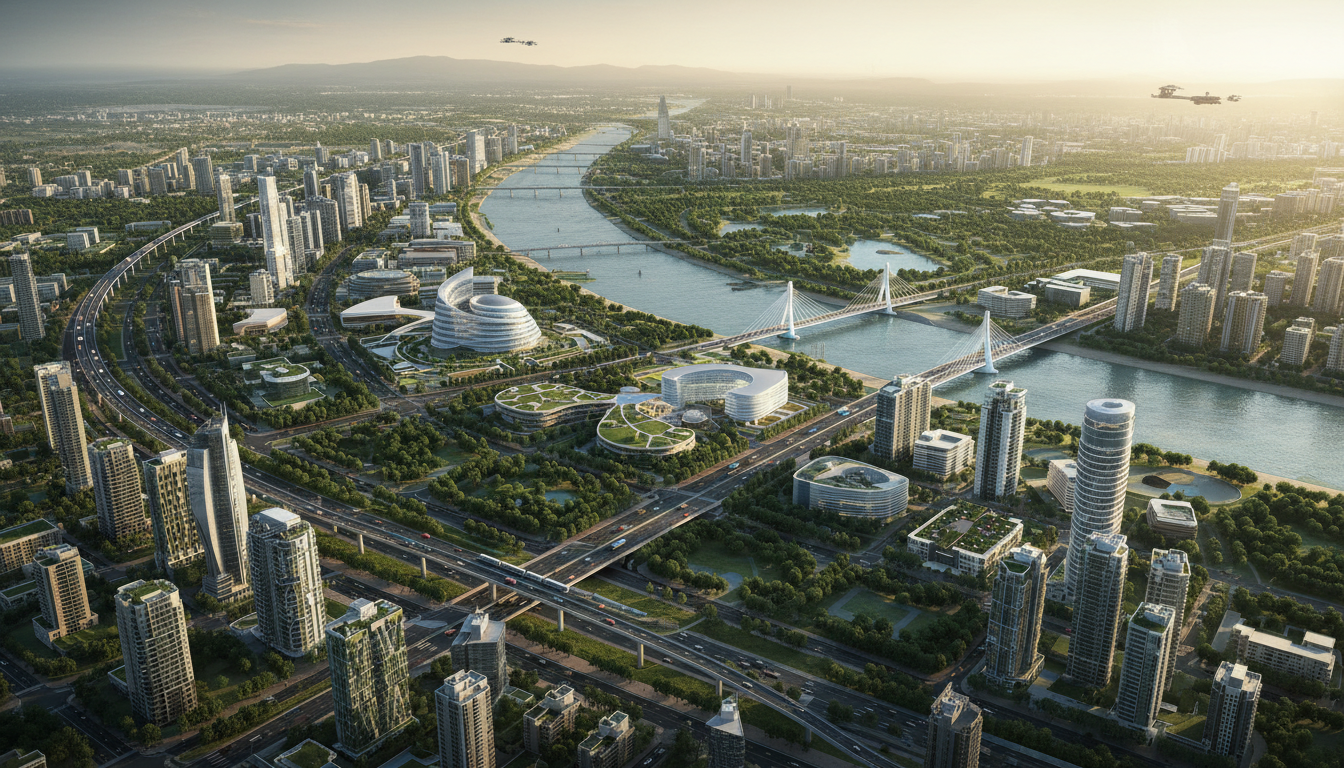
The story of Amaravati is far from linear—it’s a narrative shaped by political turns, farmer contributions, and big ambitions. This article delves into the journey of Andhra Pradesh’s capital, Amaravati—where it stands today, where it’s headed, and why it matters.
Why Amaravati? The Genesis of a Greenfield Capital
The idea of Amaravati as the capital didn’t emerge overnight. In 2014, following Andhra Pradesh’s bifurcation from Telangana, the state adopted Amaravati—a greenfield site along the Krishna River—as its future capital. A land-pooling scheme engaged farmers across hundreds of villages; in exchange for their land, they were offered developed plots and future value.
Foster + Partners, the iconic UK-based firm, drafted the master plan. Their vision included a Government Complex with a Secretariat, Legislative Assembly, and High Court—all forming a sustainable, globally designed city.
Political Halt and Revival: A Capital in Limbo
The momentum was interrupted in 2019 when a new government proposed a three-capital plan—separating administrative, legislative, and judicial functions across Visakhapatnam, Hyderabad, and Kurnool. Development momentum dried up, funding paused, and Amaravati became a stalled project.
Farmers protested, and in 2022 the Andhra Pradesh High Court ruled that Amaravati must remain the single capital—rejecting the three-capital experiment. When N. Chandrababu Naidu returned to power in 2024, the focus shifted back to Amaravati. Development resumed, international funding returned, and hope was rekindled.
Legal Confirmation and Policy Momentum
In late 2025, the Union Home Ministry granted Amaravati legal status as the sole capital, effective from June 2, 2024. This brought clarity after years of uncertainty. Union MoS Pemmasani Chandrasekhar affirmed that steps are underway to legally anchor this status. Reports from January 2026 confirm that a bill to enshrine Amaravati’s legal capital status is being prepared for the upcoming parliamentary session.
Infrastructure Revival: From Roads to Quantum Hubs
A Multi-Billion Dollar Build-Out
The government has greenlit massive infrastructure investments:
– ₹24,276 crore for roads, iconic buildings, public services, and more as of December 2024.
– A ₹7,388 crore NABARD loan plus World Bank and ADB support for sewage, flood mitigation, and other civil works .
Underground Power Grid
Amaravati is laying out one of India’s largest underground power networks—hundreds of kilometres of XLPE-insulated cables. This boost aims to enhance reliability, reduce costs by up to 30%, and maintain aesthetics free of overhead lines.
Financial Institutions & Iconic Buildings
A foundation stone for offices of 15 public sector banks and insurance firms signals financial activation in Amaravati. The Assembly, High Court, Secretariat, and flagship towers are all underway with support from international lenders and domestic agencies.
Quantum Valley: A Tech Leap
In perhaps the most futuristic move, Amaravati is set to host a “Quantum Valley,” India’s first dedicated quantum tech park in South Asia. In May 2025, IBM, TCS, and L&T committed to establishing a 156-qubit quantum computer here.
A Capital with Dreams: Goals and Projections
The government’s grand vision projects by 2050:
– Creation of 1.5 million jobs
– A population of 3.5 million
– GDP of around USD 35 billion
At the ground level, core infrastructure is set for completion by March 2028. Tenders are set, projects launched, and the foundation is visibly rising.
“A People’s Capital”: Farmer-Centric Legacy
Much of this revival rests on the contributions of farmers—who voluntarily gave land to the project—and their vision drives the narrative. The government continues to emphasize their role in shaping Amaravati’s future, and promises include tailored township developments aligned with their land allocations.
Infrastructure Snapshot
- Multi-modal roads, sewage systems, flood-resistant designs
- Underground power backbone
- Government complex with Assembly, Secretariat, judiciary
- Higher education: campuses already operational and more in pipeline
- Quantum Valley, financial hubs, smart city foundations
Bridging Politics, Reality, and Vision
This is where reality meets aspiration. Years of delays, fiscal overhang, and political tussles gave way to swift project revival post-2024. Yet challenges remain—from land allocations to funding disbursements and ensuring inclusive development. As one government official noted:
“We are truly delighted that the plans for Amaravati would be restarted in full flow. We are confident that we will be able to build a remarkable, intelligent and sustainable city that will be a source of pride for the Telugu community worldwide.”
Conclusion: Amaravati in 2026 and Beyond
Amaravati is no longer a ghost city or a halted dream. It’s carving out its trajectory toward becoming Andhra Pradesh’s singular, legally affirmed capital—a smart, sustainable, high-tech urban future. With the legal framework falling into place, core infrastructure rising, and visionary projects like Quantum Valley, the city is emerging from the shadow of uncertainty into an ambitious, human-centered reality.
Next steps include parliamentary backing, accelerated construction, deepening international partnerships, and ensuring the narrative remains grounded in social trust and inclusivity.
FAQs
What is the current capital of Andhra Pradesh?
The capital is Amaravati, which now houses the Secretariat, Legislature, and High Court and was legally recognized as the sole capital effective June 2, 2024.
Will Amaravati be India’s only single-state capital?
No, other states also have single capitals; Amaravati joins this list with unique planning and future-readiness.
When will Amaravati be fully functional as a capital city?
Core infrastructure aims to be completed by March 2028. Legislative and judicial buildings, roads, and utilities are underway.
What is “Quantum Valley” in Amaravati?
Quantum Valley is a planned tech hub focusing on quantum computing, with collaborations from IBM, TCS, and L&T to install advanced quantum systems by 2026.
How were farmers involved in Amaravati’s development?
Farmers enrolled in a land-pooling scheme voluntarily contributed thousands of acres and received developed plots in return. Their cooperation remains central to capital planning and legitimacy.
Is the project funded by international institutions?
Yes—ADB and World Bank have committed large loans (~USD 800 million each), supplemented by HUDCO, NABARD loans, and domestic funding totaling tens of thousands of crores.
