
 February 6, 2026
  5 Min
5 Min  No Comment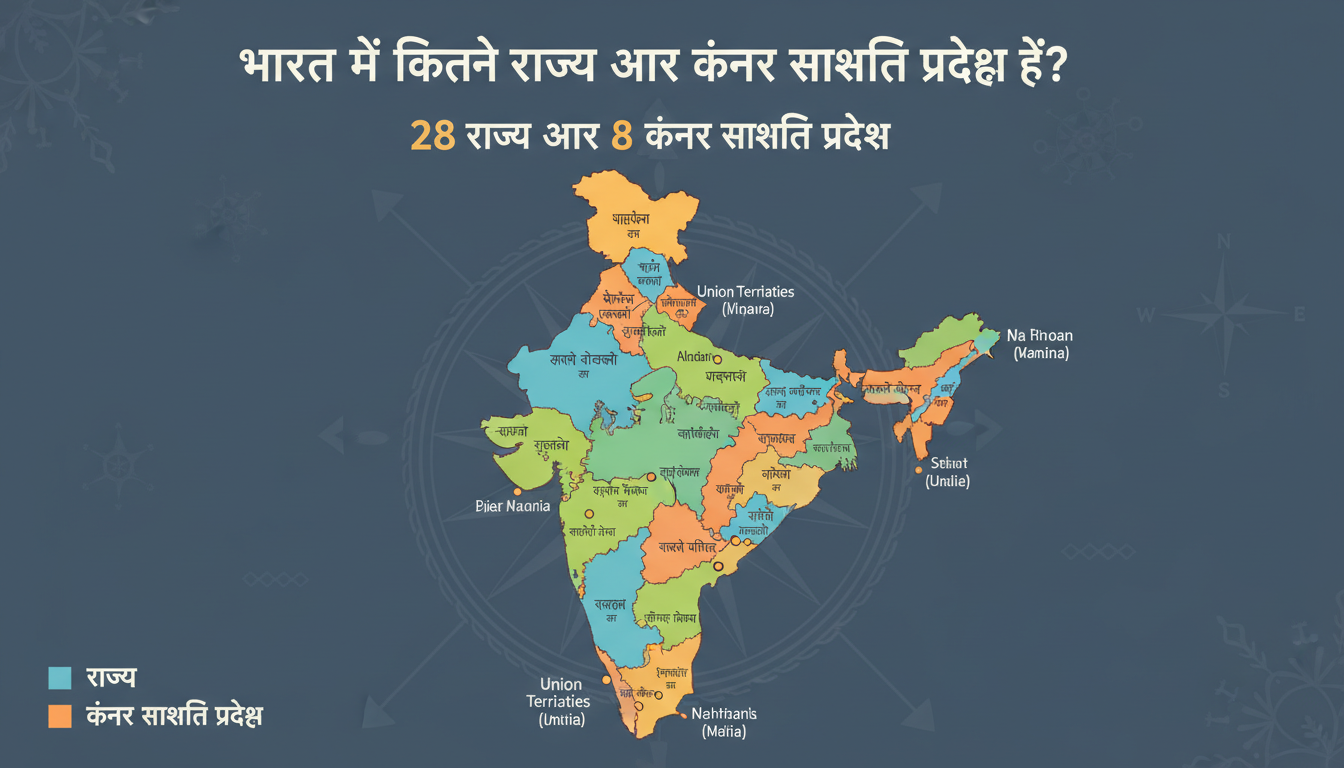
Every casual conversation about India’s federal structure eventually leads to this fundamental query: “Bharat mein kitne rajya hain?” But behind this apparently simple question lies layers of history, constitutional evolution, and governance intricacies. India today is a federal republic comprising states and union territories, each with varied powers and identities. But how many exactly? And what’s the story behind those numbers? Let’s not just throw numbers—let’s tell the story in a way that feels casually insightful, a touch reflective, maybe even slightly imperfect, as human conversation often is.
Number of States and Union Territories in Modern India
As of early 2026, India comprises:
- 28 States
- 8 Union Territories
That brings us to a total of 36 administrative units.
That’s the headline—but why this structure? India’s journey from colonial provinces and hundreds of princely states to today’s map is shaped by linguistic concerns, administrative logic, and regional identity movements.
Evolution Over Time: From Hundreds to a Few Dozen
Historic Layers and Reorganization
- In the immediate post-independence period, India integrated more than 500 princely states.
- The States Reorganisation Act of 1956 reshaped provincial boundaries, largely along linguistic lines.
- Since then, a few states were carved out for administrative clarity:
- Himachal Pradesh (1971), Arunachal Pradesh, Mizoram, Goa, Sikkim in the 1980s,
- Chhattisgarh, Jharkhand, Uttarakhand in 2000,
- and Telangana in 2014.
Recent Adds or Cuts? Not Really
No new states have been formed since 2014. In fact, some previously counted as states—like Jammu & Kashmir—were redefined into union territories in 2019.
The structure has held relatively steady since the early 2020s. Even though there are recurring political demands for new states—for example, in larger states like UP or Maharashtra—no changes have materialized as of 2026.
Why It Matters: States vs Union Territories
States have:
- Their own elected governments and legislatures,
- Powers over key areas like education, agriculture, and local law enforcement.
Union Territories, on the other hand:
- Are generally administered by the central government,
- But a few (like Delhi and Puducherry) have partial legislative powers.
So the difference isn’t just semantics—it shapes how governance happens, how policies are implemented, and even how culture and regional priorities play out on the ground.
Real-World Snapshot: Capitals and Political Setup
Understanding what “Bharat mein kitne rajya hain” means also involves recognizing where governance is anchored—in the capitals and administrative seats.
A Quick Glance at the Capitals:
- Andhra Pradesh – Amaravati
- Himachal Pradesh – Shimla (Summer), Dharamshala (Winter)
- Maharashtra – Mumbai (Summer), Nagpur (Winter)
- Uttarakhand – Dehradun (Winter), Gairsain (Summer)
…and so on, reflecting geographic, climatic, and historical factors.
Similarly, Union Territories like Jammu & Kashmir and Ladakh have seasonal capital arrangements: Srinagar/Jammu and Leh/Kargil respectively.
These shifts might seem quirky, but they reveal a human touch in administration—an attempt to bridge distance, climate, and local identity.
Insights and Contextual Perspectives
It’s tempting to treat “28 states” as a static fact, but human conversations demand more nuance:
- The map today reflects pragmatic choices shaped across languages, terrain, politics.
- What seems like a stable number masks decades of compromise, tension, and adaptation.
- The occasional call for new states reveals India’s evolving sense of self–not just governance, but belonging.
“The total remains at 28 states and 8 union territories following key changes… India’s administrative landscape in 2026 reflects a carefully balanced federal republic…”
This isn’t just a dry count—it’s a living, breathing structure shaped by real people, languages, movements, and the idea of unity in diversity.
Concluding Summary
So, “Bharat mein kitne rajya hain?” As of early 2026, the answer is 28 states and 8 union territories, totaling 36 subnational units. This configuration stands on decades of linguistic reorganizations, administrative reforms, and political decisions. Behind those numbers lie stories of regional identity, pragmatic governance, and evolving federalism.
That said, the structure remains flexible—proposals for new states crop up, and administrative maps are not set in stone. The number answers today’s reality—but tomorrow could bring new shifts.
FAQs
How many states are there in India as of 2026?
India currently comprises 28 states and 8 union territories, making 36 administrative units.
Why isn’t Jammu and Kashmir counted as a state anymore?
In October 2019, Jammu & Kashmir was reorganized from a state into two union territories—Jammu & Kashmir and Ladakh.
What’s the difference between a state and a union territory?
States have their own legislatures and more autonomy, whereas union territories are mostly governed by the central government. Some, like Delhi and Puducherry, do have limited legislative powers.
Have there been any new states created recently?
The most recent state formation was Telangana in 2014. Since then, no new states have been created; only reorganization occurred with Jammu & Kashmir in 2019.
Why do some states have multiple or seasonal capitals?
Capital arrangements can reflect geographic and climatic considerations. States like Maharashtra and Himachal Pradesh shift capitals seasonally to manage governance effectively across diverse terrains.
This conversational overview aims to feel human—imperfect, reflective, rich with context—just how one might wonder over a cup of chai.
