

 March 21, 2026
  9 Min
9 Min  No Comment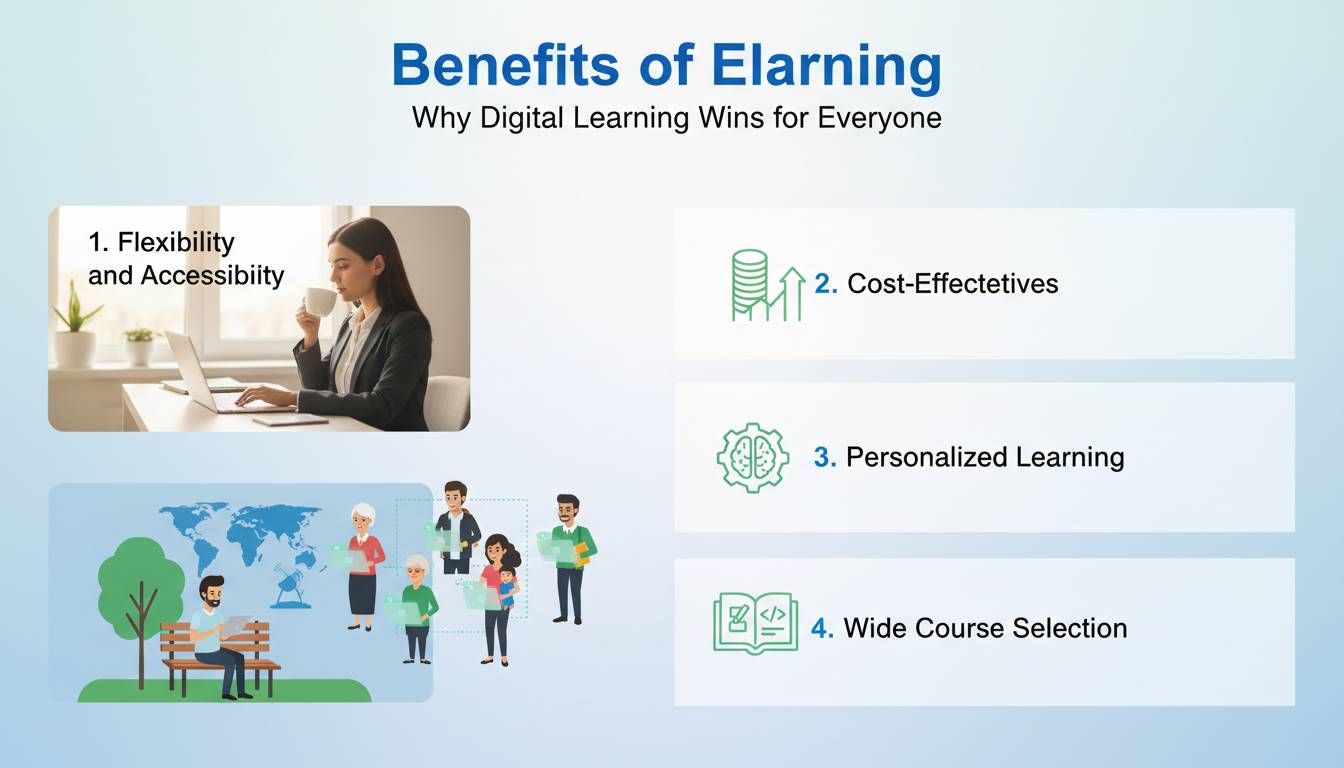
When I review corporate training programs for clients, one transformation stands out above all others: the shift from classroom-based instruction to digital learning. The numbers tell a compelling story—organizations implementing eLearning report training cost reductions averaging 70-85% while simultaneously increasing the volume of instruction delivered. For individual learners, this transition removes geographic barriers that once made quality education accessible only to those living near major universities or corporate training centers.
Digital learning has fundamentally transformed how people acquire skills, pursue degrees, and train employees. Unlike traditional classroom settings constrained by geography, schedules, and fixed curricula, eLearning delivers education directly to learners wherever they have internet access. This delivery method creates measurable advantages that impact learners, organizations, and educational institutions alike.
The global eLearning market reached approximately $250 billion in 2023 and continues growing at compound annual rates exceeding 15%, according to research from HolonIQ, a global education intelligence platform. This growth reflects documented returns: organizations implementing digital training report measurable improvements in employee performance, knowledge retention, and training costs. For individual learners, eLearning offers flexibility that fits careers, family responsibilities, and personal learning styles in ways traditional education never could.
This article examines the specific benefits driving adoption across sectors, supported by research data and practical implementation considerations.
Understanding the eLearning Landscape
Before examining specific benefits, defining what constitutes modern eLearning clarifies why these advantages exist. eLearning encompasses any educational experience delivered through digital technology—ranging from asynchronous courses accessed via learning management systems to live virtual classrooms with real-time instructor interaction.
The landscape spans multiple modalities. Self-paced courses allow learners to progress through pre-recorded content on individual schedules. Synchronous virtual sessions recreate classroom dynamics through video conferencing with instructors and peers. Adaptive learning systems adjust content difficulty based on learner performance. Mobile learning delivers bite-sized content through smartphone applications. Gamified platforms incorporate game mechanics like points, badges, and leaderboards to increase engagement.
This variety matters because different formats suit different learning objectives, content types, and learner preferences. The benefits discussed below apply broadly but manifest differently depending on implementation approach.
Cost Efficiency and Financial Accessibility
One of the most documented advantages of eLearning involves financial savings across multiple dimensions. Traditional education requires physical infrastructure—classrooms, buildings, utilities, maintenance—that drives substantial overhead costs. eLearning eliminates or dramatically reduces these facility expenses.
| Cost Factor | Traditional Training | eLearning | Savings |
|---|---|---|---|
| Per Learner (Corporate) | $1,000-$5,000 | $150-$500 | 70-85% |
| Infrastructure | High (facilities) | Low (cloud hosting) | 60-80% |
| Instructor Time | Limited capacity | Scalable delivery | Variable |
| Travel Expenses | $500-$2,000 avg | $0 | 100% |
The 2023 State of the Industry Report published by the Association for Talent Development documented that companies with effective learning programs—analyzing data from over 350 organizations—saw significantly reduced per-employee training costs while increasing training hours delivered. The shift eliminated travel costs, reduced instructor time per learner, and allowed materials to be reused indefinitely without replacement fees.
For individual learners, eLearning removes geographic and economic barriers to quality education. Students avoid costs associated with relocating to attend universities, daily commuting expenses, and often excessive textbook prices when digital materials substitute for printed versions. Scholarships and payment plans from eLearning platforms expand access further, allowing learners from lower-income backgrounds to access courses previously available only to those who could afford traditional degree programs.
Flexibility and Accessibility
Time flexibility ranks among the most valued eLearning benefits, particularly among working adults balancing careers, families, and other obligations. Classroom-based courses require physical presence at specific times, creating conflicts with work schedules, family responsibilities, and geographic constraints.
eLearning eliminates scheduling conflicts by allowing 24/7 access to course materials. Learners study at 6 AM before work, during lunch breaks, or late at night—whatever schedule suits their energy levels and personal circumstances. This asynchronicity proves especially valuable for shift workers, parents with unpredictable schedules, and caregivers attending to family members.
Geographic accessibility extends educational opportunity beyond local institutions. A marketing professional in rural Nebraska can access courses from instructors at Columbia University without relocation. A small business owner in Southeast Asia can earn certifications from European professional bodies. This democratization of access creates opportunities previously available only to those living near major educational centers or able to relocate.
| Flexibility Metric | Traditional | eLearning |
|---|---|---|
| Schedule Constraints | Fixed times | Anytime access |
| Location Requirements | Physical presence | Anywhere with internet |
| Pace Control | Instructor-determined | Learner-controlled |
| Repeat Opportunities | Limited | Unlimited |
In my experience surveying adult learners across various industries, convenience consistently emerges as the primary motivation for choosing digital programs. The LearningHouse Survey on online education (2019) found that 71% of adult learners cited convenience as their primary reason for selecting eLearning options. This preference drives continued growth as more learners prioritize accessibility over traditional classroom experiences.
Enhanced Knowledge Retention
Cognitive science research consistently demonstrates that certain eLearning design elements improve knowledge retention compared to traditional lecture formats. Active learning—where learners engage with material through quizzes, simulations, exercises, rather than passively receiving information—creates stronger memory traces.
A meta-analysis published in the journal Computers & Education (2019, Bernardo et al.) examined 73 studies with over 8,000 participants and found that eLearning programs incorporating interactive elements produced significantly better retention rates than traditional classroom training. The research attributed this difference to multiple factors: spaced repetition built into digital systems, immediate feedback on assessments, and the ability to revisit difficult concepts without instructor coordination.
Microlearning—delivering content in small, focused segments typically lasting 5-10 minutes—further enhances retention by working with natural attention spans. Research published in the Journal of Applied Psychology demonstrates that spaced learning, combined with active retrieval practice, produces 50% better long-term retention compared to massed practice sessions typical of traditional training.
| Retention Factor | Impact | Source |
|---|---|---|
| Interactive Elements | Significantly higher retention | Computers & Education meta-analysis (2019) |
| Spaced Repetition | +50% long-term memory | Journal of Applied Psychology |
| Microlearning Segments | Improved 30-day retention | cognitive learning research |
| Video + Interactivity | Higher engagement vs lecture | various learning analytics studies |
The ability to control playback in video-based learning contributes significantly. Learners can pause to reflect, rewind to review difficult sections, or accelerate through familiar material. This self-pacing eliminates the common classroom problem where some students struggle to keep up while others become bored waiting for others to grasp concepts.
Personalized Learning Experiences
Traditional classroom education follows a one-size-fits-all model—single curriculum, fixed pace, identical assessments for all learners. eLearning enables personalization that addresses individual learner needs, preferences, and goals.
Adaptive learning technologies assess learner performance in real-time and adjust content difficulty, sequence, and presentation accordingly. Struggling learners receive additional support and simplified explanations. Advanced learners encounter challenging material that prevents boredom. This individualization would be impossible in classroom settings where instructors manage 20-50 students simultaneously.
Learning style preferences also become addressable through eLearning variety. Visual learners access infographics, videos, and diagrams. Auditory learners listen to podcasts and recorded lectures. Kinesthetic learners engage with interactive simulations and hands-on virtual labs. While learning style theory remains debated among researchers, providing multiple modalities certainly increases engagement for diverse learner populations.
Research on personalization in multimedia learning (Mayer’s Cognitive Theory of Multimedia Learning) indicates that allowing learner control over content sequencing supports intrinsic motivation, which predicts completion rates and long-term learning outcomes.
Scalability and Consistent Quality
Organizations training large workforces face inherent challenges with traditional approaches. Hiring enough qualified instructors, coordinating schedules across time zones, and maintaining consistent quality across multiple sessions proves resource-intensive and often impossible. eLearning solves scalability challenges while ensuring every learner receives identical high-quality instruction.
Once developed, digital courseware can serve unlimited learners simultaneously without additional instructor time or marginal costs. A company training 10,000 employees delivers the same content uniformly—no variation in instructor energy, interpretation, or emphasis that inevitably occurs across multiple classroom sessions. Quality control becomes achievable through centralized content development and review processes.
The scalability advantage proves transformative for organizations with distributed workforces, rapid hiring cycles, or compliance training requirements affecting thousands of employees. Retail chains training seasonal workers, healthcare organizations meeting continuing education mandates, and technology companies onboarding frequent new hires all benefit from digital delivery that would be operationally impossible through classroom formats alone.
Real-World Implementation: Case Studies
Corporate Training Success – AT&T
Telecommunications giant AT&T underwent significant workforce reskilling as industry shifts required new digital competencies. The company invested over $1 billion in employee retraining through eLearning platforms, developing custom programs addressing both technical skills and professional development.
Reported outcomes included 60,000 employees completing new certifications within three years, with internal mobility increasing 40% as employees acquired skills for open positions. AT&T calculated that digital delivery reduced training costs by approximately 70% compared to previous classroom-based approaches while increasing the number of training hours completed per employee.
Higher Education Accessibility – Arizona State University
Arizona State University expanded online program offerings significantly beginning in 2011, creating pathways for learners unable to attend traditional campus programs. Online enrollment grew to exceed 80,000 students, with graduation rates for online programs matching or exceeding equivalent on-campus programs.
The university reported that military veterans—students often relocating frequently and unable to commit to fixed campus schedules—showed particularly strong outcomes in online formats, with completion rates higher than traditional programs designed for stationary students.
Healthcare Training – Cleveland Clinic
Cleveland Clinic implemented simulation-based eLearning for medical staff, particularly for rare scenarios requiring specialized knowledge that traditional training struggled to provide frequently enough. Virtual patient simulations allowed practitioners to practice decision-making for uncommon conditions without risking actual patient safety.
Post-implementation assessments showed physician diagnostic accuracy improved for simulated cases, and staff confidence ratings for handling emergency scenarios increased significantly. The hospital system estimated that digital simulation training cost substantially less than equivalent hands-on simulation center access while enabling more frequent practice opportunities.
Common Challenges and Mitigation Strategies
Despite substantial benefits, eLearning implementation presents genuine challenges that organizations and learners should anticipate. Addressing these proactively improves outcomes and reduces frustration.
Self-Motivation and Discipline