

 February 9, 2026
  8 Min
8 Min  No Comment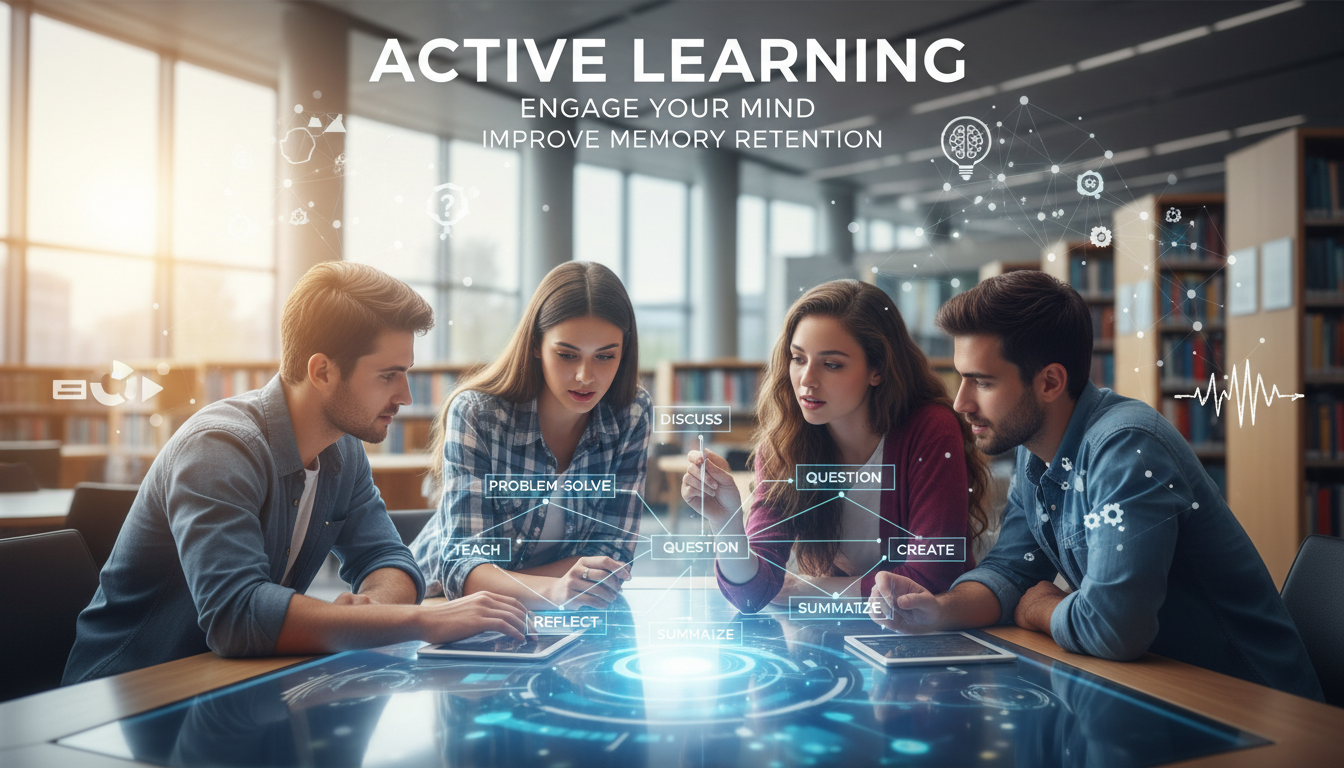
Picture this: You’re mid-lecture, pen moving across paper in aimless loops, and suddenly you realize you’ve drawn a perfect diagram of the mitochondria—while absorbing the professor’s explanation. That seemingly random doodle represents something deeper: your brain processing information through action, not just observation.
Active learning—what many dismiss as fidgeting or distraction—actually transforms passive listeners into engaged thinkers. From my years developing educational programs and observing classroom dynamics, I’ve watched this transformation happen repeatedly: students who struggle with traditional lectures often flourish when given opportunities to explain, debate, or physically act out concepts.
In academic corridors and corporate boardrooms alike, learners who actively participate—through doing, questioning, teaching, drawing—consistently outperform those passively receiving information. This article examines why active learning works, how to adapt it across different contexts, and provides strategies to spark those invaluable “aha” moments. It’s grounded in practical application, not abstract theory.
Why Active Learning Matters for Memory Retention
Memory isn’t passive—it’s constructed through interaction. Beyond listening or reading, our brains respond significantly more strongly during active engagement. A landmark meta-analysis published in Proceedings of the National Academy of Sciences examined 225 studies involving over 30,000 students and found that students in traditional lecture courses were 1.5 times more likely to fail compared to those in active learning environments. The same research documented examination score improvements averaging 6% in STEM fields when active learning replaced passive instruction.
In university seminars I’ve observed, students who summarize lectures in their own words consistently outperform peers who merely re-read notes. This isn’t coincidental—it’s the brain’s preference for novelty and participation. Engaging multiple senses or cognitive pathways creates what researchers call “stickier” learning.
Traditional “sit-and-get” sessions may feel comfortable but often produce fleeting retention. Shifting even part of these sessions into active tasks measurably boosts both attention span and long-term memory—benefits that extend well beyond immediate test performance.
Core Methods That Encourage Brain Engagement
Techniques That Work in Many Contexts
Active learning encompasses diverse methods:
- Self-explanation: Teaching concepts to yourself or others enforces clarity and reveals knowledge gaps.
- Socratic questioning: Asking “why does this matter?” or “how does this connect?” drives deeper thinking.
- Concept mapping: Visually linking ideas helps learners see structures behind terms and theories.
- Role-playing or simulations: Helps embody concepts—like acting out a negotiation or scientific process.
- Peer instruction: Discussing with classmates or colleagues builds memory and understanding collaboratively.
These aren’t rigid rules; learners and instructors typically mix and match depending on time constraints, subject matter, or energy levels. The key principle is variety—relying on a single technique quickly dulls engagement. Mixing approaches keeps content fresh, which paradoxically improves retention.
Real-World Snapshot
In corporate training programs I’ve designed, teams rotating through mini-presentations, role-play exercises, and reflective journaling consistently reported that the structured chaos felt “way more memorable” than smooth, scripted lectures. That productive friction anchors ideas more effectively than passive reception.
Structuring Active Learning for Different Environments
Educational Settings: Classrooms and Lecture Halls
In university lectures, even small tweaks create significant ripples:
- Mini-polls or clicker questions break lectures and reveal student assumptions.
- Think–pair–share: pause for individual reflection, then discuss with a peer before regrouping.
- One-minute papers: at session end, ask “what’s one key takeaway?” to reinforce reflection.
These are simple, low-cost adjustments. Yes, they occasionally create classroom chaos. But that chaos often correlates with deeper cognitive processing—and stronger recall later.
Corporate Workshops and Professional Training
Organizations frequently default to slides and handouts, and while this sometimes suffices, research suggests alternatives prove more effective. Consider flipping the script:
- Start with a problem scenario, let teams prototype or outline solutions.
- Rotate groups to critique or expand each other’s proposals.
- Introduce real-life case studies, then ask learners to rewrite or reapply content to their specific contexts.
This combination of collaboration, critique, and personalization transforms passive listening into active creation—building lasting knowledge rather than temporary familiarity.
The Science Behind Memory and Active Engagement
Memory is notoriously variable; repetition helps, but only when engaging. Cognitive psychology identifies two key phenomena supporting active learning:
- The generation effect: when learners produce information (such as summarizing in their own words), they remember it better than if they had only read it. Research published in Psychological Science demonstrated this effect across multiple experiments.
- Desirable difficulties: a controlled struggle—like working through a challenging concept—actually enhances retention compared to smoother learning paths, according to studies on educational psychology.
As cognitive scientist Robert Bjork has documented, introducing slight difficulties during learning creates what he terms “desirable storage strength”—making memories more durable over time. The initial discomfort isn’t a failure; it’s the mechanism building lasting knowledge.
Practical Tips for Embedding Active Learning Daily
For Students
- Ditch solitary re-reading: try flash recall, closing your book and writing or speaking what you remember before checking notes.
- Transform study groups into micro-teaching sessions—each participant leads a 5-minute lesson on their assigned topic.
- Sketch a mind map instead of linear lists to visualize relationships across concepts.
For Educators and Trainers
- Replace one lecture segment per session with an activity—even a 5-minute reflection creates measurable shifts in engagement.
- Use peer review in writing assignments to deepen understanding and foster ownership.
- Introduce unexpected elements—like counterintuitive facts—that re-engage students after they believe they’ve mastered material.
For Self-Learners
- Turn videos into tools: pause at key moments, predict what comes next, then play and compare your understanding.
- Write brief “explainer” summaries—even private notes—about concepts you’ve solidified.
- Simulate real application: sketch concepts, voice-record self-explanations, or create anything that shifts from passive input to active output.
Cultivating Variety and Sustaining Engagement Over Time
Active learning becomes most effective when varied and unexpected. Consider these strategies:
- Rotating methods across sessions—mapping today, teaching tomorrow, case studies after that.
- Injecting surprise questions or unscripted challenges to break predictability.
- Incorporating collaborative puzzles or games requiring application rather than recall alone.
In organizational settings, teams have transformed mundane quarterly training into interactive challenges—solving narrative-based problems complete with assigned roles. While initially appearing gimmicky, participants recalled processes and underlying principles significantly more vividly weeks afterward.
Benefits vs. Challenges
Benefits
- Higher retention: concepts cement through interaction, not mere exposure.
- Deeper understanding: learners often adapt and apply knowledge more flexibly.
- Increased engagement and motivation: active participation sparks curiosity and sustained interest.
Challenges
- Time pressure: active activities require planning and time—sometimes disproportionate to session length.
- Learner resistance: unfamiliar methods can feel awkward or inefficient, especially initially.
- Logistical complexity: coordinating interactions in large groups or online formats presents practical difficulties.
Yet acknowledging these challenges actually signals that benefits are substantive—meaningful learning rarely arrives easily or comfortably.
Conclusion
Engaging the mind through active learning transcends academic jargon—it’s a practical approach toward lasting memory and deeper comprehension. Whether you’re a student preparing for exams, an instructor designing courses, or a professional pursuing skill development, incorporating purposeful activity—questioning, mapping, teaching, acting—accomplishes more than filling time. It builds resilient knowledge that resists fading.
Next steps: choose one small habit—perhaps explain a concept to someone else today. Build from there. Over time, these individual moments compound into substantial capability—and measurably improved retention.
FAQs
What exactly is active learning?
Active learning refers to techniques involving learners directly—through doing, discussing, questioning, or explaining—rather than passively consuming information. The core principle involves transforming inputs into active outputs.
Does it work for all subjects or just certain fields?
While specific techniques vary by content type, the underlying principle applies broadly—from mathematics and sciences to literature and business. Adaptation matters, but active engagement benefits learners across disciplines.
How much time should I dedicate to active learning methods?
Even brief bursts—five to ten minutes within a session—can noticeably boost retention. Start small: a quick summary, spontaneous reflection, or peer conversation creates measurable differences.
Won’t struggling frustrate learners and reduce motivation?
Moderate difficulty, termed “desirable difficulty” by cognitive scientists, supports deeper learning. Excessive frustration can demotivate, however, so balance challenge with appropriate feedback and support.
Is active learning suitable for online or remote learning setups?
Absolutely. Breakout rooms, live polls, digital whiteboards, and paired assignments maintain engagement in virtual environments. Tools adapt; principles remain constant.
How do I measure if active learning is actually helping?
Observe improved recall, clearer explanations, reduced misconceptions, and more flexible application of knowledge. Learner feedback—enthusiastic statements like “I actually remember that!”—provides telling evidence.
Viewing learning not as a spectator activity, but as improvisation, may feel unfamiliar at first. Yet that unpredictability is precisely where durable knowledge takes root.
