

 February 24, 2026
  13 Min
  No Comment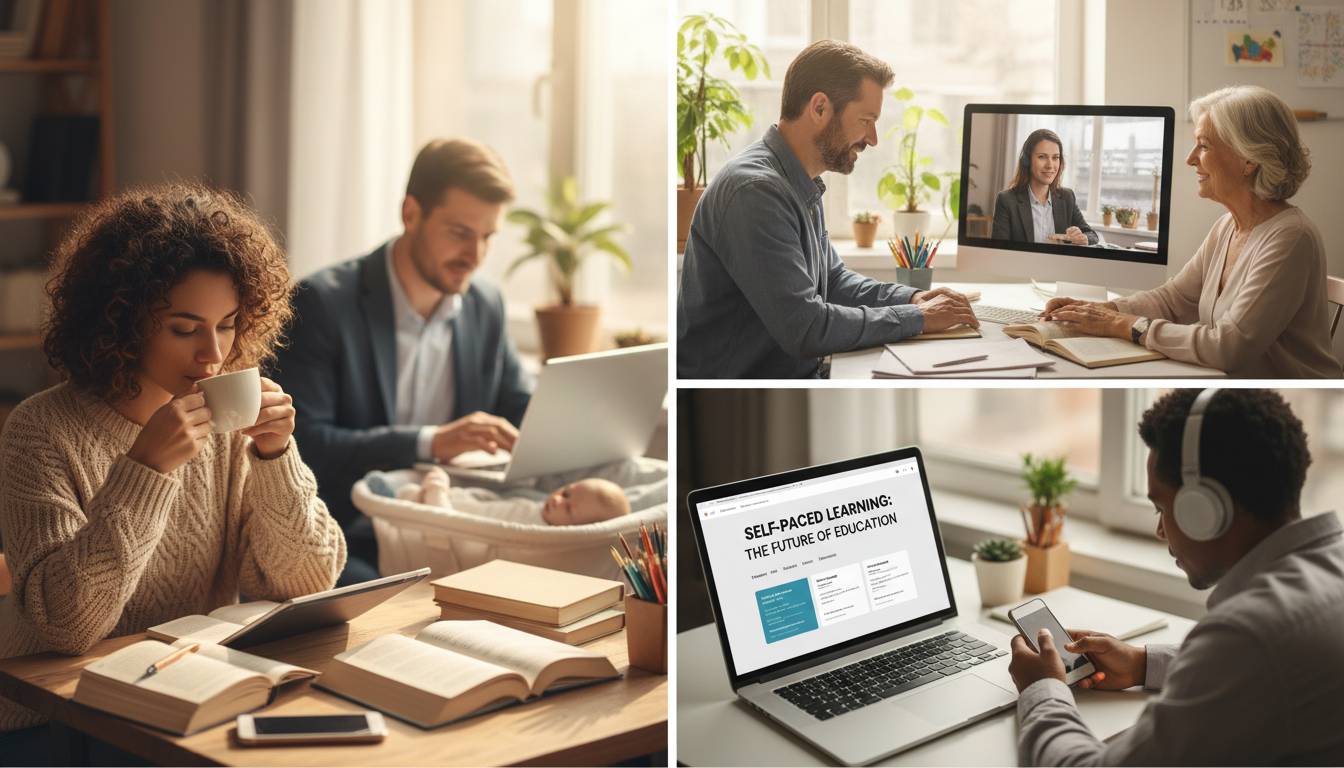
The traditional classroom model—fixed schedules, identical pacing, one-size-fits-all instruction—has dominated education for centuries. But that’s changing fast. A new approach to learning is quickly gaining ground, reshaping how we think about education altogether.
Self-paced learning, which lets learners control when, where, and how they acquire knowledge, is no longer a niche concept. It’s becoming a major force in modern education. From corporate training to K-12 classrooms, from university lectures to online certifications, the shift toward self-paced learning is changing how people of all ages engage with educational content. This isn’t just about convenience—it’s a fundamental rethinking of what learning should look like in the 21st century.
What Is Self-Paced Learning?
Self-paced learning puts the learner in control of their own journey through material. In this model, students progress at a speed that matches their individual needs, rather than following a rigid schedule set by an instructor. They can pause, rewind, and rewatch content. They can skip ahead when they already understand something and linger on difficult material until it clicks. The focus moves from synchronizing a group of diverse learners to honoring each person’s unique cognitive rhythm.
This differs dramatically from traditional classroom instruction, where teachers deliver content at a pace designed for an “average” student—a statistical fiction that rarely matches anyone actually in the room. In a self-paced environment, the learner becomes the driver, while educators and technology serve as guides. The instructor’s role shifts from primary content deliverer to facilitator, mentor, and curator of learning resources.
Self-paced learning shows up in many forms: pre-recorded video lectures watched on own schedules, interactive digital modules with built-in comprehension checks, audiobook versions of textbooks, and adaptive platforms that adjust difficulty based on performance. What ties these together is the core principle: the learner sets the tempo.
Key Benefits of Self-Paced Learning
The advantages of self-paced learning go beyond simple convenience. Research and real-world implementation have revealed a range of benefits that make this approach particularly effective for modern learners.
Flexibility is the most obvious advantage. Learners can access materials when it suits their energy levels, work schedules, and personal lives. A night owl can study at 2 AM. A working parent can learn during lunch breaks. A traveler can continue coursework from anywhere in the world. This flexibility removes logistical barriers that often stop people from pursuing education in the first place.
Self-paced learning also reduces anxiety and pressure. In traditional classrooms, students often feel rushed through difficult concepts while bored by material they already know. That mismatch creates stress and disengagement. Self-paced learning removes that pressure. Students can fail privately, retry quietly, and move forward only when genuinely ready. The psychological safety this creates encourages deeper engagement and more authentic learning.
The approach accommodates diverse learning styles and speeds. Some learners process information quickly and want to move fast. Others need more time with complex concepts. Self-paced learning honors this diversity rather than forcing everyone into the same mold. Visual learners can spend extra time with diagrams. Auditory learners can replay explanations. Kinesthetic learners can engage with interactive exercises—all at their own pace.
Cost efficiency is another significant benefit. Once educational content is created, it can reach unlimited learners without additional marginal costs. This scalability makes high-quality education more accessible and affordable, particularly for institutions with limited budgets.
The Research Behind Self-Paced Learning
The effectiveness of self-paced learning isn’t just theoretical. A substantial body of research supports its advantages over traditional synchronous instruction.
Studies across multiple educational contexts consistently show that self-paced learners demonstrate higher retention rates and better performance on assessments. Researchers at the Open University in the United Kingdom found that students who controlled their learning pacing showed improved motivation and deeper engagement with course materials. Another study published in Computers & Education found that self-paced learning environments led to better learning outcomes compared to instructor-led sessions, particularly for complex technical content.
The research is especially compelling in corporate training. Organizations that have implemented self-paced learning programs report faster time-to-competency for new employees and higher completion rates for optional professional development. A report from the Association for Talent Development found that self-paced learning can reduce training time by up to 60% while maintaining or improving knowledge retention.
Neuroscience provides additional support. The brain doesn’t learn uniformly at a fixed speed. Cognitive processing varies based on prior knowledge, sleep quality, stress levels, and material complexity. Self-paced learning aligns with how the brain actually processes information, allowing for the pauses and repetition that consolidate memory formation.
“When learners control the pace of their instruction, they engage more deeply with the material and develop stronger metacognitive skills,” notes research from Stanford University’s Center for Academic Publishing. “This leads to more durable learning that transfers more effectively to real-world applications.”
How Self-Paced Learning Improves Retention
The connection between self-paced learning and better retention rests on several psychological and neurological mechanisms that research has documented well.
The spacing effect plays a crucial role. Self-paced learning naturally allows for distributed practice—the idea that learning is more effective when study sessions are spaced out over time rather than crammed into one session. Learners can revisit material over days or weeks, reinforcing neural pathways with each return. This fights the “forgetting curve” that causes rapid knowledge loss after traditional cramming.
Active retrieval practice is also facilitated when learners control their progress. In self-paced environments, students must actively decide when they’re ready to move forward, which often involves self-testing or attempting to explain concepts in their own words. This active engagement strengthens memory more effectively than passive content consumption.
The testing effect—the finding that taking tests improves subsequent learning—can be incorporated more easily into self-paced curricula. Adaptive platforms can present comprehension checks at optimal intervals, using the act of retrieving information to cement learning.
Emotional regulation also contributes to retention. When learners feel stressed, rushed, or overwhelmed—as often happens in traditional classroom settings—the prefrontal cortex, responsible for memory formation and reasoning, works less effectively. Self-paced learning reduces these stressors, creating better conditions for the brain to encode and store new information.
Metacognitive development improves alongside retention. Self-paced learners must develop skills in assessing their own understanding, identifying knowledge gaps, and regulating their study habits. These metacognitive abilities improve immediate learning outcomes and serve learners throughout their lives as they encounter new skills and domains.
Implementing Self-Paced Learning
Moving from traditional instruction to self-paced learning requires thoughtful planning and the right infrastructure. Successful implementation involves several key considerations that educators and organizations should address.
Content design must prioritize clarity and modularity. Self-paced courses work best when broken into discrete, manageable units that learners can complete in relatively short sessions. Each module should have clear learning objectives and built-in opportunities for practice and self-assessment. The content should be engaging enough to maintain motivation while structured enough to ensure coverage of essential material.
Technology infrastructure matters enormously. A solid learning management system forms the backbone of any self-paced program. The platform should track progress, provide analytics on learner performance, support multiple content formats, and integrate with other systems the organization uses. Mobile compatibility is essential, since many learners access materials on smartphones and tablets.
Instructor support remains critical, even in self-paced environments. While learners control their progress, they still need access to experts who can answer questions, provide feedback on assessments, and offer guidance when stuck. This support can come through office hours, discussion forums, chatbots, or AI-powered tutoring systems—but it must be available.
Onboarding and orientation help learners succeed. Self-paced learning requires different skills than traditional classroom attendance. Learners must develop time management habits, self-motivation strategies, and metacognitive awareness. Providing orientation modules or guides that help students develop these skills improves completion rates and learning outcomes.
Social connection should be intentionally designed. One criticism of self-paced learning is that it can feel isolating. Successful implementations address this by incorporating peer interaction through discussion forums, group projects, or collaborative exercises. These social elements maintain engagement and provide the collaborative learning benefits that humans naturally seek.
Challenges and Solutions
Despite its many advantages, self-paced learning isn’t without obstacles. Addressing these challenges is essential for successful implementation.
Procrastination remains the most common pitfall. When learners control their own schedules, some struggle to maintain discipline. Without external deadlines, work piles up, and students may fall dangerously behind. The solution involves strategic use of internal deadlines, progress tracking that creates accountability, and engagement strategies that maintain motivation. Some programs use gamification elements—badges, streaks, progress visualizations—to encourage consistent engagement.
Initial confusion about learning strategies can hinder progress. Many students arrive with years of traditional education that trained them to wait for instructions rather than direct their own learning. They may not know how to allocate time effectively or how to identify their own knowledge gaps. Providing explicit instruction in learning strategies—including how to take notes, how to self-test effectively, and how to manage a learning schedule—addresses this gap.
Technical barriers can exclude some learners. Not everyone has reliable internet access, appropriate devices, or the digital literacy needed to navigate complex learning platforms. Ensuring accessibility requires providing multiple ways to access content, offering support for learners who struggle with technology, and maintaining alternative options for those without stable connectivity.
Assessment in self-paced environments requires rethinking. Traditional exams administered at fixed times may not accurately measure learning that has occurred asynchronously. Competency-based assessments that allow learners to demonstrate mastery when ready align better with the self-paced philosophy. Portfolios, projects, and practical demonstrations can complement or replace time-bound tests.
Accreditation and credentialing present ongoing challenges. Many industries and professions still require evidence of learning that occurs within specific timeframes. As self-paced learning becomes more mainstream, credentialing bodies and employers are increasingly recognizing alternative forms of proof, but this evolution takes time.
The Future of Education
The trajectory is clear: self-paced learning will play an increasingly central role in education at all levels. Several converging trends accelerate this shift.
Workforce demands are driving change. The skills required in the modern economy evolve rapidly. Traditional degree programs can’t keep pace with changing industry needs. Self-paced learning allows continuous upskilling throughout careers, enabling workers to adapt to new requirements without leaving their jobs to pursue full-time education.
Generational expectations are evolving. Digital natives who have grown up with on-demand content—streaming video, social media, personalized recommendations—expect similar customization in their education. The fixed schedule of traditional schooling feels increasingly out of step with how younger generations consume information.
Technological advances make self-paced learning more powerful. Artificial intelligence enables truly adaptive learning experiences that adjust in real-time to each learner’s needs. Virtual and augmented reality create immersive educational environments accessible from home. Natural language processing powers intelligent tutoring systems that can answer questions and provide feedback at scale.
Globalization expands access. Self-paced learning transcends geographic boundaries in ways that traditional classroom instruction cannot. A student in a rural community can access the same high-quality content as one in a major city. A professional in a developing economy can earn credentials from top institutions without relocating.
The post-pandemic world has normalized remote and flexible learning. The COVID-19 pandemic forced educational institutions worldwide to experiment with asynchronous, self-paced approaches. Many discovered these methods worked better than expected—and students developed expectations for continued flexibility.
Looking ahead, the most successful educational institutions will be those that blend self-paced learning with meaningful human connection. Pure self-paced approaches, while effective for many learners, may not serve everyone equally. The future likely involves hybrid models that combine the flexibility and personalization of self-paced learning with the mentorship, collaboration, and community that humans derive from interacting with teachers and peers.
Frequently Asked Questions
What is self-paced learning?
Self-paced learning is an educational approach that lets learners control the timing, speed, and sequence of their learning. Rather than following a fixed class schedule, students progress through material at their own pace—faster learners can advance quickly while those needing more time can take it.
What are the main benefits of self-paced learning?
The primary benefits include flexibility in scheduling, reduced anxiety, accommodation of diverse learning speeds, improved retention through spaced practice, and cost efficiency. Learners also develop stronger metacognitive skills as they take responsibility for directing their own education.
How does self-paced learning improve retention?
Self-paced learning improves retention through several mechanisms: the spacing effect (distributing study over time), active retrieval practice (self-testing before moving forward), reduced stress (allowing the prefrontal cortex to function optimally), and metacognitive engagement (requiring learners to assess their own understanding).
What are the challenges of implementing self-paced learning?
Common challenges include procrastination, initial learner confusion about self-directed study strategies, technical barriers, assessment design, and credential recognition. These can be addressed through strategic support structures, clear orientation programs, accessible technology, and competency-based assessment options.
Conclusion
Self-paced learning represents more than a technological innovation in education. It embodies a fundamental shift in how we think about knowledge acquisition—a shift from the industrial model of mass-producing learning at fixed rates to an organic approach that honors individual cognitive rhythms. The evidence is clear: when learners control their own pace, they learn better, retain more, and develop skills that serve them throughout their lives.
The transition won’t be seamless. It requires new skills from learners, new approaches from educators, and new infrastructure from institutions. But the direction of travel is unmistakable. As workforce demands evolve, as technology enables more sophisticated personalization, and as generations raised on on-demand content enter educational institutions, self-paced learning will become not just an option but an expectation.
The future of education isn’t about choosing between self-paced and traditional instruction. It’s about designing learning experiences that combine the best of both approaches—the flexibility and personalization of self-paced learning with the community and mentorship that human connection provides. That hybrid future is already emerging, and it promises an education system more responsive to learners, more effective at building knowledge, and more aligned with how humans actually learn.
