

 February 8, 2026
  5 Min
5 Min  No Comment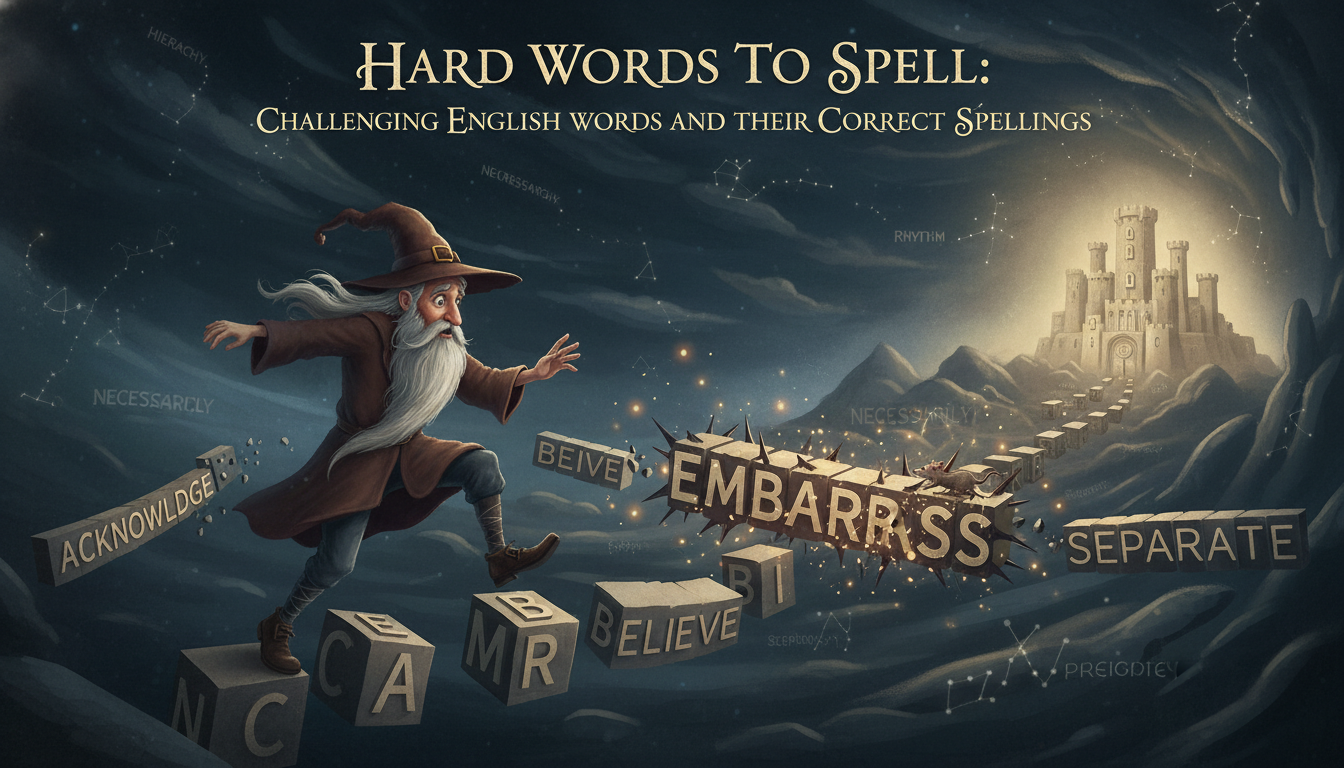
Spelling in English often feels like navigating a wordy obstacle course—thanks to silent letters, double consonants, foreign borrowings, and downright illogical patterns. Words that should be straightforward twist into traps: “necessary” with its puzzling s’s and c’s, or “pneumonia” with that sneaky silent p. This article looks at some of the most notoriously hard words to spell, digs into why they trip us up, illustrates how to master them with real-world examples, and even shares a quote from an expert tip or two. Let’s dive into the chaos—and emerge more confident.
## Why Certain English Words Are Hard to Spell
Historical Sprawl and Borrowings
English is a linguistic house where everyone kept bringing over furniture—Latin, French, Greek, Germanic, and more—and none of those pieces always fit neatly together. That’s why “bureaucracy” has that jumbled vowel-consonant combo, and “connoisseur” wears its French heritage on its sleeve .
Silent Letters & Double Consonants
Silent letters are like uninvited guests—you hear them, but they don’t show up phonetically. Words like “knapsack,” “island,” or “gnaw” hide letters that fall quiet in pronunciation . And then there’s the double consonant dilemma—should it be one m or two? One c or three? “Accommodate,” “committee,” “misspell”—they’re all guilty of drowning in duplicate letters .
Homophones & Misleading Phonetics
“Rendezvous” and “quarantine” are audio illusions—they sound simpler than they look on the page . And then “minuscule” vs. “miniscule”—so easily mixed because it sounds like “mini”—but the correct version saves the u .
## Examples of Challenging Words and How to Tackle Them
Here’s a breakdown of some classic troublemakers and how to tame them:
Double Letter Trouble
Words like accommodate, committee, embarrass, necessary, misspell, possession, and vacuum are infamous for their duplicate letters. A mnemonic for “necessary”? Try imagining one collar and two sleeves—or simply repeat the word slowly and test your memory .
Silent Letter Snafus
- Pneumonia, receipt, subtle, gnome, and island hide crafty silent letters that keep your fingers guessing during typing .
- Wednesday throws in a silent “d” from old Germanic roots—don’t let it fool you .
Foreign Words That Stick
- Bureaucracy and cacophony bring Greek and French complexities to your keyboard .
- Chiaroscuro? Trip over the Italian spelling as you recall its artsy meaning.
- Entrepreneur, charcuterie, liaison, bourbon, Connecticut, and Massachusetts wear their diverse origins proudly—and challenge your fingers fiercely .
Long, Rare, or Ornate Words
- Antidisestablishmentarianism—a political mouthful from 19th-century Britain—holds up as one of the longest non-technical English words and famously tested on old game shows .
- Floccinaucinihilipilification is even more absurdly long—basically meaning “considering something worthless”—and not for faint-hearted spellers .
- Others, like sacrilegious, chrysanthemum, bougainvillea, and schwarzenegger, layer on length and complexity through unusual endings and rare consonant clusters .
Sneaky Phonetics
- Minuscule often looks like it should have an “i,” but no—stick with the u .
- Epitome? You might instinctively want a “y” at the end, but the “e” is correct, carrying a Greek-derived vowel pattern .
“Breaking words into smaller syllables—like di–chot–omy or con–nois–seur—helps make complex spellings feel manageable rather than monstrous.”
## Strategies to Spell Like a Pro
Chunk It, Syllable by Syllable
Breaking words into fragments like con–nois–seur or epi–to–me can turn a brain-bender into something approachable .
Mnemonics for Memory
Use visuals or quirky sentences: maybe “Never Eat Cake, Eat Salmon Sandwiches And Remain Young” helps with necessary—even if it’s a bit goofy, it works .
Read, Say, Type, Repeat
Repeating the tricky word—seeing it, saying it, writing it—activates memory in multiple ways. It’s old school, but it sticks.
Leverage Quizzes or Tools
Platforms like Vocabulary.com offer spelling bees, flashcards, and quizzes—great for turning spelling practice into play .
Conclusion
English spelling can make even seasoned writers pause—thanks to silent letters, foreign spellings, doubling, and just plain inconsistency. But habits like breaking words down, using mnemonics, practicing repetitive recall, and trying vocabulary tools can turn daunting words like accommodate, pneumonia, or connoisseur into conquerable challenges. It takes persistence—but rhyme, chunk, repeat, and you’ll see steady improvement.
FAQs
What makes English words so difficult to spell?
English spelling is a patchwork of multiple language influences, inconsistent phonetics, silent letters, and irregular rules—making the path from sound to spelling often unpredictable.
How can I remember words like “necessary” or “accommodate”?
Chunk the words into parts, use playful mnemonics to latch onto letter patterns, and repeatedly see, say, and write them to strengthen recall.
Are foreign-derived words always harder to spell?
Often they are trickier, thanks to their original spelling patterns—from French connoisseur to Italian chiaroscuro. Familiarity and chunking help overcome those hurdles.
Any quick tricks for tackling very long words?
Start by syllable-breaking, then tackle small segments sequentially. With repetition and maybe a mnemonic anchor, even antidisestablishmentarianism starts to look less scary.
Are interactive tools helpful for mastering spelling?
Absolutely—flashcards, spelling bees, and quiz apps from sites like Vocabulary.com can make consistent practice far more engaging and effective.
