

 February 12, 2026
  9 Min
9 Min  No Comment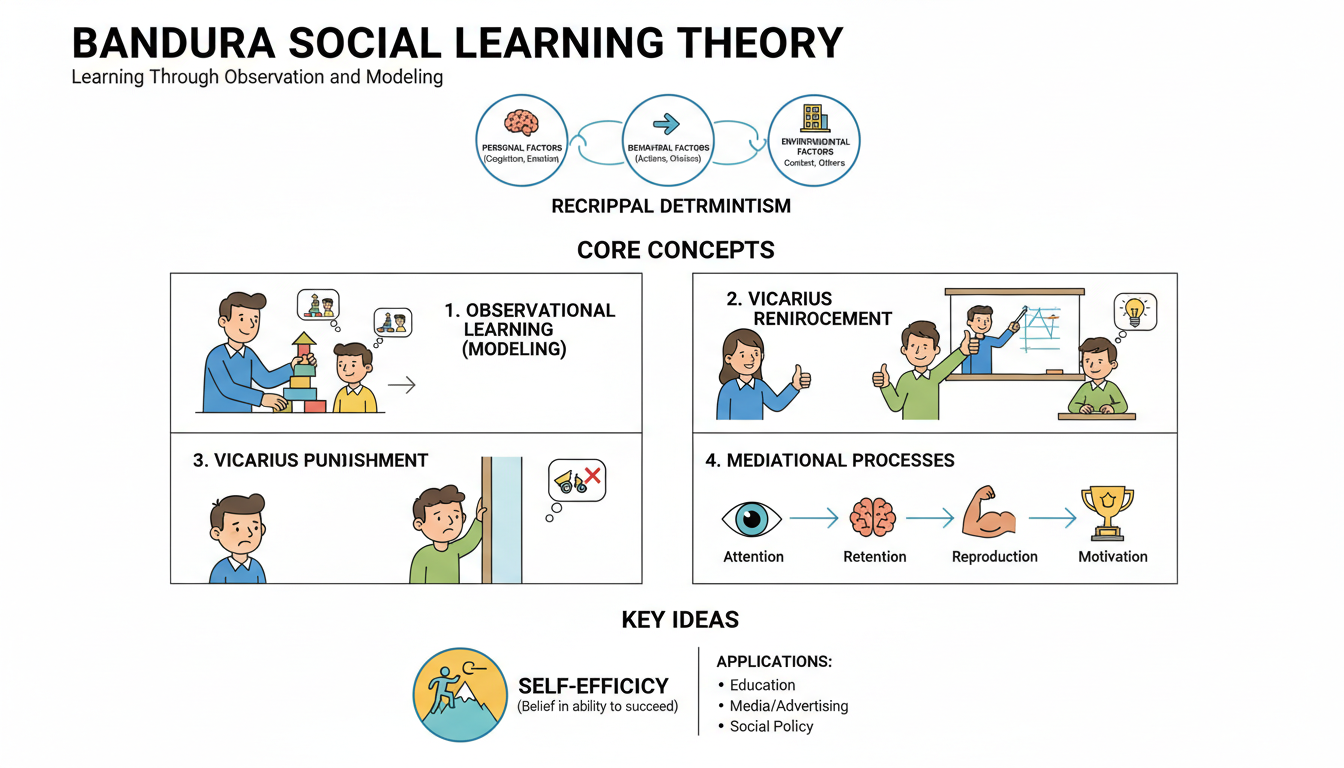
The Bandura Social Learning Theory sheds light on how people—kids, teens, grown-ups—pick up behaviors, attitudes, even emotional responses just by watching others. It’s sorta obvious if you think about how kids imitate adults, but the theory digs deeper: we don’t only mimic actions; we internalize intentions, consequences, context. In everyday life, from the playground to the boardroom, learning through observation is powerful, pervasive…and kinda messy. This article unpacks how Bandura’s ideas apply to real settings, why—and when—it works (or doesn’t), plus how professionals and educators are using this model in modern times.
The Roots and Core of Social Learning
Bandura didn’t pop out with this idea in a vacuum. Observational learning, or social learning, extends traditional behaviorist thought. While behaviorists stressed conditioning, Bandura emphasised that a lot of learning happens vicariously, just by watching. He introduced four key processes—attention, retention, reproduction, motivation—that need to happen for observational learning to stick.
1. Attention: What Catches Our Eyes (and Minds)
You notice things that are interesting, emotionally charged, or come from people you respect. Mix in novelty or surprising outcomes, and your attention spikes. In a classroom, a lively demo outperforms a monotone lecture. In real life, think of teenage fans mimicking music stars, not just because of the music, but because those stars seem “cool,” rebellious, or aspirational.
2. Retention: Storing the Behavior (Mentally)
This part is where mental representation matters. You need to process and hold onto what you observe—through imagery, symbolic coding, talking it out. Even a fleeting action can get retained if it’s striking enough. That’s why memorable commercials, with outrageous visuals or catchy taglines, stick around in our heads way longer than bland ones.
3. Reproduction: Trying It Out Yourself
Watching isn’t enough—you actually have to try, practice, refine. When kids imitate adults pouring coffee, they aren’t perfect at first—but through trial, error, feedback, they refine that behavior. In workplaces, apprentices shadow pros and, over time, reproduce complex tasks with growing competence.
4. Motivation: What Drives Us to Imitate
You’re more likely to copy behaviors that seem rewarding—socially, emotionally, practically. A coworker praised for a confident presentation? You might mimic that posture or speech style. If a behavior rarely pays off or seems risky, you’re less inclined to imitate. Observing consequences for others matters a lot here—vicarious reinforcement or punishment shapes whether you’re motivated.
“Observation without involvement doesn’t imprint. It’s the watching, remembering, testing—and seeing it pay off—that anchors behavior.”
That’s not a direct Bandura quote, but it nails the idea: all four elements must be in sync for learning to emerge.
How Bandura’s Theory Manifests in Real-World Contexts
Let’s take the theory off the dusty bookshelf and into daily life—where its quirks, strengths, and limitations matter.
Education and Teaching Settings
In classrooms, observational learning is central. Teachers model problem-solving strategies out loud. Students might tackle math problems, hearing the internal reasoning: “Okay, I need to isolate x… subtract, divide… aha.” That think-aloud is a form of modeling retention and reproduction. Peer examples also count—classmates displaying prosocial behaviors can cascade, especially when reinforced.
Beyond traditional classrooms, consider digital learning platforms. They often include video-based demonstrations: “Here’s how we’ll do this step.” Seeing someone execute a procedure gives learners that vital visual and cognitive map to mirror.
In the Workplace: Mentoring, Training, and Culture
Mentorship is steeped in social learning. New hires watch veterans navigate meetings, tone, email etiquette, conflict. Over time, the behaviors that net rewards seep into the newcomer’s toolkit. Some companies even formalize it: shadowing programs, peer observation sessions, recorded session reviews. These efforts intentionally embed Bandura’s model, though not by name.
Case in point:
At a mid‑sized marketing firm, new account managers sit in on client calls led by senior peers. Afterward, they role-play similar situations, then get feedback. This sequence touches all four processes: they pay attention, internalize language, practice, then adjust based on real reactions. That scaffolding accelerates skill acquisition.
Media and Digital Culture: Behavioral Contagion Online
Social media is a petri dish for observational learning. A TikTok influencer tries a quirky DIY hack, seemingly succeeds, and bam—tens of thousands of users imitate that hack, skipping skeptical testing. Why? They saw it, they retained it, they figured “hey, looks fun or efficient,” and they reproduce. But there’s minimal feedback loop—results vary widely.
This shows a flaw: if the observation lacks nuance (like the effort behind the scenes), people might overgeneralize. That’s why experts warn against overreliance on social proof without context.
Parental Influence and Childhood Learning
Kids soak up parental actions like sponges. A parent expressing frustration through yelling teaches emotional regulation—useful or not. Likewise, daily rituals—like reading before bed—become ingrained through repetition and implicit reinforcement. And it’s not just direct imitation: children observe relational dynamics, coping strategies, even language nuances.
When Observation Fails—or Misleads
Observation is powerful, but imperfect. Here are circumstances where the four processes break down:
Cognitive Overload and Distractions
Too much complexity—or too much going on—can wreck attention. Watching a dense training video with multiple overlays may be overwhelming. Learners might miss critical cues, hampering retention and reproduction.
Low Motivation Due to Lack of Reinforcement
Even if someone models positive behavior, if it’s not clearly rewarded, observers may not bother trying. Imagine a brilliant strategy shared at work but ignored by leadership—colleagues could learn it, but without visible payoff, they won’t go out of their way to reproduce.
Stereotypes and Negative Role Modeling
Not all models are positive. If a high-status individual showcases harmful or stereotypical behavior, observers—especially youth—might absorb it, distorting their own behavior. Social learning isn’t moral—it’s neutral. What matters is who’s modeling and what they’re modeling.
Misleading or Edited Representations
Digital platforms often present edited highlights. Watching a curated montage can create unrealistic expectations. Say someone models “effortless success.” Observers may try to replicate it, only to face the messy reality behind-the-scenes. That gap can lead to frustration or dropout.
Strategies to Leverage Social Learning Effectively
Having seen both strengths and pitfalls, here’s how educators, trainers, leaders can maximize the upside.
Intentional Modeling with Commentary
When demonstrating an action, narrate your thinking. Explain why you do each step. Highlight pitfalls. This scaffolds retention and assists observers in mapping behavior to outcomes.
Scaffolded Practice with Feedback Loops
Pair observation with guided practice. Let observers try a simplified version, then provide feedback. Over time, complexity increases. This aligns with the reproduction and motivation phases.
Use Multiple Models and Diverse Examples
Include a range of models—varied in style, background, approach. This tests adaptability and reinforces that multiple paths lead to success, not just the “one right way.”
Highlight Realistic Consequences
Be transparent about effort, failure, and adjustment. When modeling, don’t just show the win—briefly mention the missteps. That builds trust and prepares observers for likely challenges.
Channel Design to Support Observational Learning
Whether in a workplace learning portal or consumer app, structure content to pause for reflection. Maybe include short questions like “What did you notice?” or “How could you try that this week?” This nudges retention and intent.
Expert Insight: Beyond the Four Processes
Behavioral scientists note that Bandura’s model isn’t static—it interacts with factors across culture, identity, and technology. Researchers studying remote teams, for example, find that video-based modeling helps but often lacks social nuance like tone or informal cues. They emphasize hybrid models—real-life shadowing paired with digital rehearsal—as most effective.
Media psychologists also point out that observational learning via screens often skips the feedback loops—motivation can dwindle without community validation. Online learning platforms can patch this: peer comments, progress badges, mini assessments all aim to recreate the invisible boosts that happen in live contexts.
Ethical and Trustworthy Practice: Trust, Expertise, Authority
Using Bandura thoughtfully isn’t just about effectiveness—it’s about trust. Leaders and educators modeling values such as vulnerability, equity, respect—and doing so publicly—build credible culture. Observers learn not by instruction, but by immersion in environment. That underscores E‑E‑A‑T: when someone with experience leads transparently, using their expertise to model behaviors, the resulting social learning is more authentic and lasting.
Conclusion
Observation is more than mimicry—it’s a complex, layered process involving attention, retention, reproduction, and motivation. Across classrooms, workplaces, digital platforms, parents’ homes—Bandura’s theory reveals how we absorb behavior from our surroundings. But to make it work well, modeling must be intentional, context-rich, iterative, and ethically grounded. When learners see not just what to do, but why and how (including mistakes), learning solidifies. Observational learning, done thoughtfully, becomes a bridge between theory and lived human experience—messy, dynamic, but deeply meaningful.
FAQs
What is Bandura’s Social Learning Theory in simple terms?
It’s the idea that people can learn behaviors, attitudes, and emotional responses by watching others. It involves paying attention, remembering what’s observed, practicing it themselves, and being motivated to repeat it.
What are the four key components of observational learning?
They are attention (noticing the behavior), retention (remembering it), reproduction (trying it out), and motivation (having reason to repeat it).
How can educators apply this theory effectively?
By modeling behaviors while explaining thought processes, encouraging learners to practice with feedback, and showing both successes and failures for realism.
Why doesn’t observational learning always work online?
It may lack social nuance, feedback, and context. Without reinforcement or interaction, observers may lose motivation or misinterpret cues.
Can negative behaviors be learned just by watching?
Absolutely. Observational learning is neutral—if someone sees harmful or biased behavior by a model, they can internalize it. That’s why ethical modeling is essential.
How does Bandura’s theory support mentorship and training?
By pairing shadowing or modeling with active practice and feedback, mentors help learners internalize behavior patterns and increase confidence in reproducing them.
