

 February 11, 2026
  7 Min
7 Min  No Comment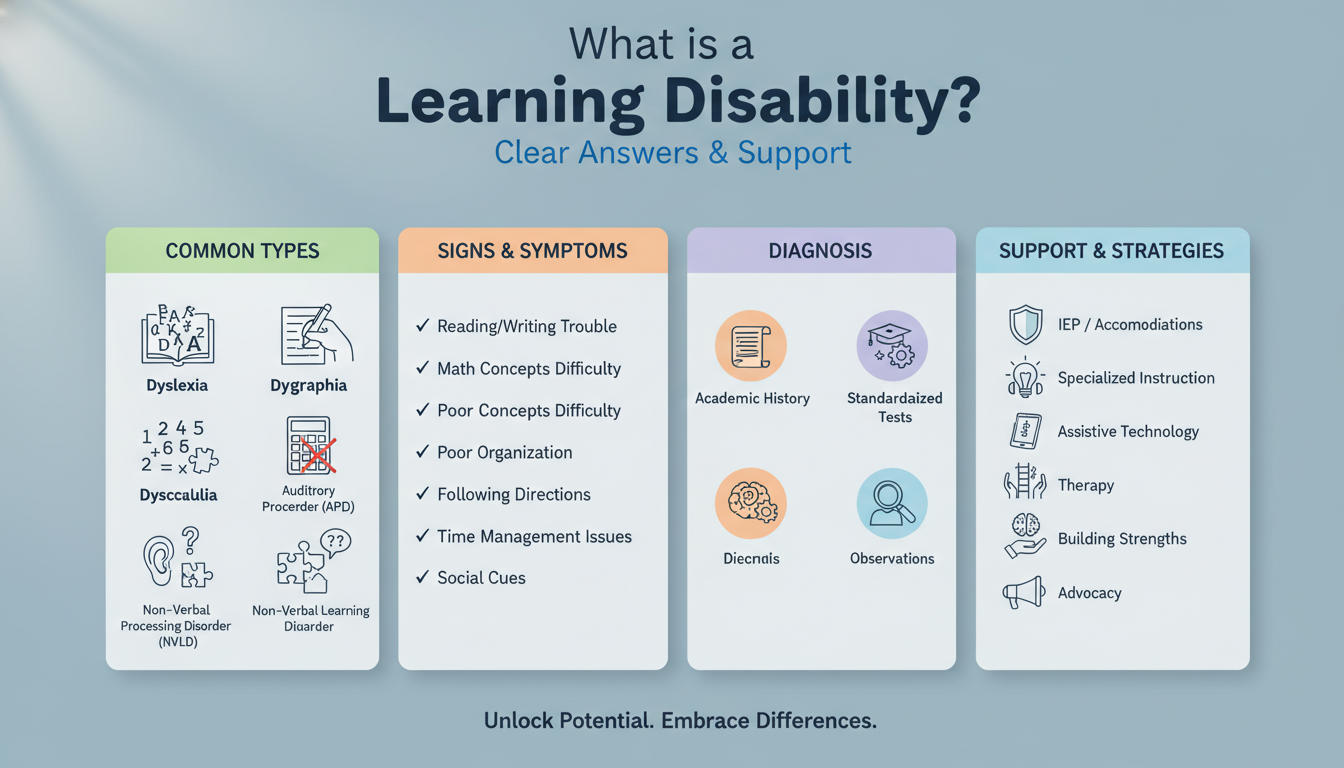
Everyday conversations sometimes trip over the phrase learning disability, and that’s understandable—it’s a complex, often misunderstood topic. Let’s unpack it, in a way that feels conversational—like we’re discussing it over coffee—without losing depth or clarity.
What Is a Learning Disability?
A learning disability refers to a neurodevelopmental condition where individuals face enduring challenges in specific academic or life skill areas, such as reading, writing, mathematics, or processing information. Crucially, these difficulties:
- Exist despite appropriate intelligence levels and effective teaching.
- Reflect differences in how the brain processes information, rather than limits of effort or motivation.
In simpler terms, think of it like this: two people might see the same recipe, but their brains interpret instructions differently—one breezes through, while the other may need creative strategies or extra time.
Diverse Presentations Across Individuals
Learning disabilities vary widely. For instance:
- Dyslexia often affects reading fluency and decoding.
- Dyscalculia interferes with number sense and math reasoning.
- Dysgraphia can hamper writing legibility and structure.
Yet, these can co-occur or present uniquely—one person might struggle with reading comprehension but excel verbally, another could thrive in storytelling while grappling with math sequencing. This diversity means it’s rarely one-size-fits-all.
Why Definitions Matter—and Why They Sometimes Trip Us Up
Misconceptions abound because definitions shift across contexts—in schools, policy, or therapy. For example, educational systems may label someone with a “specific learning disability” using criteria that differ state-by-state. In clinical settings, assessments may be more nuanced. This variance can lead to frustrations:
- Parents seeking support encounter inconsistent thresholds.
- Students feel “diagnosed” under one system but don’t qualify for services under another.
The Real-World Impact
In practice, these inconsistencies have big ripple effects. A child might get an Individualized Education Program (IEP) in one district but get overlooked in another. Meanwhile, adults who learned creative coping methods may go undiagnosed entirely, despite still navigating academic or workplace challenges.
That said, this variability isn’t all bad—it highlights the importance of local advocacy and individualized approaches.
Supporting People with Learning Disabilities: Strategies That Work
Let’s pivot to solutions—because understanding must lead to support. Support strategies fall into several complementary categories:
Educational Accommodations and Assistive Technology
Accommodations—like extra test time, note-taking assistance, or alternative formats—empower learners. Technology, such as text-to-speech tools, speech-to-text software, and visual organizers, can bridge gaps. Some students, with such support, outperform their peers, simply because the playing field is more even.
Multi-Sensory and Structured Instruction
Programs embedding multisensory approaches—say, blending sight, sound, and touch—help reinforce learning. The Orton–Gillingham approach, for example, is often used for teaching reading to individuals with dyslexia; it systematically builds from phonological awareness to complex text. Interventions like this often yield steady improvement when applied consistently.
Emotional and Social Support
Learning challenges don’t exist in isolation—they affect confidence, peer relationships, and mental health. Support networks—teachers who stay curious, parents who advocate (even imperfectly), therapists, mentors—create environments where individuals feel seen, not defined by labels.
“Recognition without belittling, support without enabling—those are the relationships that change lives,” said an educator specializing in neurodiverse learners.
Lifespan Perspective
Learning disabilities persist beyond childhood. High schoolers navigating college prep, adults balancing learning with work and family—everyone benefits from adaptable strategies. Someone who used paper-based cues early on might later rely on digital tools or collaboration.
That continuity of support, often missing, can mean the difference between thriving and just scraping by.
Real-World Examples: Stories of Adaptation and Persistence
A few snapshots illustrate how different strategies apply:
-
High school sophomore with dyslexia: Read aloud during class using a text-to-speech app, while also attending a peer reading group. Over time, both confidence and reading fluency improved—not dramatically overnight, but gently, steadily.
-
College student managing dyscalculia: Prefers narrated tutorials and visual breakdowns of formulas. Math anxiety faded once foundations were built using video walkthroughs, guided practice, and word problems tied to real-life situations.
-
Working professional with dysgraphia: Uses voice dictation and outlines before drafting reports. Juggling complex ideas becomes easier when thoughts don’t stall on spelling or letter formation.
These examples echo a principle: with tailored tools, empathy, and patience, individuals often unlock potential they didn’t know they had.
Moving Beyond Labels: Emphasizing Strengths and Strategies
Labels like “dyslexia” or “learning disability” serve a purpose—recognition, planning, access to services—but they shouldn’t define the person. Many people with learning differences exhibit strengths in creativity, critical thinking, empathy, or resilience borne of navigating challenges. Highlighting those strengths shifts the conversation from deficit to difference.
Practically, this means:
- Focusing on skill-building while leveraging natural abilities (visual reasoning, verbal fluency, problem-solving).
- Collaborating with learners to co-design strategies—after all, they know what works best in real life.
Building Trust Through Expertise and Compassion
True support balances professionalism with empathy. Experts—educators, clinicians, advocates—bring methodologies and data, but impact grows when paired with trust and adaptability. Families and professionals who work together, even imperfectly, tend to progress further than isolated systems striving for textbook solutions.
That lived experience, the trial-and-error, the late-night strategies redefining complexity—those are the stories that build trust.
Conclusion: Clear Understanding Leads to Real Help
Learning disabilities are nuanced, neurodevelopmental realities—diverse in form, but united in the need for informed, empathetic support. Definitions help clarify, but practical strategies transform lives. From multisensory instruction to assistive tech, from emotional scaffolding to leveraging strengths, the path isn’t about “curing” differences—it’s about unlocking potential.
Recognizing variability, staying in conversation—sometimes messy, often awkward—is part of the journey. And that, in itself, is both human and hopeful.
FAQs
What exactly qualifies as a learning disability?
A learning disability refers to persistent, neurodevelopmental challenges in specific areas—like reading, writing, or math—despite average or above-average intelligence and access to quality instruction.
Are learning disabilities the same as intellectual disabilities?
No. Learning disabilities affect specific cognitive processes without implying overall intellectual impairment. In contrast, intellectual disabilities involve broader limitations in cognitive functioning and adaptive behavior.
Can adults have learning disabilities they didn’t know about?
Absolutely. Many adults learn adaptive strategies and might never receive a diagnosis. Still, they may face ongoing challenges in tasks like reading dense text or organizing complex information—support can still be helpful later in life.
What supports really make a difference?
Individualized accommodations (extra time, multisensory tools), assistive technology (text-to-speech, dictation), targeted instruction (structured literacy programs), and emotional support (mentorship, understanding environment) each play a key role—often in combination.
Is a “label” helpful or harmful?
Labels can be a double-edged sword. They offer clarity, access to services, and validation—but can also feel limiting. The most helpful approach emphasizes strategies and strengths, not just the label itself.
How can educators and parents best collaborate?
Open, ongoing communication—acknowledging successes, surprises, and setbacks—tends to work best. Trialing different tools, asking the learner what helps, refining approaches together: that collaborative, flexible spirit yields the most meaningful results.
In summary, clear answers paired with real-world supports can make a profound difference for those with learning disabilities. It’s a journey marked by adaptability, empathy, and continued learning—both for individuals and the communities around them.
