

 February 11, 2026
  5 Min
5 Min  No Comment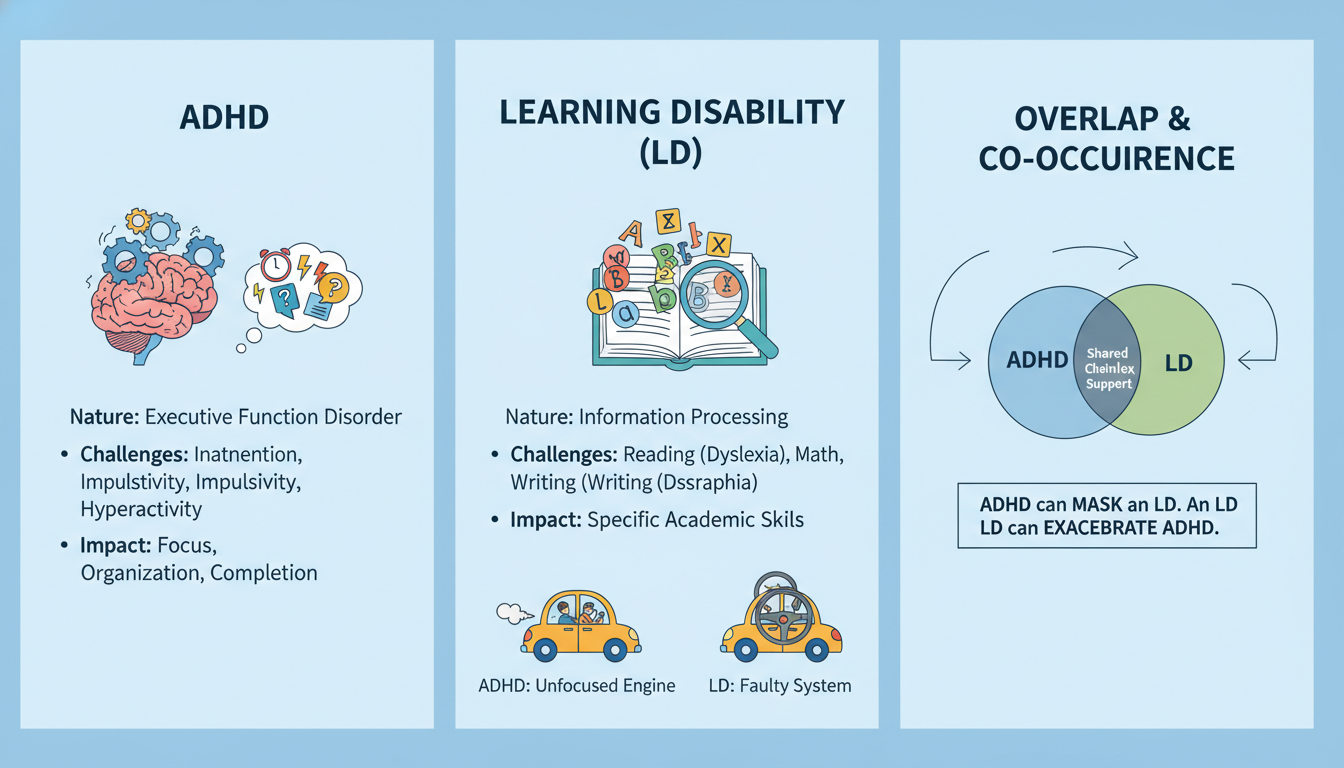
Let’s dive in with a bit of curiosity, shall we? The heart of our discussion asks: Is ADHD a learning disability? The phrasing carries subtle assumptions, and it’s essential to separate two truths that often get tangled together. First, ADHD—Attention-Deficit/Hyperactivity Disorder—is not defined as a learning disability. Yet, its effects can muddy the educational waters, complicating how individuals learn, interact, and keep pace. Let’s untangle this with nuance, real-world examples, and expert insights.
What ADHD Is — And What It Isn’t
ADHD Defined by Executive Function, Not Skill Gaps
ADHD is a neurodevelopmental disorder rooted in executive function—which encompasses the mental skills for planning, organizing, focusing, and managing time and impulses. Unlike learning disabilities, which are tied to specific academic deficits (like reading, writing, or math), ADHD doesn’t impair those abilities per se. Instead, it undermines the process of learning.
A Disability Under Law, but Not Academically Categorized
Legally speaking, ADHD qualifies as a disability under U.S. laws such as IDEA and Section 504—yet it’s categorized under “Other Health Impaired,” not “Specific Learning Disabilities.” That distinction influences eligibility for special education services: ADHD is recognized, but separately from classic learning disabilities.
When Learning Gets Complicated: Comorbidity and Confusion
Co-Occurrence Is Common — But Not Inevitable
Studies estimate that between 20% and 50% of children with ADHD also have a specific learning disability (SLD)—dyslexia, dyscalculia, or dysgraphia. That overlap underscores how ADHD frequently complicates academic life, though it doesn’t mean ADHD is an SLD.
Everyday Challenges Amplified
When ADHD and a learning disability coincide, challenges multiply. One study showed that children with both conditions face stronger academic hurdles than peers with either alone. And interestingly, children with just ADHD often still show some learning difficulties, suggesting a continuum rather than rigid categories.
Classroom Reality: Hidden Struggles and Delayed Support
Many students with ADHD fly under the radar because their difficulties aren’t tied to a specific academic skill—they might appear inattentive or “lazy.” It means some don’t get help until later, particularly if educators miss the underlying executive function struggle.
Practical Scenarios: How ADHD and Learning Interact
Scenario A: Inattention Does Not Equal Dyslexia
Imagine Sarah, who zones out during reading class—not because she can’t decode words, but because her mind drifts. A misdiagnosis of dyslexia might follow if attention isn’t part of the assessment.
Scenario B: Boost from Focused Interests
In contrast, a student hyper-engaged by music may suddenly grasp math concepts when lessons are set to rhythm or sound—an example of using ADHD’s quirks creatively.
Scenario C: Dual Diagnoses Require Dual Strategies
Then there’s Jamal: dyslexic and diagnosed with ADHD. His school crafts both reading specialists and executive function coaching, teaching him how to decode words and manage tasks—and suddenly he’s learning, not just “trying.”
Support Strategies: Education, Accommodations, and Tools
Tailored Interventions for ADHD Alone
When ADHD alone impacts learning, interventions focus on executive skills: structured routines, task breakdown, and environmental tweaks like noise buffers or seat placement. Sometimes medication and therapy complement these strategies.
When Learning Disabilities Are Involved Too
If ADHD overlaps with a learning disability, support must be multi-pronged:
– Targeted instruction (e.g., multi-sensory reading methods for dyslexia)
– Organizational coaching and attentional supports for ADHD
This dual approach prevents gaps—ensuring neither condition derails progress.
In Practice: Legal Accommodations in School
Legal frameworks offer tangible pathways:
– IDEA: Provides IEPs for students whose ADHD significantly impacts learning, classified under “Other Health Impaired.”
– Section 504: Offers more flexible, often faster accommodations—like extended time, visual aids, or assignment segmentation—for students with ADHD in general education settings.
“ADHD and learning difficulties may overlap, but they are fundamentally distinct—one affects the process of learning, the other affects its skills.”
— Dr. Vincent Alfonso, School Psychologist
Bridging Understanding: Why the Distinction Matters
- Clarity in Diagnosis ensures proper support and not conflating issues.
- Tailored Learning Plans prevent frustrated teachers and students alike.
- Empowerment over Labeling encourages moving from barriers to workable strategies.
In other words, getting this distinction right helps schools and families focus less on “what’s wrong” and more on “what works.”
Conclusion: Distinct Yet Connected
ADHD is not a learning disability, yet its features—impulsivity, distractibility, disorganization—can interfere with learning. Learning disabilities, conversely, involve specific academic skill gaps. Yet, when these conditions overlap—like two hurricanes colliding—the educational impact intensifies.
Understanding both as separate but potentially coexisting conditions is vital. It opens doors to dual-layered interventions, legal support, and humane empathy—helping learners not just cope, but genuinely thrive.
FAQs
Q1: Why isn’t ADHD considered a learning disability?
ADHD impacts how students learn—not directly impairing skills like reading or math—but affecting focus, organization, and behavior instead. Learning disabilities target specific academic deficits.
Q2: Can a student have both ADHD and a learning disability?
Absolutely. Research indicates that roughly 20–50% of students with ADHD also have a learning disability, meaning dual support is often essential.
Q3: What legal accommodations can help students with ADHD?
Under U.S. law, students with ADHD may qualify for special education via IDEA (“Other Health Impaired”) or less intensive accommodations via Section 504—like extra time, reduced workload, or alternate formats.
Q4: How can parents advocate for a child with both ADHD and a learning disability?
Push for comprehensive evaluations. Ask the school to assess both executive functioning and academic skills. Then work with educators to create a plan addressing both.
Q5: Are there strengths associated with ADHD that support learning?
Yes—some individuals with ADHD experience hyperfocus when engaged, creative thinking, and strong problem-solving—especially when learning aligns with their interests.
Q6: What’s the first step if I suspect ADHD or a learning disability?
Start with a professional evaluation through your school or a qualified psychologist. Early, accurate diagnosis unlocks more effective support strategies.
