

 February 8, 2026
  7 Min
7 Min  No Comment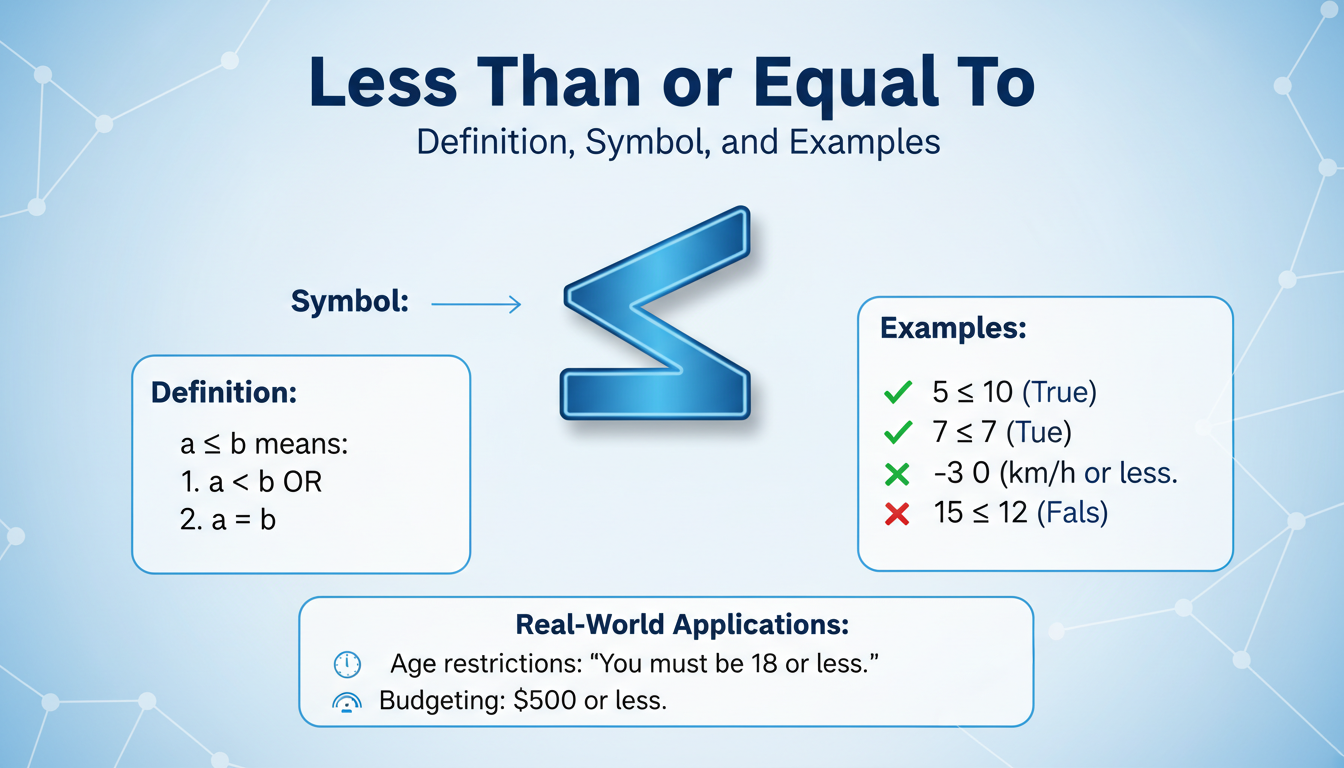
Diving into “less than or equal to” might seem straightforward—it’s a math symbol, right? But hang on, there’s more to it than meets the eye. This operator, often written as “≤”, quietly plays a starring role in programming, engineering, data analysis, even everyday logic. So let’s stroll through its definition, usage, and examples in a way that’s clear, occasionally imperfect, but totally human. (Because let’s be honest, perfect folks are kinda boring.)
Understanding the Symbol and Its Definition
“Less than or equal to” (≤) indicates that one quantity is either smaller or exactly equal to another. In everyday talk, you’d say “A is not greater than B”—and nope, that’s not word salad, it’s spot on. We use it when we want to allow equality or a smaller value. Pretty neat when you think about it—it’s inclusive.
In mathematical notation:
– A ≤ B means A is less than B or A equals B.
This dual meaning makes it versatile. It’s not just about one thing—it gives room for both edge cases and typical behavior.
When ≤ Pops Up: Real-World Contexts
Everyday Scenarios Where It Makes Sense
- Budgeting sense: “You should spend ≤ $50 for snacks.” That means $50 hits your ceiling, and less is totally fine.
- Speed limits: Radar might be set to beep if your speed exceeds ≤ 65 mph. (Though in a sense, they alarm at “greater than 65”, it’s conceptually tied.)
- Calories or orders of magnitude: Fitness apps saying you’ve burned ≤ 500 calories—you’re not overshooting, and hitting under or exactly that is great.
These scenarios show how “less than or equal to” keeps expectations clear yet flexible.
Programming Logic—In Code We Trust
In many programming languages, you’ll see:
python

if x <= y:

    # do something
This translates to “run this block if x is no more than y”. The beauty is that it handles both x < y and x == y without needing messy extra checks.
Similarly, in SQL:
sql

SELECT * FROM orders

WHERE total_price <= 100.00;
That query captures orders costing $100 or less. There’s no need to write “< 100 OR = 100”—less than or equal handles both seamlessly.
Spotting the Symbol and Its Variants
You’ll encounter “≤” in textbooks, sheet music, scientific papers… occasionally typed as “<=” when the real symbol isn’t available. Computers love the ASCII-friendly version “<=”, especially in coding environments or plain-text tools.
Visual Variations
- Proper typographic: ≤
- ASCII-friendly: <=
- Handwritten: often slanted or with imperfect strokes, but the meaning’s still crystal.
In some cases, especially in older documents or newer code editors that don’t auto-convert, you’d see “<=”. For most non-math-savvy folks, that might even feel more intuitive—it’s like reading directly from code to concept.
Why “Less Than or Equal To” Matters: A Technical Dive
Let’s layer in some context—beyond the classroom:
-
Constraints in optimization: When building models (say, linear programming), constraints like x ≤ 10 ensure variables stay within bounds. That’s how operations research keeps schedules on track or logistics lean.
-
Safety thresholds: Engineers use “≤” when tolerances matter—pressures must stay ≤ a certain PSI to avoid system failure. That inclusion of the edge case (equal to) can make or break fail-safe design.
-
Statistics and probabilities: You’ll see expressions like P(X ≤ x₀) in CDFs (cumulative distribution functions)—capturing the likelihood that a random variable X falls at or below x₀. That small “or equal” quietly ensures you account for all relevant outcomes.
“Including equality in inequality isn’t just semantics—it’s often crucial. You don’t want to accidentally exclude the boundary case that could tip a system over or mischaracterize your data.”
That’s the kind of nuance experts keep an eye on, because it’s rarely about the inequality as an abstract, more about how precisely you’re capturing reality.
Examples Across Disciplines
1. Mathematics Classroom
Problem: Solve for x if (2x + 3 ≤ 7).
Breakdown:
– Subtracting 3: (2x ≤ 4).
– Dividing by 2: (x ≤ 2).
Answer: x can be two or anything less, like 1, 0, -5. Simple and inclusive.
2. Coding Example
javascript

let score = 85;

if (score <= 90) {

  console.log("Keep going—you’re under or at the goal!");

} else {

  console.log("You've exceeded the target—nice work!");

}
Here, hitting exactly 90 fits the “goal range”, which feels more motivating than excluding it.
3. Business Policy
Imagine a retailer offering free shipping on orders ≤ $50—not quite common, but let’s say they ship small items up to that limit. It encourages small-value purchases without burdening their margins.
4. Scientific Measurement
A piece of lab gear may report concentrations as “≤ 0.05 mg/L”. That typically means the substance is at or below the detection limit—an important signal for researchers distinguishing “none detected” from “slightly above”.
Common Misconceptions (and Tiny Human Blunders)
-
Thinking “A ≤ B” and “A < B” are interchangeable. Spoiler: missing that equality piece can lead to off-by-one-ish mistakes, especially in loops or boundary conditions.
-
Misreading ASCII “<=” as something else—sometimes folks see it and momentarily think “less-than, then assignment”, especially in languages like C (
a <= bvsa = b). -
In casual writing, someone might say, “It’s less than or equal, so close enough.” That relaxed phrasing can hide the precision that “≤” is meant to signal.
When to Use (and When to Skip) “Less Than or Equal To”
Use “≤” When:
- You want to include the boundary value—like deadlines, thresholds, or capacities.
- Precision matters—in math, algorithms, or engineering, missing the equality case can cause logical flaws.
- You’re communicating rigorously—academic writing, technical docs, or formal specs benefit from clarity.
Skip It When:
- You explicitly need to exclude equality. For example, when “strictly less” is required. In code, that’s just
<—handle edge cases cleanly, without ambiguity. - The context is casual or conversational—like “No more than 50 people can join” is fine, but feeding that to a formula you convert to “≤ 50”.
Narrative Aside: Why I (occasionally) Mess Up “≤”
Let’s acknowledge—it’s easy to slip up. Once while coding, I wrote if (i <= 10) when I meant < 10. The loop ended up running one extra iteration. I remember scratching my head: “Why is that off-by-one?” That “or equal” turned me into a Sherlock of code debugging.
It’s that human unpredictability—making small mistakes, then appreciating that symbol’s precision—that kinda makes understanding it feel more real.
Conclusion: Wrapping Up “Less Than or Equal To”
“Less than or equal to” isn’t just a math symbol—it’s a linchpin in precise thinking across domains. Whether you’re writing code, modeling systems, interpreting data, or drafting rules, that “or equal” nuance often separates accuracy from oversight. Keep it in your toolkit, understand when to use it—and love how it quietly keeps logic consistent.
FAQs
What does “less than or equal to” actually mean?
It means one value is smaller than another or exactly matches it. Used when both possibilities are allowed.
Why not just use “less than”? When is equality important?
Because sometimes the exact match matters—like deadlines, capacity limits, or statistical thresholds. Leaving out “equal” can lead to logical slip-ups.
Can “≤” be written differently?
Yes—often you’ll see “<=” in code or plain-text contexts when the proper symbol isn’t available. It conveys identical meaning.
What’s a real-world risk of missing the equality part?
In coding, loops may run one time too few or too many. In engineering, safety margins might be overlooked. Inclusion or exclusion of the boundary value can have tangible effects.
Is “≤” used outside math?
Absolutely. It’s common in programming, science, business rules, and everyday phrases like budgets or speed advisories—anywhere a maximum (including equal) is implied.
How do I avoid mixing it up?
Practice writing and thinking through examples. When coding, test edge cases—for instance, check behavior at exactly the limit. That small test catches the “or equal” slip before it becomes a bug or misunderstanding.
