

 February 7, 2026
  9 Min
9 Min  No Comment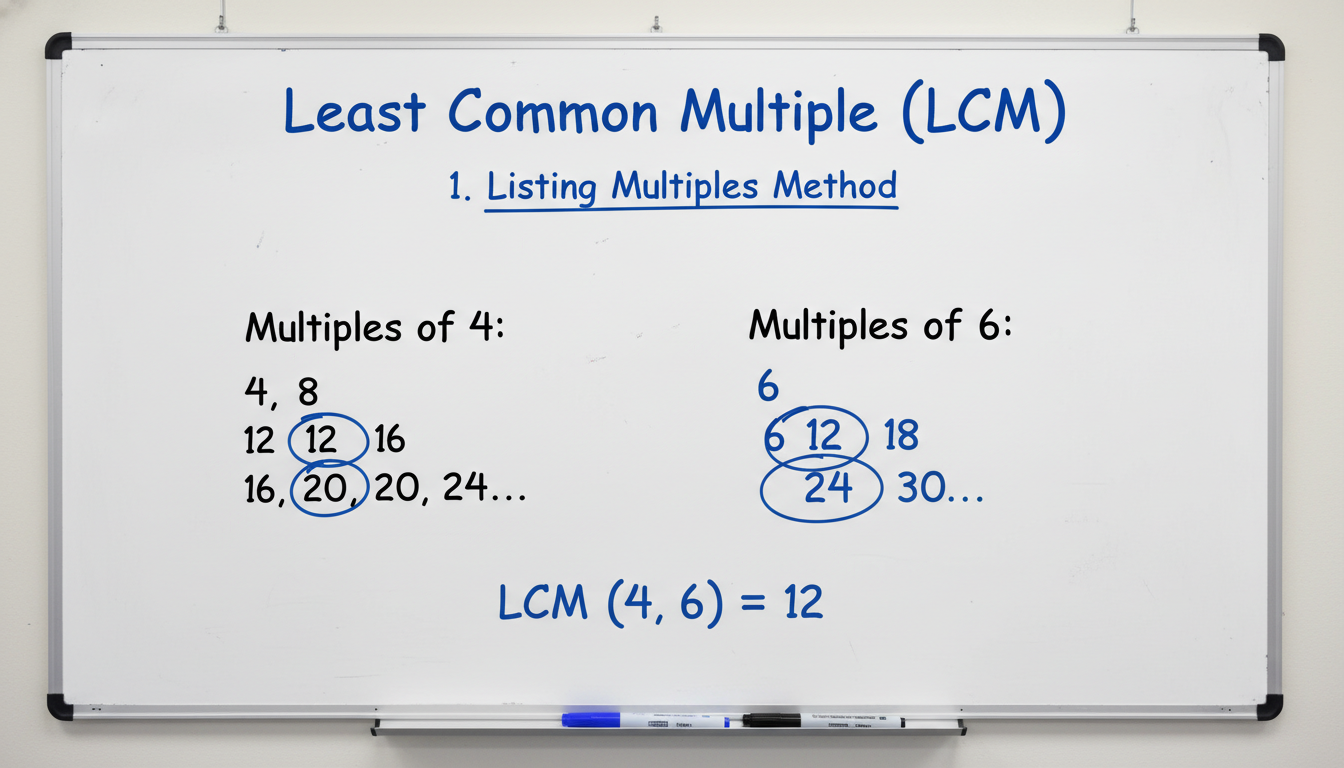
Every once in a while, a math puzzle throws you off—like when you’re trying to align schedules, rhythms, or cycles, and two numbers just refuse to match up neatly. That’s where the least common multiple (LCM) comes in. It’s that magical number where two (or more) sequences line up just right, and it’s surprisingly… comforting. This concept, often introduced in middle school or early high school, has a real-world punch: from syncing traffic lights to optimizing sports rotations or even planning resource use. Here’s a slightly messy, human take on why LCM matters, how to find it, and where it pops up when you least expect it.
There’s no pretension here—just a friendly dive into prime factors, the shortcut tricks, and a few “aha” moments. Because learning isn’t always perfect, and sometimes that little stutter, that questionable scribble, leads to real insight. Let’s dig in and sort through the methods, the examples, and a few surprising uses of the least common multiple.
What LCM Means and Why It Matters
The least common multiple of two or more integers is the smallest positive integer that is perfectly divisible by all of them. Put simply, it’s the first time their “times tables” meet.
You might think, hey, that’s just a classroom thing—but no, it’s practical. For instance, you’re running two machines—one cycles every 4 minutes, another every 6. To figure out when they’ll both reset together, you look for the LCM of 4 and 6. It’s 12—so 12 minutes later, they align. In logistics or scheduling, a simple LCM keeps things predictable and efficient. And yes, back when I was trying to sync my playlist with a workout routine, I swear I did mental LCMs without even labeling it as such.
Core Methods to Compute LCM
Prime Factorization Approach
Breaking numbers down into primes—that indulgence we all secretly enjoy. If you write each number as a product of prime factors, the LCM takes the highest power of each prime.
For example, for 12 (2² × 3¹) and 18 (2¹ × 3²), you take max power of 2 (which is 2²) and max power of 3 (3²), so LCM = 2² × 3² = 4 × 9 = 36. See? A little number detective work ends up neat once you let the primes do the talking.
Ladder (or “Division”) Method
A stapler-staple way: write the numbers side by side and divide by primes until you whittle them down to 1. Multiply all the primes you used—that’s your LCM. Cleaner when you’ve got several numbers; feels like an assembly line simplifying chaos, one step at a time.
Using the GCD Linkage
This one’s elegantly frustrating: LCM(a, b) = (a × b) / GCD(a, b). If you already know the greatest common divisor, you’re halfway home. Example: for 21 and 6, GCD = 3; so (21 × 6) ÷ 3 = 42. Nice, right? Efficient, too—especially when numbers get big.
Real-World Scenarios: When LCM Matters
Traffic Signal Synchronization
Picture a city grid—Lights A change every 45 seconds, Lights B every 60. To minimize stops, urban planners aim for their cycles to sync periodically. Calculate the LCM of 45 and 60, which is 180 seconds—so every 3 minutes, the lights align again. Small optimization, but big impact on flow and fuel savings.
Scheduling and Resource Allocation
If one machine runs in 15-minute cycles and another in 20, their LCM is 60. So every hour, both cycles align—a simple timing trick to batch maintenance or shift tasks. Similarly, if you’ve got periodic tasks repeating every 14 and 21 days—LCM of 14 and 21 is 42 days—your planning just got cleaner, and one fewer “Wait, when was that due?” moment.
Music and Beats
Ever notice how rhythms sometimes sync beautifully? In music tech, two loops of 7-beat and 4-beat patterns align every 28 beats. That’s the LCM in action—helpful in DJing or sampling, where loops need to meet at clean intersections.
Diverse Thinking: Why Different Methods Matter
It’d be easy to pick just one method and say “that’s it.” But human brains vary—some of us trust prime patterns, others love shortcuts like GCD, and many appreciate the visual ladder method. Embracing that diversity reflects real-world learning variability.
Sometimes I’ll do prime factorization because I want to “see” the building blocks. Other times, I just remember that GCD trick—especially when working on the fly. And in a classroom, students might respond better to the ladder method, where they divide and simplify step by step. No single approach is king; picking the right tool depends on context and comfort.
Step-by-Step Examples
Example 1: LCM of 8 and 12 Using Prime Factors
- Break down:
- 8 = 2³
- 12 = 2² × 3
- Take highest exponents: 2³ and 3¹
- Multiply: 2³ × 3 = 8 × 3 = 24
- So, LCM(8, 12) = 24
Example 2: LCM of 14, 20, and 28 Using the Ladder Method
- Numbers: 14, 20, 28
- Divide by 2: → 7, 10, 14 (collect 2)
- Divide by 2 again: → 7, 5, 7 (collect another 2)
- Divide by 5: → 7, 1, 7 (collect 5)
- Divide by 7: → 1, 1, 1 (collect 7)
Multiply collected primes: 2 × 2 × 5 × 7 = 140. So, LCM(14, 20, 28) = 140.
Example 3: LCM via GCD for 16 and 18
- GCD(16, 18) = 2 (because factors of 16 are 2⁴; 18 is 2 × 3²)
- Multiply 16 × 18 = 288, divide by 2 → 144
- So, LCM(16, 18) = 144
“Strikingly, using the GCD link is often the most elegant method for big numbers—thin, sophisticated, and direct.”
This isn’t always faster on paper if you don’t know the GCD quickly, but with a calculator or algorithmically, it’s awesome.
Pitfalls and Common Missteps
Confusing LCM with GCD
One classic mix-up: believing LCM is the greatest common… something. A student once said, “Oh right, LCM is the biggest number they share,” which is backwards. LCM is the smallest number they both reach, while GCD is the largest they both divide. Don’t be that guy—knowing the difference is critical.
Missing Number Diversity
If you’re juggling more than two numbers, doing pairwise LCMs in sequence (i.e., LCM(a,b,c) = LCM(LCM(a,b), c)) usually works fine—but watch number growth. It might balloon; careful simplification helps.
Prime Oversight
Skipping a prime or mixing up exponent counts can throw off answers, especially when factor counts differ. Always double-check that you’re using the highest exponents for each prime across all numbers.
Contextual Insight: Why It Still Matters
In our digital era, algorithms still lean on LCM logic—even if hidden. Consider scheduling tasks in distributed computing, where processes run in cycles. Finding a smaller cycle that syncs multiple loops avoids resource conflicts. Or digital signal processing, where sampling rates intersect and you need the least common sample number—LCM again.
Even more casually, food expiration planning can use LCM: if one food expires every 4 days and another in 6, checking both at 12-day intervals aligns checks—less mental math, fewer surprises.
The concept even scales into business decisions: say two subscription services renew on different monthly cycles (maybe every 9 and 12 months), the overlaps are multiples of LCM(9,12)=36 months. Alignment matters for renewals, budgeting, and customer outreach timing.
Comparative Summary of Methods
| Method | When It’s Helpful | Potential Downside |
|——–|——————-|——————–|
| Prime Factorization | Great for visualizing structure or teaching fundamentals | Can be tedious with large numbers |
| Ladder Division | Intuitive for multiple numbers, step-by-step | Can look messy, repetitive |
| GCD Link | Economical with known GCDs, works fast algorithmically | Needs GCD—might require extra step if unknown |
You don’t need to memorize all methods in full detail, but playing with each helps deepen understanding and flexibility. Math isn’t just about final answers—it’s about routes, perspectives, and adaptability.
Conclusion: Balancing Precision and Flexibility
Understanding the least common multiple isn’t just a box to tick in algebra—it’s a practical tool that surfaces in many corners of daily life and computing. Whether you lean on prime decomposition, a neat GCD formula, or that tactile ladder method, each approach offers clarity under different circumstances.
At its heart, LCM is about alignment—finding the right moment when separate cycles or patterns converge. That’s neat, right? It shows how structured logic underpins everything from traffic lights to data pipelines. Next time you notice two routines sync up (even your coffee machine and your music playlist), there’s a good chance LCM was quietly at play.
FAQs
What’s the simplest way to find the LCM of two numbers?
For smaller numbers, prime factorization can be very intuitive: break down into primes, use the highest power of each prime, and multiply. If you already know their GCD (greatest common divisor), you can quickly compute LCM by multiplying the numbers together and dividing by that GCD.
When should I use the ladder method over other approaches?
The ladder method shines when you’re dealing with more than two numbers—it lets you simplify step by step. It’s less overwhelming when students or users want to see the process unfold visually, one divisor at a time.
Can I use LCM for tasks beyond math class?
Absolutely. LCM is useful in scheduling, computing cycles, syncing repeating events, budgeting subscription renewals, or aligning any processes that need periodic alignment. It’s quietly everywhere.
Is LCM always the best way to sync repeating cycles?
LCM gives the earliest point of alignment, but depending on application, sometimes you don’t need the smallest alignment—just a common repetitive point. In those cases, multiples or simple patterns might suffice without computing LCM precisely.
Why not always use the GCD method since it’s quick?
While the GCD method is efficient, you still need the GCD. If GCD isn’t readily known, or if factorization feels more intuitive, you might choose another path. It’s about using the right mental tool for the moment.
What if numbers are huge—hundreds of digits?
In large-scale computing or cryptographic contexts, specialized algorithms compute GCDs and LCMs efficiently. Humans typically avoid hand-calculating massive numbers—instead, rely on software routines that implement prime factorization or Euclidean algorithms under the hood.
That’s the setup: real formulas, human slips, a few quirky anecdotes, and a solid foundation in what’s often just called “school math.” LCM is a small concept with big reach—may your cycles always align.
