

 February 8, 2026
  6 Min
6 Min  No Comment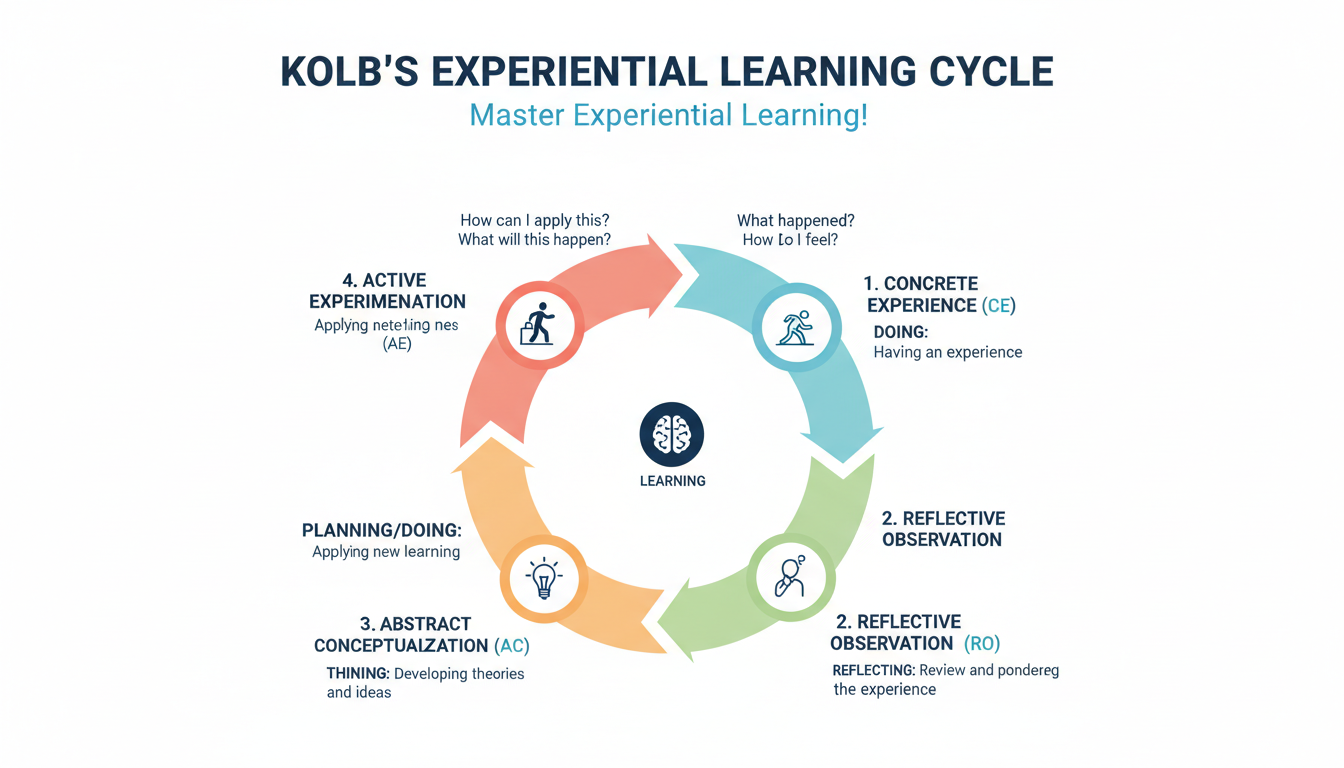
There’s something compelling—and, okay, a bit messy—about learning by doing. The phrase “Kolb’s Learning Cycle: Master Experiential Learning!” isn’t just clickbait—it points to a robust framework that keeps buzzing in teaching, training, and even AI-tool design. While some folks might think this theory is academic fluff, it quietly shapes how professionals, educators, and curious minds adapt, reflect, and improve. Let’s wander through the four-stage cycle, peek at real-world use, tussle with criticisms, and get strategic about applying it.
The Four Stages of Kolb’s Learning Cycle
1. Concrete Experience: Jumping Into the Unknown
This is where learners step into a real, sometimes awkward situation—hands-on from the get-go. Imagine interns shadowing in a lab, students tackling a simulation, or workers trying a new tool without a script. Kolb defines this as the grounding moment of learning . It’s raw, often uncomfortable, but essential.
2. Reflective Observation: Rethinking What Just Happened
Next comes the mental space to ponder—“What did I do? What felt off? What surprised me?” This reflective pause is often underestimated in training programs but central to making sense of experience . Reflection transforms muddled actions into mindful insight.
3. Abstract Conceptualization: From Reflection to Ideas
Here learners synthesize patterns and theories from their reflections. They shift from “I did X and failed” to “Maybe there’s a principle at play here.” It’s conceptual learning built on personal experience, not just theory pulled from thin air .
4. Active Experimentation: Testing New Insights
Finally, learners take these ideas into new terrain—tweaking, iterating, refining. It’s about planning the next move: trying another approach, adjusting a technique, or applying the idea in different contexts . This leads back to a new concrete experience, and the cycle continues.
“Learning is the process whereby knowledge is created through the transformation of experience.”
It’s not a dull, linear train ride. It’s more like a spiral—messy, iterative, sometimes looping back or skipping ahead .
Connecting Learning Preferences: Kolb’s Styles
Kolb didn’t just sketch a cycle—he inferred that people naturally flow through it in different ways. He proposed four learning styles:
- Diverging (Concrete Experience + Reflective Observation): Creative, imaginative folks who like observing and gathering perspectives .
- Assimilating (Reflective Observation + Abstract Conceptualization): Logical thinkers who favor well-organized, theoretical models .
- Converging (Abstract Conceptualization + Active Experimentation): Problem-solvers who lean toward practical application .
- Accommodating (Concrete Experience + Active Experimentation): Hands-on learners who improvise and take a trial-and-error approach .
These preferences help tailor instruction—though they aren’t rigid labels but indicators of a learner’s typical mode.
Real-World Applications: From Classroom to Workplace
In Engineering and Business Education
A student might attend a lecture, reflect on the ideas, approach homework problems, and then apply lessons in a lab—cycling neatly through all stages . In business schools, incorporating simulations, internship experiences, and reflective debriefs embodies Kolb’s model .
In Cryptography Education (K–12)
A recent crypto-learning tool designed for middle and high school students uses Kolb’s four steps: hands-on cryptography exercises, AI-facilitated reflection, concept-building, and coding experiments. Evaluations showed high comprehension and enthusiasm—so it wasn’t just theory; it worked . That’s a neat example of Kolb powering modern, tech-friendly pedagogy.
Navigating the Critiques: Where the Model Fumbles
Oversimplification and Linearity
Critics argue Kolb’s cycle suggests a neat, step-by-step process when real learning is often messy, recursive, and non-linear . In truth, people may reflect before experiencing or apply ideas without deep conceptual understanding. Expecting rigid adherence can lead to brittle programs, not dynamic learning.
Ignoring Context: Culture, Social Dynamics, Identity
The model largely focuses on the individual learner—but learning often happens in social, cultural ecosystems. Power dynamics, cultural norms, team relations, and identity influence the process in ways Kolb’s model doesn’t explicitly account for .
Kolb later clarified that styles are not fixed traits but fluid states that shift with context . Still, adaptations or complementary frameworks help enrich this theory for diverse settings.
Practical Tips: Applying Kolb’s Cycle Effectively
1. Design for Full-Cycle Learning
Ensure experiences aren’t one-off events. Plan lessons or training that intentionally move learners from doing to reflecting to conceptualizing to testing. Embrace the spiral.
2. Shift Focus by Role
Educators or trainers can play different roles—facilitator, coach, evaluator, expert—shifting based on where learners are in the cycle . Sometimes letting learners stumble is the best learning.
3. Encourage Role Fluidity
Help learners explore different stages—even if that’s uncomfortable. For example, a convergent learner might try reflective journaling; a diverger might test theories in action.
4. Embed Reflection Prompts
Use structured prompts—like “What happened?”, “So what?”, “What’s next?”—to help learners move through reflective steps rather than gloss over them .
5. Contextualize Learning
Adapt materials with cultural, social, or professional contexts in mind. Reflective debriefs can surface how identity, norms, or expectations shaped the experience.
Conclusion: Activating Learning Through Lived Experience
Kolb’s Learning Cycle offers more than an instructional outline—it maps how experience binds to reflection, theory, and action. While imperfect, it remains one of the most intuitive ways to think about learning in real life. Its power lies in prompting deliberate experience, reflection that isn’t rushed, and thoughtful experimentation. Whether in classrooms, corporate settings, or emerging AI-powered tools, it anchors learning in the messy, vivid, unpredictable reality of doing and redoing. Start small, build cycles, and aim for growth through doing, thinking, and trying again.
FAQs
What makes Kolb’s Learning Cycle different from traditional learning models?
It emphasizes learning through a repeated cycle of experience, reflection, theory, and experimentation—rather than passive absorption of information.
Can learners skip stages in the cycle?
Yes, people often skip or shortcut stages. But deeper, lasting learning tends to occur when all four stages are intentionally engaged.
Are learning styles fixed based on Kolb’s model?
No—they’re preferences, not labels. Individuals may gravitate toward certain modes but can and should shift across stages depending on context.
How can educators implement Kolb’s cycle practically?
By designing activities that include all four stages, using reflection prompts, rotating educator roles, and encouraging learners to try unfamiliar styles.
Why is reflection so critical in experiential learning?
Reflection turns raw experience into insight—without it, experiences remain fleeting or superficial. It’s the bridge between doing and understanding.
Is Kolb’s model still relevant in modern, digital learning environments?
Absolutely—especially when blended with tools like simulations, AI feedback, or interactive labs that support each stage of the cycle.
