

 March 19, 2026
  13 Min
  No Comment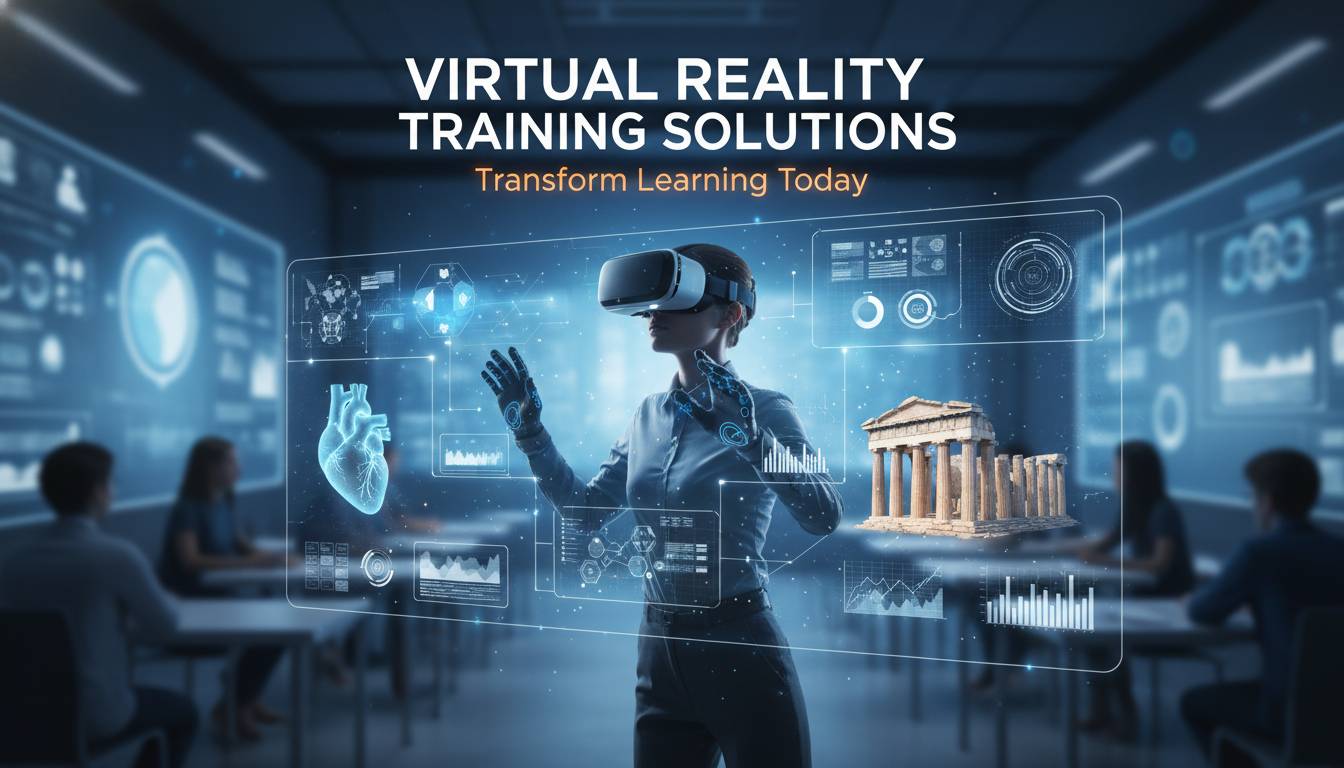
The global corporate training market has reached $366 billion, and virtual reality is rapidly becoming one of the most impactful technologies reshaping how organizations develop their workforce. Companies that have implemented VR training report up to 375% higher knowledge retention rates compared to traditional classroom methods, along with a 40% reduction in training time. For organizations seeking more effective, engaging, and measurable learning experiences, virtual reality training solutions represent a strategic investment that addresses long-standing challenges in skill development and employee performance.
This comprehensive guide explores how VR training works, the measurable benefits it delivers, practical implementation strategies, and how to select the right solution for your organization’s specific needs.
What Are Virtual Reality Training Solutions?
Virtual reality training solutions use immersive digital environments to simulate real-world scenarios for learning purposes. These systems combine specialized hardware—typically head-mounted displays (HMDs), motion controllers, and haptic feedback devices—with software platforms that create interactive, 3D training environments. Users experience a sense of presence in these simulated spaces, allowing them to practice skills, make decisions, and encounter realistic consequences without the costs, dangers, or time constraints associated with real-world training.
The technology spans a spectrum from fully immersive VR to augmented reality (AR) and mixed reality (MR) applications. Fully immersive VR places users entirely within a digital environment, blocking out physical surroundings. Augmented reality overlays digital information onto the real world, while mixed reality combines elements of both, enabling interaction with virtual objects in physical spaces. Each approach offers distinct advantages depending on training objectives, with immersive VR proving most effective for high-stakes scenarios where complete focus and environmental control are essential.
Modern VR training platforms incorporate sophisticated analytics dashboards that track user movements, decision-making patterns, response times, and error rates throughout each session. This data-rich approach enables organizations to move beyond simple completion metrics and gain genuine insight into skill mastery, allowing trainers to identify specific areas where individual employees or entire cohorts require additional development.
Key Benefits and Business Impact
Organizations implementing VR training solutions consistently report substantial returns across multiple operational dimensions. Understanding these benefits helps stakeholders make informed decisions about where VR investment delivers the greatest value.
Knowledge Retention and Learning Outcomes
The brain encodes information differently when learning occurs through immersive experience versus passive observation. Research published in the journal Psychological Science demonstrates that active participation in learning activities creates stronger neural pathways than passive reception. VR training leverages this principle by requiring users to actively engage with content, make decisions, and experience consequences in real time.
A landmark study conducted by PwC found that learners in VR training courses were four times more focused than their classroom counterparts and three times more emotionally connected to the material. The same research revealed that VR learners completed training courses faster than traditional methods while achieving equivalent or superior assessment scores. These findings suggest that VR training doesn’t merely replicate conventional learning—it fundamentally enhances the learning process itself.
Cost Reduction and Efficiency Gains
While initial investment in VR training infrastructure requires significant capital, the long-term cost benefits prove compelling across numerous industries. Traditional training methods often involve substantial expenses including instructor time, facility rental, travel, equipment wear, and material consumption. VR training eliminates many of these recurring costs once the initial system is deployed.
Consider the financial implications for high-risk industries. Manufacturing facilities spend an average of $1.5 million annually on workplace injuries, with inadequate training contributing to a significant percentage of incidents. Oil and gas companies investing in VR safety training have documented injury reductions exceeding 30% within the first year of implementation. The technology enables employees to experience dangerous scenarios and practice emergency responses without actual risk, building muscle memory and decision-making reflexes that transfer directly to real-world situations.
| Training Method | Average Completion Time | Knowledge Retention (30-day) | Cost per Learner (Annual) |
|---|---|---|---|
| Traditional Classroom | 8 hours | 58% | $350 |
| E-Learning | 6 hours | 65% | $180 |
| VR Training | 4.5 hours | 75% | $220* |
*Includes hardware depreciation over 3-year period
Scalability and Consistency
Training consistency presents a persistent challenge for organizations operating across multiple locations. Traditional methods rely heavily on individual instructors, whose teaching quality, emphasis, and interpretation inevitably vary. VR training delivers identical experiences to every learner, ensuring that key concepts, procedures, and safety protocols receive consistent coverage regardless of geographic location or time of training.
Organizations with distributed workforces particularly benefit from this consistency. A multinational corporation can deploy a single VR training module across facilities in twenty countries, confident that every employee receives the same foundational instruction. This standardization proves especially valuable for compliance-related training, where regulatory requirements demand precise adherence to specific procedures.
Industry Applications and Use Cases
Virtual reality training has demonstrated value across diverse sectors, with implementation approaches tailored to each industry’s unique requirements and constraints.
Healthcare and Medical Training
Medical professionals face a paradox: they must develop competence in procedures that carry life-or-death consequences, yet opportunities to practice remain limited by ethical considerations and patient safety requirements. VR training addresses this challenge by allowing medical students and practicing clinicians to perform procedures repeatedly in risk-free environments.
Surgical training represents one of the most mature VR applications in healthcare. Systems like Osso VR and Surgical Theater enable surgeons to practice intricate procedures with haptic feedback that simulates tissue resistance and tool interaction. Research published in JAMA Surgery found that surgeons who completed VR training demonstrated 23% improvement in surgical performance metrics compared to those who trained exclusively with traditional methods.
Beyond surgery, VR training supports nursing education, emergency response preparation, and patient communication skills development. Medical facilities have also implemented VR for onboarding new staff, allowing employees to navigate facility layouts, practice equipment operation, and learn emergency protocols before their first actual shift.
Manufacturing and Industrial Operations
Manufacturing environments present complex training challenges involving heavy machinery, hazardous materials, and intricate assembly processes. VR training allows workers to develop proficiency with equipment and procedures without endangering themselves or damaging expensive machinery.
Automotive manufacturers were early adopters of VR training, using the technology to teach assembly line procedures and quality control inspection techniques. General Motors implemented VR training systems across its manufacturing facilities, reporting that workers trained through VR demonstrated 30% faster assembly times and 50% fewer errors than those trained through traditional methods. The ability to repeat procedures countless times without material waste or production delays creates substantial cost savings while building worker confidence.
Industrial maintenance training benefits particularly from VR’s ability to simulate equipment failures and emergency scenarios. Technicians can practice diagnosing problems and executing repairs in virtual environments that accurately represent the complexity of actual industrial systems. When real equipment fails, trained technicians respond more quickly and effectively because they’ve encountered similar situations repeatedly in training.
Safety and Compliance Training
Workplace safety training represents one of the highest-impact applications for VR technology. Industries ranging from construction and mining to aviation and energy face stringent regulatory requirements for safety instruction, yet traditional methods often fail to create genuine understanding of hazard recognition and response.
VR safety training excels at scenario-based learning, placing workers in realistic situations where they must identify hazards, select appropriate protective equipment, and respond to emergencies. The immersive nature of VR creates emotional engagement that strengthens memory encoding—workers who “experience” a virtual fire or equipment failure develop stronger responses than those who simply read about such events.
The construction industry has embraced VR safety training extensively. Fall hazards remain the leading cause of death in construction, and VR systems that simulate working at heights, operating scaffolding, and navigating elevated walkways have demonstrated measurable improvements in worker attention to safety protocols. Companies implementing VR safety training report reductions in recordable injuries ranging from 20% to 60%, depending on implementation quality and workplace culture.
Retail and Customer Service
Frontline employees in retail and service industries benefit from VR training that simulates customer interactions, difficult scenarios, and sales situations. Unlike role-playing exercises that can feel artificial, VR creates immersive interactions where employees practice communication skills, product knowledge, and problem-solving in realistic contexts.
Luxury retailers use VR to train employees on product knowledge, ensuring staff can confidently explain features and benefits of high-value items. Hospitality companies train front-desk staff on check-in procedures, complaint resolution, and upselling techniques through VR scenarios that replicate actual customer interactions. Call centers have implemented VR to prepare representatives for difficult conversations, building confidence and de-escalation skills before they engage with real customers.
Implementation Best Practices
Successful VR training implementation requires thoughtful planning that considers technological requirements, organizational change management, and ongoing program optimization.
Needs Assessment and Pilot Planning
Before selecting a VR training solution, organizations should conduct thorough needs assessment to identify where VR delivers maximum value. Not all training content benefits equally from VR implementation, and resources should focus on areas where traditional methods struggle most visibly.
High-priority candidates for VR training typically share several characteristics: high stakes (safety, financial, or compliance consequences), physical or procedural complexity, limited practice opportunities in real environments, or substantial cost associated with traditional training delivery. Organizations should map their training portfolio against these criteria and prioritize initial pilots accordingly.
Pilot programs provide essential data before enterprise-wide deployment. A well-designed pilot tests not only technology functionality but also learner acceptance, logistics of deployment, and integration with existing training programs. Pilot participants should represent the full range of users who will eventually access VR training, and feedback mechanisms should capture both quantitative performance data and qualitative experience insights.
Technology Selection Considerations
The VR training market offers diverse solutions ranging from proprietary hardware-software packages to platform-agnostic software that operates on various head-mounted displays. Key selection criteria include:
Hardware durability and warranty: Enterprise training environments demand equipment designed for repeated use by multiple users. Consumer-grade devices lack the durability, hygiene solutions, and warranty coverage appropriate for organizational deployment.
Content library and customization: Some vendors offer extensive pre-built content libraries, while others focus on custom development tools. Organizations should evaluate whether existing content meets their needs or whether custom development is required.
Analytics and reporting capabilities: The value of VR training depends significantly on measuring outcomes. Robust analytics platforms that integrate with organizational learning management systems (LMS) enable continuous program improvement.
Scalability and deployment options: Cloud-based platforms offer easier scaling across locations, while on-premises solutions may better suit organizations with specific data security requirements.
Integration with Existing Programs
VR training rarely operates as a standalone solution. Most organizations integrate VR modules within broader learning ecosystems that include classroom instruction, e-learning, on-the-job coaching, and performance support tools. Thoughtful integration ensures that VR content reinforces and connects with other learning experiences rather than creating isolated episodes.
Learning path design should position VR experiences strategically—typically after foundational knowledge has been acquired through other means, allowing VR sessions to focus on application, practice, and skill refinement. Post-VR debriefing sessions provide valuable opportunities for reflection, discussion, and connection to real-world application.
Future Trends and Technology Evolution
The VR training landscape continues evolving rapidly, with emerging technologies promising even more impactful learning experiences in coming years.
Advances in haptic feedback technology are creating increasingly realistic tactile sensations, enabling training applications that simulate tool use, material handling, and physical interaction with greater fidelity. Researchers are developing haptic gloves and suits that allow users to “feel” virtual objects, dramatically expanding the range of skills that VR can effectively train.
Artificial intelligence integration is enabling more responsive and personalized VR training experiences. AI-powered virtual instructors can adapt scenarios based on learner performance, providing additional challenge for advanced learners while offering extra support to those struggling with specific concepts. This personalization accelerates learning while ensuring all participants achieve minimum competency standards.
Collaborative VR environments are making multi-user training scenarios more accessible and effective. Teams can now train together in shared virtual spaces, practicing coordination, communication, and collective decision-making regardless of physical location. This capability proves particularly valuable for organizations with distributed workforces or those preparing teams for complex multi-person scenarios.
Frequently Asked Questions
How much does virtual reality training cost to implement?
Initial implementation costs vary significantly based on scale, content development requirements, and hardware selection. Entry-level enterprise VR training programs typically start around $25,000-50,000 for hardware and basic content, while comprehensive enterprise solutions with custom development can reach $500,000 or more. However, organizations should evaluate total cost of ownership over 3-5 years, including content updates and hardware replacement, against the ongoing costs of traditional training methods they would otherwise deploy.
What hardware is required for VR training?
Most enterprise VR training solutions require head-mounted displays (such as Meta Quest Pro, Pico, or HTC Vive Focus), motion controllers, and potentially haptic feedback devices depending on the training application. Some solutions require powerful gaming PCs, while standalone headsets offer greater deployment flexibility. Organizations should select hardware based on the specific requirements of their training content rather than choosing devices first.
How long does it take to develop custom VR training content?
Development timelines depend on content complexity, interactivity requirements, and visual fidelity needs. Simple procedural training modules may require 8-12 weeks for development, while highly complex scenarios with sophisticated interactivity and realistic environments can take 6-12 months. Many vendors offer content libraries covering common training scenarios, which can be deployed immediately with customization possible for organizational-specific requirements.
What is the ideal training session length in VR?
Research suggests optimal VR training sessions last between 15-30 minutes for most applications. Extended sessions can cause fatigue and reduce effectiveness, particularly with more immersive experiences. However, multiple short sessions distributed across days or weeks typically produce better learning outcomes than single longer sessions. Effective program design structures curriculum to take advantage of distributed practice while accounting for VR’s intensity.
How do you measure ROI from VR training?
Measuring VR training ROI requires establishing baseline metrics before implementation and tracking changes in key performance indicators over time. Relevant metrics include training completion rates, knowledge assessment scores, time to competency, error rates in actual job performance, workplace incident frequency, customer satisfaction scores, and employee confidence self-assessments. Organizations should define success metrics before implementation and collect data systematically to demonstrate program value.
Can VR training integrate with existing learning management systems?
Most enterprise VR platforms offer learning management system integration through industry-standard protocols like SCORM (Sharable Content Object Reference Model) or xAPI (Experience API). This integration enables organizations to track completion, capture performance data, and manage learner progress within existing training infrastructure. When evaluating VR solutions, organizations should confirm LMS compatibility and data exchange capabilities to ensure seamless integration with current systems.
Virtual reality training solutions represent a transformative approach to workforce development that delivers measurable improvements in learning outcomes, cost efficiency, and operational performance. While implementation requires thoughtful planning and meaningful investment, organizations across industries have demonstrated substantial returns through reduced training time, improved knowledge retention, decreased error rates, and fewer workplace incidents. As the technology matures and costs continue decreasing, VR training is positioned to become a standard component of comprehensive learning and development strategies for organizations committed to building high-performing, skilled workforces.