

 February 11, 2026
  6 Min
6 Min  No Comment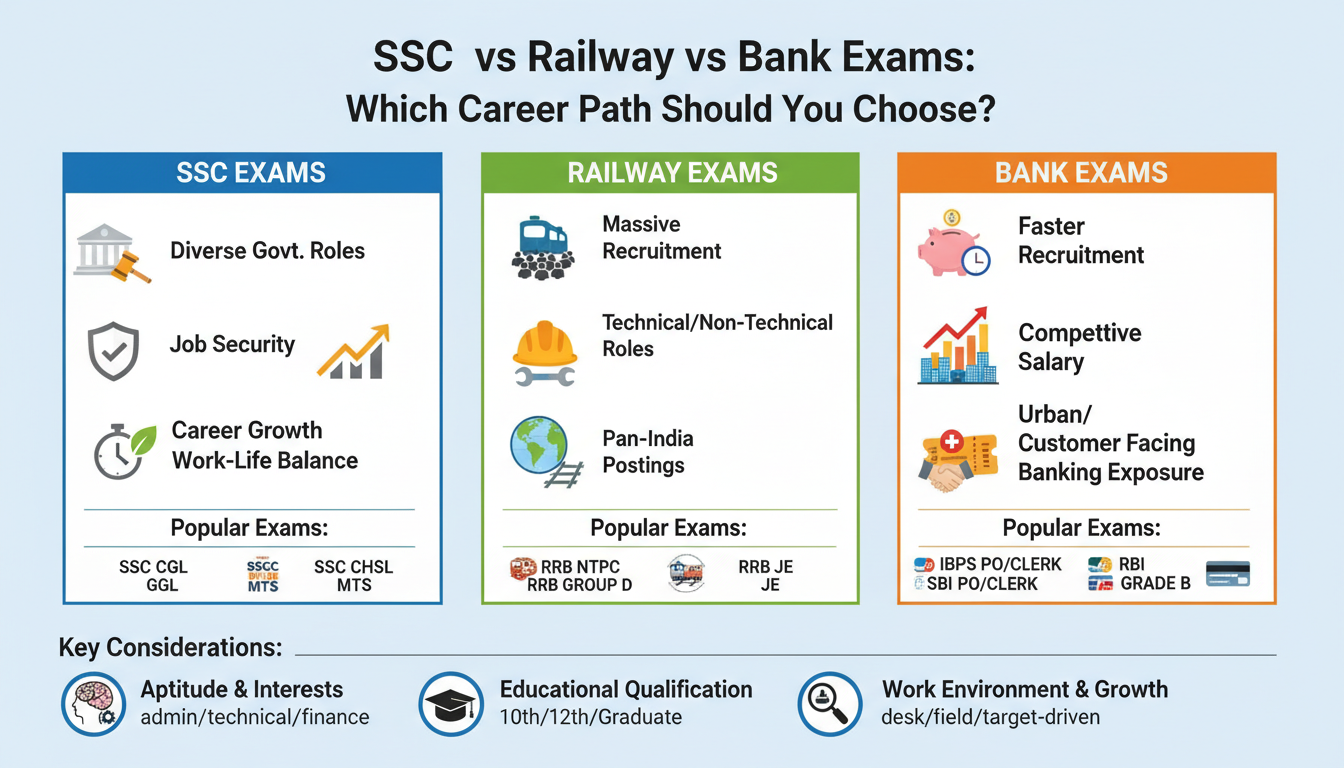
If you’re wondering “Which is best: SSC, Railway, or Bank Exams 2025?”, here’s the straight answer: it depends on what you value—job stability, growth potential, location, or work-life balance. All three are strong government exam routes, but each serves different career ambitions. So let’s sort it out quickly and clearly.
Why the right match matters from the start
You’re likely preparing intensively for government job exams. Each path leads to secure employment—but the nature of your daily life, salary, promotions, and postings will differ. Picking the right road now can save time, effort, and confusion later.
Overview of Each Exam Path
SSC (Staff Selection Commission) Exams
SSC covers a wide range of central government posts—clerks, inspectors, assistants, ministry staff. You’ll deal with General Awareness, Reasoning, Quantitative Aptitude, English.
It’s highly competitive, attracts massive numbers, and has a centralized exam structure. On the plus side, it offers wide visibility—positions in NCS (National Career Service), CBIC, CBIC, CAG, etc. There’s frequent recruitment, job security, and clear promotion norms.
The downside? Posting locations are varied, sometimes remote. Career growth can plateau early unless you clear departmental promotions later.
Railway Exams
Railway jobs—like NTPC (Non-Technical Popular Categories), JE (Junior Engineer), ALP (Assistant Loco Pilot), Group D—are coveted for safety, fixed shifts, housing, and perks.
You focus on RRB NTPC, RRB JE syllabus—General Awareness, Maths, Reasoning, and domain-specific technical subjects for engineers. Exams are less frequent, but when they run, massive hire happens.
Benefits include predictable work hours (especially for clerk and station roles), railway housing, transfer flexibility (state to state), and solid pension. But promotion can be slow for lower grades, and transfers can uproot family frequently.
Bank Exams
Banking careers (like IBPS Clerk, PO, SBI PO, Specialist Officer) revolve around finance, reasoning, computer skills, with separate sections for Banking Awareness. These often feel aligned to graduates with commercial/commerce background.
Advantages? Strong salary growth, timely promotions, comfortable urban postings, and modern work culture. You build skills in fintech, customer service, credit analysis.
However, exam pattern changes often. Competition is intense. Transfers can keep you in cities, but can still shift you across regions. Workload can be unpredictable—especially in POs with branch targets.
Comparing Factors Side by Side
Stability & Perks
- SSC: Central government benefits, well-defined pension.
- Railway: Housing, canteen, free travel, dependable schedules.
- Bank: Good allowances, urban convenience, digital workspace.
Promotion & Career Growth
- SSC: Structured departmental promotions, but slower upward movement.
- Railway: Grade-based, but upper-tier promotions limited without exams.
- Bank: Better mid-level acceleration (officer roles), performance-linked incentives.
Posting & Location Flexibility
- SSC: Dust to dawn across India—your transfer mileage may vary.
- Railway: Transfer frequent but lateral—redeploy within the zone.
- Bank: Mostly city-based, transfers across urban centers; families adjust easier.
Exam Preparation & Frequency
- SSC: Frequent recruitment, predictable syllabus.
- Railway: Periodic pulses; some years heavier than others.
- Bank: Monthly pattern shifts; require agility in prep style.
What Aligns with Your Career Goals?
If You Want Nationwide Service and Stability…
SSC might suit you if you’re fine with varied locations, central-government frameworks, and a calm career pace with reliable benefits. A friend ace’d SSC GD police last year… she got a posting near home and loves the stable office hours.
If You Desire Tangible Perks and Routine Timings…
Railway jobs are like secure day jobs with perks. A cousin joined as ALP—he’s got subsidized housing, fixed shifts, and time for side learning. However, moving from station to station was tougher than he thought.
If Your Aim is Urban Lifestyle and Faster Growth…
Banking roles, especially PO, offer better pay, city comfort, and ramp-up opportunities. A batch mate who took SBI PO last year says working in a bank opened doors to training courses and tech-savvy roles very quickly.
Strategic Decision Path For You
- Clarify priorities: Is it pay, location, growth, lifestyle?
- Check eligibility & interest: Engineering? Banking? General posts?
- Observe recent trends: Count intake numbers, frequency of exams.
- Test-fit via mock surveys: Do SSC prelims, banking finance quizzes, railway technical tests.
- Speak to current employees: Real insights beat fancy brochure claims.
“The best career path isn’t always the one with the highest pay; rather, it’s the one matching your long-term values and daily comfort,” says Maya Rao, a careers coach with two decades helping government job aspirants.
Example Comparison Table
| Path | Strengths | Considerations |
|————-|——————————–|—————————————-|
| SSC | Wide options, job security | Slower promotions, mixed postings |
| Railway | Perks, routine, housing | Less promotion, frequent transfers |
| Bank Exams | Urban life, better growth | Target pressure, shifting patterns |
Next Steps You Can Take Now
- Register for mock tests across all three paths.
- Join discussion forums and follow result trends for 2025.
- Watch exam calendars for SSC CGL, RRB NTPC, IBPS PO/SBI PO.
- Sync study schedules—common sections (math, reasoning, English) help multitask.
Conclusion
Choosing between SSC, Railway, and Bank Exams boils down to your daily life preferences and long-term goals. Pick SSC if you favor structured central roles, opt Railway for fixed hours and perks, go Bank for urban growth and modern work vibe. Start by testing your interest and aptitude in each exam. Over time, your best-fit path will become clear.
FAQs
Which exam path has the easiest competition?
Each is competitive, but railway and bank exams often attract more focused applicants for fewer posts. SSC spreads out across many positions, so success rates vary significantly.
Can I prepare for more than one exam path at the same time?
Yes, shared sections like math and reasoning help multitasking. Just adjust for domain-specific weight—finance for banks, general knowledge for SSC, technical for railway.
Which job offers the best chances of promotion within five years?
Bank POs generally see faster mid-level growth if performance is strong. Railway and SSC promotions follow slower, structured timelines.
Do I need a particular educational background for these exams?
SSC and Railway exams are open to general graduates; technical rail jobs need engineering degrees. Bank exams often favor commerce and finance but accept general graduates too.
Are transfers a big challenge in these services?
SSC postings vary widely—both easy and remote. Railways transfer within zones frequently. Banks tend to keep you in cities, but still shift you among branches.
How do I decide if I should attempt all three?
Start with self-assessment: where you’d rather live, how you study, your career time horizon. Use mock tests and interviews with current employees to guide your decision.
Remember, there’s no one-size-fits-all. Trust your priorities, try the exams, and go where you’ll feel most at home and motivated.
