

 February 6, 2026
  6 Min
6 Min  No Comment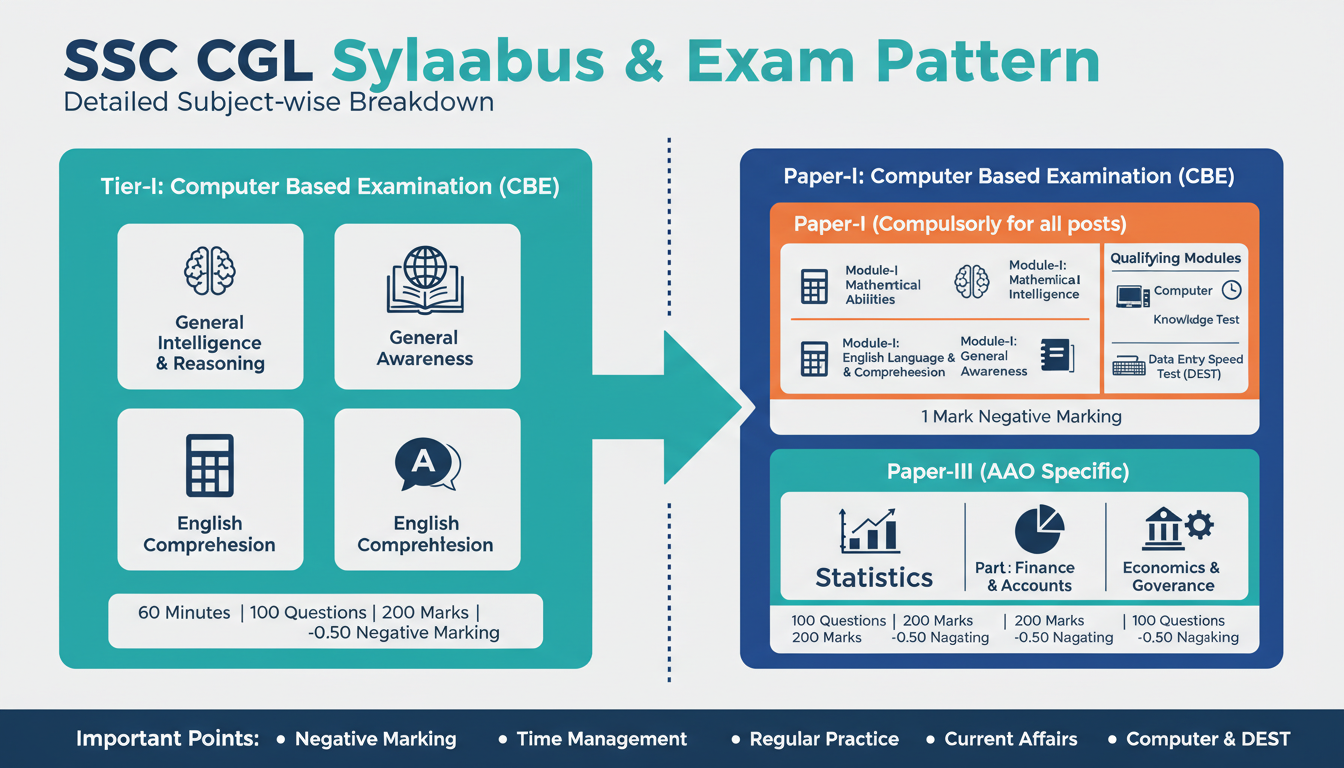
Navigating the SSC CGL syllabus feels a bit like walking through a maze: structured on the surface yet dotted with confusing bits—slightly conflicting topic lists, nerves about negative marking, and Tier‑two nuances you keep putting off. Let’s walk through this together, imperfectly, acknowledging that yes, we all fuzz over details from time to time.
This article dives into the SSC CGL syllabus, offering a clear, human‑friendly, subject‑wise breakdown of the exam pattern and topics for both Tier 1 and Tier 2. There’s a bit of editorial meander (what can I say—I talk like I think), but the goal remains: to give you grounded clarity, neat structure, and a guide you can actually stick with.
Tier 1 Exam Pattern: Big Picture at a Glance
What’s the layout for Tier 1?
Tier 1 is your entry‑ticket: four sections, 25 questions each, 50 marks apiece, all crammed into 60 minutes. A wrong answer deducts 0.50 marks. In sum, 100 questions, 200 marks.
| Section | Questions | Marks |
|———————————-|———–|——-|
| General Intelligence & Reasoning | 25 | 50 |
| General Awareness | 25 | 50 |
| Quantitative Aptitude | 25 | 50 |
| English Comprehension | 25 | 50 |
Most sources confirm this structure. It’s reliable and consistent across official outlines and prep platforms.
The negative marking – no sugar‑coating
Yes, 0.50 per wrong answer—so accuracy matters as much as speed. That’s the unforgiving part we groan about but must respect.
Tier 1 Topics: What You Actually Need to Cover
Here’s where the syllabus becomes the real roadmap. I’m noting some overlaps, a few contradictions—’cause real life, right?—but these are the threads you can follow.
General Intelligence & Reasoning
Expect a steady diet of:
– Analogies (word, number, figural)
– Coding‑decoding, series (number/alphabet)
– Blood relations, directions, mirror/water images
– Paper folding/cutting, odd one out, syllogism.
It’s a grab‑bag of logic, reasoning puzzles and tricks that just keep coming.
General Awareness
This is the section that tests both memory and awareness:
– Current affairs (last 6–8 months) across national, international, sports, awards
– Static GK: History (ancient to modern), Indian and world geography, polity (constitution, amendments), science at around 10th‑grade level.
Some sources break it further into economics and environmental bits, but these are usually sub‑parts under static GK or general studies edge cases.
Quantitative Aptitude
Arithmetic and basics rule the show:
– Percentage, ratio, profit & loss, simple/compound interest, time & work, time & distance, averages, partnerships, mixtures, algebra, geometry, trigonometry, data interpretation, number systems.
Geometry/trig often have heavier weight, but really, you’d want a solid fluency across all these if you’re gunning for high scores.
English Comprehension
Language skills tested via:
– Reading comprehension, synonyms/antonyms, one‑word substitutions, idioms/phrases
– Sentence correction, error spotting, fill‑in‑blanks, sentence rearrangement, cloze tests, active/passive transformations.
Tier 2 Exam Pattern and Syllabus: Deep Dive into the Next Stage
Once you clear Tier 1—the real stuff begins. Tier 2 is merit-determining, with Paper 1 mandatory, and selective extra papers for certain roles.
Paper 1 (Compulsory for All)
Broken into three components:
Session 1:
- Mathematical Abilities: 30 Qs, ~90 marks
- Reasoning & General Intelligence: 30 Qs, ~90 marks
Session 2:
- English Language & Comprehension: ~45 Qs, ~135 marks
- General Awareness: ~25 Qs, ~75 marks
Section III (Qualifying only):
- Computer Knowledge: 20 Qs, ~60 marks (but only qualifying)
- Data Entry Speed Test: practical task.
Brain‑bleed on sections I & II: they actually add to merit, with negative marking in most modules (except qualifying ones). Keep calm about that.
Paper 2 & Paper 3 (For Special Posts)
- Paper 2: Statistics – 100 Qs, 200 marks. Required only for Junior Statistical Officer, Statistical Investigator Grade II.
- Paper 3: General Studies (Finance & Economics) – 100 Qs, 200 marks. For Assistant Audit Officer/Accounts Officer paths.
These are role-specific and not required by all candidates—but if this is your path, it’s deep diving into numbers, economics, and public finance realms.
On the Ground Insights: Real‑World Aspirant Talk
There’s chatter online—aspirants hashing out plans, confusion, confidence worries. It’s kind of reassuring that everyone’s in the same boat.
One aspirant shared how they spread Quant over weeks, nudging PI, P&L, ratio, DI and eventually grabbing mocks to spot pattern weak spots.
Another admitted confusion over syllabus variations across resources and pleaded for an official clear list—a relatable frustration.
That’s the human mess in preparation, but also the chance—you can take this clarity and build a plan based on the official structure.
Expert Insight in Context
“Understanding the exam architecture—the relative weightage of reasoning, quant, GA and English—lets aspirants strategize effectively rather than chase random topic lists.”
Yep, it comes down to using what’s confirmed (official exam pattern, reliable sources) to guide prep, not every trending YouTube channel.
Conclusion: Your SSC CGL Syllabus Compass
Let’s sum it up: Without glazing over complexity, here’s what matters most:
- Tier 1: Four sections, 25 Qs each, 2 marks per correct response, −0.5 for wrong answers, 60 minutes.
- Tier 1 Syllabus: Reasoning (analogy, puzzles), GA (current affairs + static GK), Quant (arithmetic + basic algebra/geometry), English (grammar, comprehension, vocabulary).
- Tier 2: Paper 1 mandatory (maths, reasoning, English, GA, computer qualifying), extras only if you’re aiming for statistical or finance/audit roles.
Prep wise? Use the official pattern, map topic lists from trusted platforms, schedule prep like a rough week‑by‑topic plan, and pepper in mocks early to adjust.
You’ve got this—just steady steps, smart focus, and a syllabus plan that’s human‑friendly rather than robotic.
FAQs
What are the four sections in SSC CGL Tier 1 and their question counts?
Tier 1 includes General Intelligence & Reasoning, General Awareness, Quantitative Aptitude, and English Comprehension. Each section has 25 questions, contributing 50 marks apiece in a 100‑question paper.
Is there negative marking in the SSC CGL exams?
Yes—Tier 1 and qualifying modules in Tier 2 penalize wrong answers with 0.50 marks deduction each. Computer knowledge and skill tests are qualifying only and do not carry this penalty.
What does the Tier 2 Paper 1 include?
Tier 2 Paper 1 includes Mathematical Abilities, Reasoning & General Intelligence, English Language & Comprehension, General Awareness, plus qualifying parts like Computer Knowledge and a Data Entry Speed Test.
Which candidates must take Papers 2 or 3 in Tier 2?
Paper 2 (Statistics) is for aspirants aiming for JSO or Statistical Investigator Grade‑II roles, while Paper 3 (General Studies—Finance & Economics) is for Assistant Audit/Accounts Officer positions.
How can aspirants manage topic clarity amid conflicting online sources?
Stick with official or widely corroborated outlines. Prioritize analyzing exam patterns, trusted prep platforms, and supplement with mocks. When in doubt, loop back to the SSC notification or respected sources to avoid wasted effort.
By weaving clarity, real-world voices, and structured breakdowns, this article aims to be your syllabus compass—warts, curveballs, and all.
