

 March 20, 2026
  10 Min
  No Comment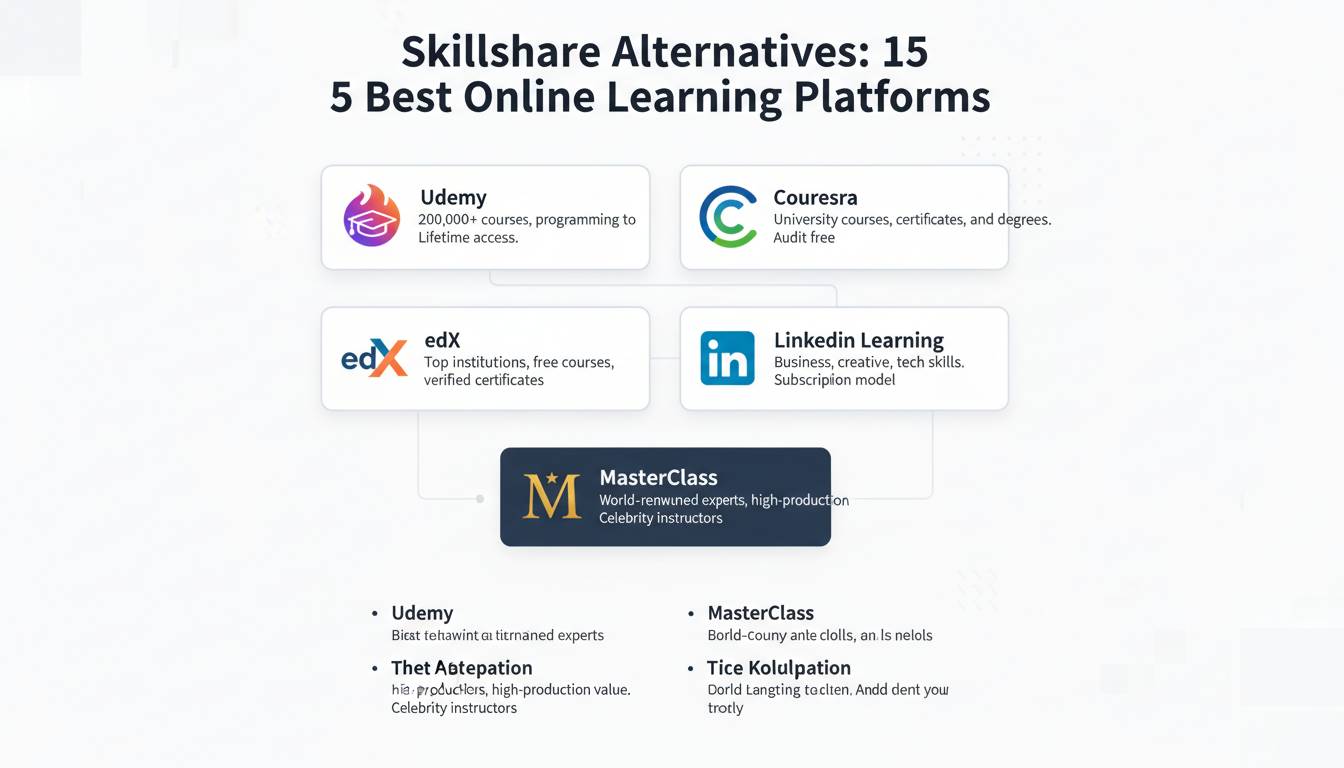
The online learning market has exploded to over $400 billion globally, with millions of professionals upgrading skills daily. If you’re evaluating Skillshare alternatives, you’re likely seeking better pricing, more specialized content, or specific features that match your learning goals. This comprehensive guide examines 15 platforms worth your attention, comparing what each does well and where it falls short.
Key Insights
– The average professional spends 4-6 hours weekly on online learning platforms
– Udemy hosts over 210,000 courses, while Coursera partners with 200+ universities
– Subscription models typically range from $10-$50/month; one-time purchases can run $15-$200
– Niche platforms often outperform generalists in specific domains like creative arts or tech skills
Understanding the Online Learning Landscape
The e-learning industry has matured significantly since Skillshare launched in 2010. Today’s platforms分化 into distinct categories: massive open course providers (Coursera, edX), creative-focused communities (Domestika, CreativeLive), professional development hubs (LinkedIn Learning, Pluralsight), and university-backed programs offering credentials.
Skillshare operates on a subscription model at approximately $13.99/month or $99.90/year, emphasizing creative skills through project-based learning. However, learners increasingly report gaps in advanced content, limited instructor interaction, and a catalog that prioritizes breadth over depth.
The right alternative depends on three factors: your learning style, career objectives, and budget constraints. Some platforms excel at foundational skills; others prepare you for certification or degree programs. Understanding these distinctions prevents wasted subscription fees and accelerates skill acquisition.
Comprehensive Alternatives: Breadth of Content
Udemy
Udemy remains the largest course marketplace with over 210,000 video courses spanning business, tech, design, and personal development. Unlike Skillshare’s subscription model, Udemy operates on individual course purchases, though subscribers can access a subset through Udemy Business.
Strengths:
– Massive catalog means you’ll find courses on nearly any topic
– Frequent sales bring prices down to $12-$15 for most courses
– Lifetime access after purchase provides unlimited review opportunities
– Student reviews and ratings help gauge quality before buying
Limitations:
– Course quality varies significantly since anyone can publish
– No structured learning path or community features
– Instructor response times differ dramatically
Pricing: Individual courses $14.99-$199.99; Business plans starting at $360/year per user
Coursera
Coursera partners with 200+ universities and organizations to offer university-level courses, professional certificates, and degree programs. This platform distinguishes itself through academic rigor and credential value.
Strengths:
– Degrees and certificates from Yale, Stanford, Google, and IBM carry real weight in hiring
– Financial aid available for verified certificates
– Structured learning paths with deadlines and assignments
– Peer interaction and graded assignments create accountability
Limitations:
– Free access limits you to audit mode; certificates require payment
– Less focus on hobbyist or creative skills
– Self-paced options exist but deadlines drive completion
Pricing: Individual courses free to audit; certificates $39-$100+; degrees $10,000-$40,000
edX
Founded by Harvard and MIT, edX provides university-level education from institutions including MIT, Harvard, and Georgetown. The platform emphasizes academic credibility and offers both free and paid pathways.
Strengths:
– Access to actual university courses and materials
– MicroMasters and Professional Certificate programs provide career advancement
– Verified certificates prove identity and completion
– Self-paced and instructor-led options available
Limitations:
– Less suited for casual or hobbyist learning
– Interface feels more academic than modern consumer platforms
– Community features less developed than competitors
Pricing: Free for audit; verified certificates $50-$300; MicroMasters $1,000-$15,000
Creative-Focused Alternatives
Domestika
Domestika has emerged as the premium platform for creative professionals, offering courses taught by recognized artists and designers. The Spanish-founded platform emphasizes project-based learning with creative communities.
Strengths:
– Curated instructors who are working professionals, not career educators
– High production quality with creative briefs and resources
– Strong community features including project sharing and feedback
– Focus on practical skills applicable to creative careers
Limitations:
– Smaller catalog (~2,000 courses) limits topic breadth
– Subscription model less flexible than one-time purchases
– Primarily creative focus excludes professional/technical subjects
Pricing: Courses $9.99-$19.99; subscription plans around $12.99/month
CreativeLive
CreativeLive pioneered live streaming creative education and maintains a strong focus on photography, design, and entrepreneurship. The platform combines free live classes with a paid course library.
Strengths:
– Free live classes create community and attract new learners
– Workshop-style courses with extensive production value
– Strong focus on creative entrepreneurship and business skills
– Downloadable resources and class materials included
Limitations:
– Pricing appears higher than competitors at first glance
– Some courses feel dated as platform has existed since 2010
– Business focus sometimes overshadows creative technique
Pricing: Individual courses $29-$149; subscription $29.99/month or $199/year
Professional and Technical Alternatives
LinkedIn Learning
LinkedIn Learning integrates directly with the world’s largest professional network, offering video courses focused on business, technology, and creative skills. The platform leverages LinkedIn’s employment data to recommend relevant skills.
Strengths:
– Integration with LinkedIn profiles displays completed courses
– Skill recommendations based on job titles and industry trends
– Courses from industry professionals with real-world experience
– Enterprise solutions for team learning management
Limitations:
– Less community interaction than creative-focused platforms
– Certification value unclear compared to formal credentials
– Annual subscription required for best pricing
Pricing: Monthly $29.99; annual subscription $19.99/month
Pluralsight
Pluralsight positions itself as the technology skills platform, offering courses specifically for IT professionals, software developers, and technology teams. The platform acquired CodeSignal to add skills assessment capabilities.
Strengths:
– Technical depth unmatched for IT and development skills
– Skill assessments identify learning gaps
– Path-based learning for career advancement
– Enterprise focus with team management features
Limitations:
– Narrower topic focus limits appeal to non-technical learners
– Higher pricing than generalist platforms
– Less suitable for hobbyists or casual learning
Pricing: Individual annual $299; team and enterprise pricing available
Udacity
Udacity focuses on technology skills through Nanodegree programs developed with industry partners including Google, Meta, and IBM. The platform emphasizes job-ready skills with project-based curricula.
Strengths:
– Nanodegrees designed with hiring managers from major companies
– Hands-on projects with code review and feedback
– Career services including resume review and interview prep
– Clear learning paths for specific tech roles
Limitations:
– Nanodegrees represent significant time and financial investment
– Monthly subscription can add up quickly for extended programs
– Less breadth outside technology and data science
Pricing: Monthly subscriptions $199-$399; Nanodegrees $399-$1,596
Free and Budget Alternatives
Khan Academy
Khan Academy remains the gold standard for free educational content, covering K-12 subjects, test preparation, and select college-level topics. The nonprofit model eliminates any paywall barriers.
Strengths:
– Completely free with no subscription or course fees
– Consistently high-quality content reviewed by educators
– Strong for foundational learning and test prep
– Available in multiple languages
Limitations:
– Limited to academic subjects; few professional or creative courses
– No certificates or credentials for professional use
– Community features minimal compared to commercial platforms
Pricing: Free (nonprofit)
FutureLearn
FutureLearn offers courses from UK and international universities with both free and paid tiers. The platform emphasizes social learning through discussions and peer interaction.
Strengths:
– UK university partnership provides academic credibility
– Short courses and programs at various price points
– Strong social learning features and discussion threads
– Digital upgrade and certificates available
Limitats:
– Interface feels less modern than newer competitors
– Limited US university partnerships compared to Coursera/edX
– Business focus less developed
Pricing: Free to upgrade; individual courses $39-$69; programs $99-$249
Creator and Course-Building Platforms
Teachable
Teachable differs from other alternatives as it’s primarily a platform for creators to build and sell their own courses. However, learners can access individual creator courses directly.
Strengths:
– Creator control over pricing, curriculum, and delivery
– Diverse course offerings from individual experts
– Built-in payment processing and student management
– Integrations with marketing tools for creators
Limitations:
– Quality varies significantly between creators
– No unified platform search or discovery
– Learning experience depends entirely on individual course creator
Pricing: Free basic plan; paid plans $29-$119/month; transaction fees apply
Thinkific
Like Teachable, Thinkific enables course creators to build and sell courses. The platform emphasizes ease of use and has grown to power over 50,000 courses.
Strengths:
– Creator-focused with strong support and resources
– Course variety from business to hobby topics
– Built-in pricing and sales features
– Free plan allows free course distribution
Limitats:
– Not a unified learning platform; experience varies by course
– Discovery and search less robust than dedicated marketplaces
– Creator support varies across courses
Pricing: Free plan available; paid plans $49-$399/month
Comparative Analysis: Choosing Your Platform
| Platform | Best For | Price Range | Key Strength |
|---|---|---|---|
| Udemy | Self-directed learners | $15-$200/course | Massive catalog, lifetime access |
| Coursera | Career-focused learners | Free-$100+ | University credentials, structured learning |
| LinkedIn Learning | Professionals | $20-$30/month | Career integration, business skills |
| Domestika | Creative professionals | $10-$20 | Curated quality, creative community |
| Pluralsight | Tech professionals | $299/year | Technical depth, skill assessments |
| Udacity | Tech career changers | $199-$1,600 | Industry partnerships, job readiness |
| Khan Academy | Academic foundations | Free | Quality, accessibility |
How to Select the Right Platform
Define Your Goal First
Professional advancement typically demands platforms offering certificates or credentials—Coursera, edX, or LinkedIn Learning. Creative skill development suits Domestika or CreativeLive. Technical career changes benefit from Udacity’s Nanodegrees or Pluralsight’s technology paths.
Consider Your Learning Style
Self-motivated learners with clear direction often succeed on marketplace platforms like Udemy. Those needing structure and accountability benefit from Coursera’s guided paths or Udacity’s Nanodegree programs. Community-oriented learners thrive on platforms with active discussion features.
Evaluate Total Cost Over Time
A $15 course on Udemy costs less than a single month of Skillshare if you complete it and never return. However, heavy learners consuming multiple courses monthly find subscriptions more economical. Calculate your expected consumption before committing to any model.
Test Before Committing
Most platforms offer free trials, preview courses, or audit options. Spend time exploring interface, sample content, and community features before purchasing subscriptions. Your learning experience depends heavily on platform usability.
Conclusion
The “best” Skillshare alternative depends entirely on your specific circumstances. Udemy excels for variety and one-time purchases. Coursera and edX deliver university-backed credentials. Domestika offers superior creative education. LinkedIn Learning integrates career development. Pluralsight and Udacity lead in technology skills training. Khan Academy provides free academic foundations.
Rather than defaulting to the most popular option, assess your learning goals, preferred style, and budget. Many professionals maintain multiple subscriptions—a subscription for creative hobbies, separate access for professional development. This approach lets you use the right tool for each learning objective without compromising on quality or overspending on unused features.
The online learning landscape continues evolving, with new platforms and features emerging regularly. Stay flexible, evaluate your progress periodically, and don’t hesitate to switch platforms if your current choice no longer serves your needs.
Frequently Asked Questions
Is Skillshare worth it compared to these alternatives?
Skillshare works well for creative hobbyists seeking project-based learning in design, illustration, and photography. However, professionals seeking career advancement often find LinkedIn Learning or Coursera provide more valuable credentials. Tech professionals typically benefit more from Pluralsight or Udacity’s specialized content.
Which platform is cheapest for learning new skills?
Khan Academy offers the most comprehensive free education, though limited to academic subjects. Udemy’s frequent sales make individual courses very affordable at $12-$15. FutureLearn and Coursera provide free audit options for many courses, though certificates require payment.
Can I get job-recognized certificates from these platforms?
Coursera offers professional certificates from Google, IBM, and Meta, plus full degrees from partner universities. edX provides MicroMasters and professional certificates from MIT, Harvard, and other institutions. LinkedIn Learning certificates display directly on LinkedIn profiles. Udacity’s Nanodegrees are recognized by hiring managers at partner companies.
Which platform is best for learning coding and development?
Pluralsight and Udacity lead for professional development training, with Pluralsight offering deeper technical content and Udacity providing career-focused Nanodegrees. Udemy hosts extensive programming courses at various skill levels. Coursera partners with universities for computer science coursework.
Do these platforms offer mobile apps for learning on the go?
All major platforms listed offer iOS and Android apps enabling offline downloads and mobile learning. Udemy, Coursera, LinkedIn Learning, and Skillshare all provide robust mobile experiences. Domestika and CreativeLive also offer mobile access, though features may differ slightly from desktop versions.
Can I teach on these platforms if I want to create my own courses?
Teachable and Thinkific are designed specifically for course creators. Udemy, Skillshare, and Coursera also allow instructor partnerships. Each platform has different revenue share models, requirements, and support resources for new instructors.