

 March 19, 2026
  12 Min
  No Comment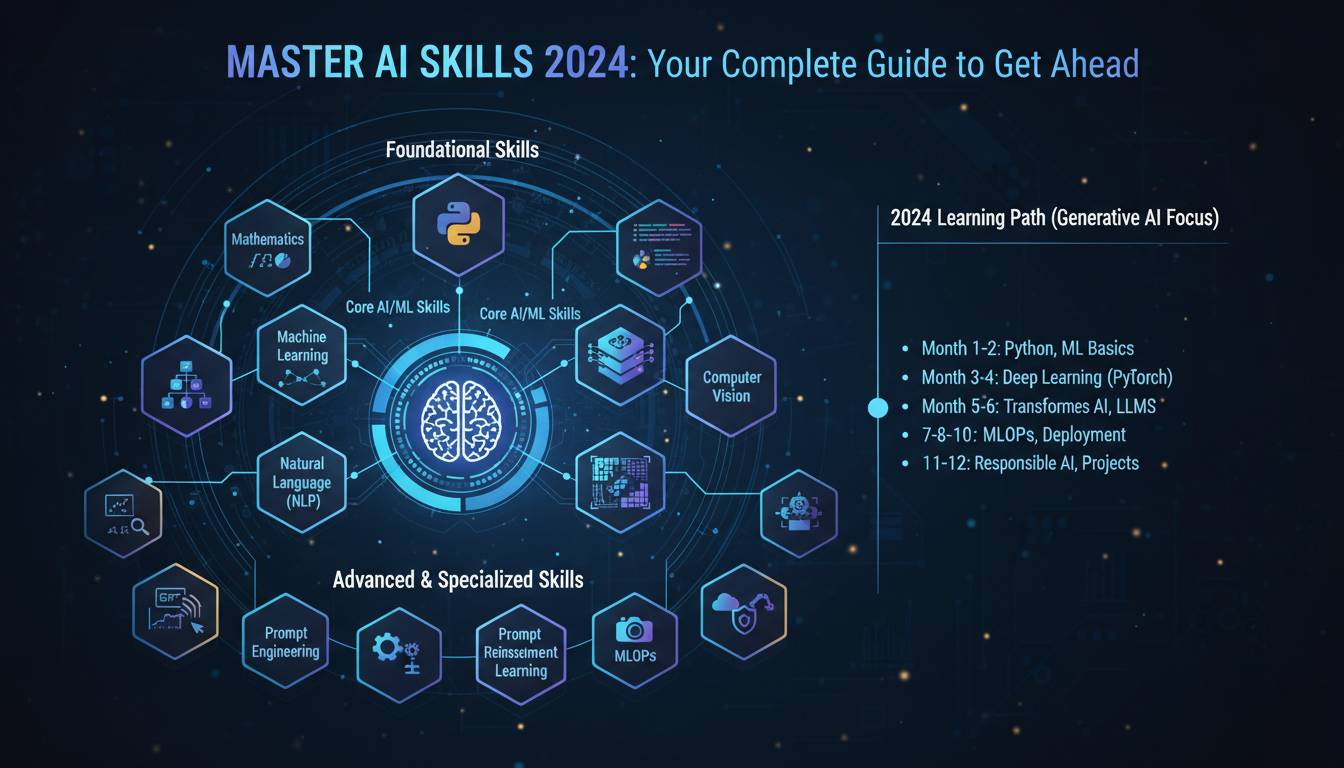
Artificial intelligence has transformed from a futuristic concept into an essential workplace competency. Whether you’re a seasoned professional or just starting your career, understanding AI skills in 2024 is no longer optional—it’s a career imperative. This comprehensive guide walks you through everything you need to know to master AI skills and gain a competitive edge in today’s rapidly evolving job market.
📊 STATS
• 83% of enterprises now cite AI as a strategic priority
• 97 million people will work in the AI sector by 2025 (World Economic Forum)
• $407 billion is the projected global AI market value by 2027 (Statista)
• 72% of executives plan to implement AI across their organizations
Key Takeaways
• Foundation first: Python programming and data literacy form the bedrock of AI competency
• Specialization matters: Prompt engineering and ML ops are among the fastest-growing skill categories
• Hands-on experience: Portfolio projects outweigh certifications for hiring managers
• Continuous learning: AI evolves rapidly—commit to ongoing education
• Business + tech: Combining AI knowledge with domain expertise maximizes career value
The AI landscape in 2024 has shifted dramatically from just two years ago. What once required specialized PhD-level knowledge is now accessible to professionals across industries through no-code tools, pre-built APIs, and intuitive platforms. However, this democratization doesn’t mean AI skills have become less valuable—in fact, the opposite is true. As tools become more accessible, the ability to strategically implement and optimize AI solutions has become a premium skill that commands higher salaries and better job security.
What Are AI Skills and Why Do They Matter in 2024
AI skills encompass the technical abilities and strategic knowledge required to develop, implement, and manage artificial intelligence solutions. These skills range from foundational programming and mathematics to advanced machine learning engineering and ethical AI governance.
The significance of AI skills in 2024 cannot be overstated. According to the Bureau of Labor Statistics, AI and machine learning specialist roles are projected to grow 40% through 2033—far outpacing the average for all occupations. This isn’t limited to tech companies; industries from healthcare to finance, marketing to manufacturing are actively seeking professionals who can bridge the gap between business problems and AI solutions.
Core Components of AI Competency
Technical Foundations:
• Python programming – The dominant language for AI development, with libraries like TensorFlow, PyTorch, and scikit-learn
• Data analysis and visualization – Skills in pandas, NumPy, and visualization tools like Tableau
• Machine learning fundamentals – Understanding algorithms, model training, and evaluation
• Statistics and probability – Essential for interpreting data and understanding model behavior
Strategic Capabilities:
• Prompt engineering – Crafting effective inputs for large language models
• AI tool selection – Choosing the right AI solutions for specific business needs
• Project management – Leading AI initiatives from conception to deployment
• Ethical considerations – Understanding bias, privacy, and responsible AI use
💡 STAT: Professionals with AI skills earn 25-40% more than their non-AI counterparts in equivalent roles
How AI Skills Differ From General Tech Skills
Traditional tech skills focus on building and maintaining systems. AI skills, by contrast, center on teaching systems to learn and make decisions. This fundamental shift requires a different mental model—one that embraces uncertainty, iteration, and continuous improvement rather than deterministic outputs.
The most successful AI professionals combine technical depth with business acumen. They can translate complex AI concepts into actionable insights for non-technical stakeholders while also understanding the technical constraints that shape what’s possible.
The Most In-Demand AI Skills for 2024
The AI job market has matured significantly, with clear skill tiers emerging based on roles and career objectives. Understanding these categories helps you chart a precise learning path.
| Skill Category | Demand Level | Average Salary | Learning Curve |
|---|---|---|---|
| Prompt Engineering | Very High | $130K | Short |
| Python + AI Libraries | Very High | $125K | Moderate |
| Machine Learning Ops | High | $145K | Long |
| Data Engineering | High | $140K | Moderate |
| AI Ethics & Governance | Growing | $135K | Moderate |
| Computer Vision | Moderate | $150K | Long |
| NLP / LLMs | Very High | $145K | Moderate |
Prompt Engineering
Prompt engineering has emerged as the most accessible entry point into AI. This skill involves crafting inputs that maximize the quality and relevance of outputs from large language models. It’s less about coding and more about understanding how AI models interpret instructions.
Key abilities:
• Clear and specific instruction writing
• Understanding model limitations and biases
• Iterative refinement of prompts
• Chain-of-thought reasoning techniques
• Few-shot and zero-shot learning applications
Machine Learning Operations (ML Ops)
ML Ops bridges the gap between model development and production deployment. As organizations move from AI experiments to enterprise-wide implementation, professionals who can manage the entire ML lifecycle have become invaluable.
Key abilities:
• Model versioning and tracking
• Automated pipeline development
• Performance monitoring and alerting
• Infrastructure management (cloud platforms)
• Containerization and deployment
Data Engineering for AI
AI systems are only as good as their data. Data engineers who understand AI requirements—data quality, preprocessing, feature engineering—command premium salaries and face less competition than pure ML engineers.
Key abilities:
• ETL pipeline development
• Data warehousing and lake architectures
• SQL and database optimization
• Real-time data processing
• Data governance and compliance
AI Ethics and Governance
With AI adoption accelerating, organizations face mounting pressure to implement responsible AI practices. This has created a growing demand for professionals who can navigate the ethical, legal, and regulatory landscape.
Key abilities:
• Bias detection and mitigation
• Privacy-preserving AI techniques
• Regulatory compliance (GDPR, emerging US frameworks)
• AI audit and documentation
• Stakeholder communication on AI risks
How to Acquire AI Skills: A Step-by-Step Path
Building AI skills requires a structured approach that balances theory with practical application. Whether you’re starting from scratch or adding AI to existing expertise, a clear roadmap accelerates your journey.
Prerequisites
- [ ] Basic programming knowledge (Python preferred)
- [ ] High school-level mathematics (algebra, basic statistics)
- [ ] Access to a computer with internet connection
- [ ] 5-10 hours per week for learning
- [ ] Curiosity and persistence
Time: 3-12 months depending on starting point | Cost: $0-$2,000
Step 1: Build Your Foundation (1-2 months)
Begin with accessible, practical introductions before diving into complex algorithms. Online platforms like Coursera, edX, and free resources like Google’s Machine Learning Crash Course provide excellent starting points.
Focus areas:
• Python fundamentals (if new to programming)
• Basic statistics and probability
• Introduction to AI concepts
• Hands-on experience with no-code AI tools
⏱ Timeline: 4-6 weeks | 💡 Tip: Start with ChatGPT, Midjourney, and other accessible tools to build intuition before learning the technical details
Step 2: Develop Technical Skills (3-6 months)
Once you understand AI concepts at a high level, develop practical technical abilities through project-based learning. This phase involves writing actual code and building working AI systems.
Focus areas:
• Python for data science (pandas, NumPy)
• Machine learning libraries (scikit-learn)
• Deep learning frameworks (TensorFlow or PyTorch)
• Model training and evaluation
• Version control and collaborative development
⚠️ Avoid: Tutorial paralysis—consuming endless courses without building anything
Fix: Complete one small project per week. Even simple implementations teach more than watching dozens of tutorials.
Step 3: Specialize and Build a Portfolio (2-4 months)
With foundational skills established, specialize in an area aligned with your interests and career goals. Simultaneously, build a portfolio that demonstrates practical capability to potential employers.
Project ideas:
• Chatbot development using LLMs
• Image classification system
• Predictive analytics model
• Data analysis with AI insights
• Automation workflow with AI integration
Portfolio platforms:
• GitHub repositories with clear documentation
• LinkedIn articles explaining your projects
• Personal website showcasing work
• Kaggle competitions and rankings
Step 4: Join the Community and Continue Learning
AI evolves rapidly, making community involvement essential for staying current. Engage with other learners and professionals through forums, meetups, and open-source projects.
Recommended communities:
• GitHub and Stack Overflow
• Reddit communities (r/MachineLearning, r/ArtificialIntelligence)
• LinkedIn groups
• Local AI/ML meetups
• Discord servers for AI learners
AI Skills by Career Path
Different roles require different AI skill configurations. Understanding the landscape helps you tailor your learning appropriately.
Technical Career Paths
| Role | Primary Skills | Secondary Skills | Experience Level |
|---|---|---|---|
| ML Engineer | Deep learning, MLOps | Software engineering | Senior |
| Data Scientist | ML, Statistics | Business acumen | Mid-level |
| AI Researcher | Research methods, Math | Publication record | Advanced |
| Prompt Engineer | LLM expertise | Communication | Entry-Mid |
Business and Strategy Roles
| Role | Primary Skills | Secondary Skills | Experience Level |
|---|---|---|---|
| AI Product Manager | AI capabilities, Roadmapping | Technical understanding | Mid-Senior |
| AI Consultant | Business + AI | Client communication | Senior |
| AI Ethicist | Ethics frameworks | Technical literacy | Mid-level |
| AI Project Manager | Implementation | Technical basics | Mid-level |
Industry-Specific Applications
Healthcare professionals with AI skills are transforming patient care through diagnostic assistance and treatment optimization. Financial analysts use AI for fraud detection and algorithmic trading. Marketing professionals leverage AI for personalization and campaign optimization. The pattern holds across industries—domain expertise combined with AI literacy creates powerful career advantages.
📈 CASE: A marketing professional who added AI skills to their resume saw a 35% salary increase within six months, transitioning from a generalist role to an AI-powered marketing specialist position
Common Mistakes to Avoid When Learning AI Skills
The AI learning journey presents unique challenges. Awareness of common pitfalls helps you navigate them more effectively.
| Mistake | Impact | Solution |
|---|---|---|
| Skipping fundamentals | 📉 Weak foundation, inability to debug | Master basics before advancing |
| Theory-only learning | 📉 No practical capability | Build projects from day one |
| Chasing every new tool | 📉 Shallow knowledge across everything | Specialize in 2-3 core areas |
| Ignoring ethics | 📉 Limited career advancement | Integrate ethical considerations early |
| Learning in isolation | 📉 Poor networking, limited opportunities | Join communities and collaborate |
| Comparing to experts | 📉 Discouragement, burnout | Measure progress against your starting point |
⚠️ CRITICAL: The biggest mistake is not starting. The AI field is growing so fast that waiting for the “perfect time” or “perfect course” means falling further behind. Begin with available resources and adjust your path as you learn.
Prevent these errors:
1. Set specific, measurable goals (not “learn AI” but “build a chatbot in 3 months”)
2. Schedule consistent learning time—treat it as a non-negotiable appointment
3. Celebrate small wins to maintain motivation
4. Find an accountability partner or community
Essential Tools and Resources for AI Skills
The right tools accelerate your learning and enable practical application. Here’s a curated selection based on cost-effectiveness and industry adoption.
Learning Platforms
| Tool | Cost | Best For | Rating |
|---|---|---|---|
| Coursera (AI courses) | Free-$99/mo | Structured learning | ⭐⭐⭐⭐⭐ |
| fast.ai | Free | Practical deep learning | ⭐⭐⭐⭐⭐ |
| Kaggle | Free | Hands-on practice | ⭐⭐⭐⭐⭐ |
| Google AI Learning | Free | Foundations | ⭐⭐⭐⭐ |
| Udemy | $20-200 | Specific topics | ⭐⭐⭐⭐ |
Development Tools
| Tool | Cost | Best For | Rating |
|---|---|---|---|
| Python | Free | Core programming | ⭐⭐⭐⭐⭐ |
| Google Colab | Free | Cloud notebooks | ⭐⭐⭐⭐⭐ |
| Hugging Face | Free | LLM applications | ⭐⭐⭐⭐⭐ |
| TensorFlow | Free | Production ML | ⭐⭐⭐⭐ |
| PyTorch | Free | Research & development | ⭐⭐⭐⭐⭐ |
AI Productivity Tools
For Learning:
• ChatGPT/Claude: Explaining concepts, debugging code, brainstorming projects
• Perplexity: Research and finding up-to-date information
• GitHub Copilot: Accelerated coding with AI assistance
For Application:
• Zapier/Make: No-code workflow automation
• LangChain: Building LLM applications
• Gradio: Quick AI demo creation
Expert Insights on AI Skills in 2024
Industry leaders emphasize practical ability over formal credentials when evaluating AI talent.
👤 Andrew Ng, Founder of DeepLearning.AI
“The AI skills that matter most in 2024 are the ability to identify high-value AI applications and lead implementation projects. Technical knowledge is necessary but insufficient without business judgment.”
👤 Fei-Fei Li, Professor at Stanford University
“We need to educate not just AI engineers, but AI citizens across all professions. Every knowledge worker will benefit from understanding what AI can and cannot do.”
Industry Benchmarks
| Metric | Average Professional | Top 10% AI Professionals |
|---|---|---|
| Projects completed | 3-5 | 10+ |
| Tools proficient in | 5-8 | 12-15 |
| Learning hours/month | 20-30 | 40-60 |
| Certification count | 2-3 | 5-8 |
Frequently Asked Questions
What is the best way to start learning AI skills in 2024?
Start with accessible tools like ChatGPT to build intuition about how AI works, then progress to Python fundamentals. Focus on one area initially—prompt engineering offers the fastest entry point, while Python programming provides the most versatile foundation. Commit to consistent, scheduled learning time and build projects from the beginning.
Do I need a degree to work in AI?
No degree is strictly required. Many successful AI professionals are self-taught or transitioned from other fields. What matters most is demonstrable skill through projects and portfolio work. However, certain specialized roles (AI research, advanced ML engineering) typically benefit from formal education.
How long does it take to learn AI skills?
Basic AI literacy takes 1-3 months. Functional proficiency for entry-level roles takes 6-12 months with consistent effort. Advanced expertise requires 2-4 years of dedicated practice. The timeline varies based on prior background, learning intensity, and specialization depth.
Which AI skills are most valuable for career advancement?
Prompt engineering, Python with AI libraries, and machine learning operations currently offer the best balance of accessibility and career value. Combined with domain expertise in your existing field, these skills create powerful career differentiation.
Are AI certifications worth it?
Certifications from reputable sources (Google, AWS, DeepLearning.AI) provide structure and credentials that some employers value. However, practical project experience typically outweighs certifications in hiring decisions. Use certifications to fill knowledge gaps rather than as the primary learning method.
Will AI replace jobs?
AI will transform many jobs rather than completely replacing them. Professionals who learn to collaborate with AI—using it to enhance their productivity and decision-making—will be more valuable than those who avoid it entirely. Adaptability and continuous learning are the most future-proof career strategies.
Conclusion
The AI revolution isn’t coming—it’s already here, and professionals with AI skills are reaping the benefits. Whether you aim to transition into an AI-specific role or simply want to enhance your current position, the time to start building AI skills is now.
The journey from AI novice to proficient practitioner is challenging but achievable. Focus on foundational skills, build practical projects, join supportive communities, and maintain consistency. Remember that AI literacy is becoming as fundamental as computer skills were in previous decades—those who develop these abilities early will have significant advantages as the technology continues to reshape every industry.
Your next step is simple: choose one resource from this guide and begin today. The AI-powered future belongs to those who prepare for it.