

 March 22, 2026
  13 Min
  No Comment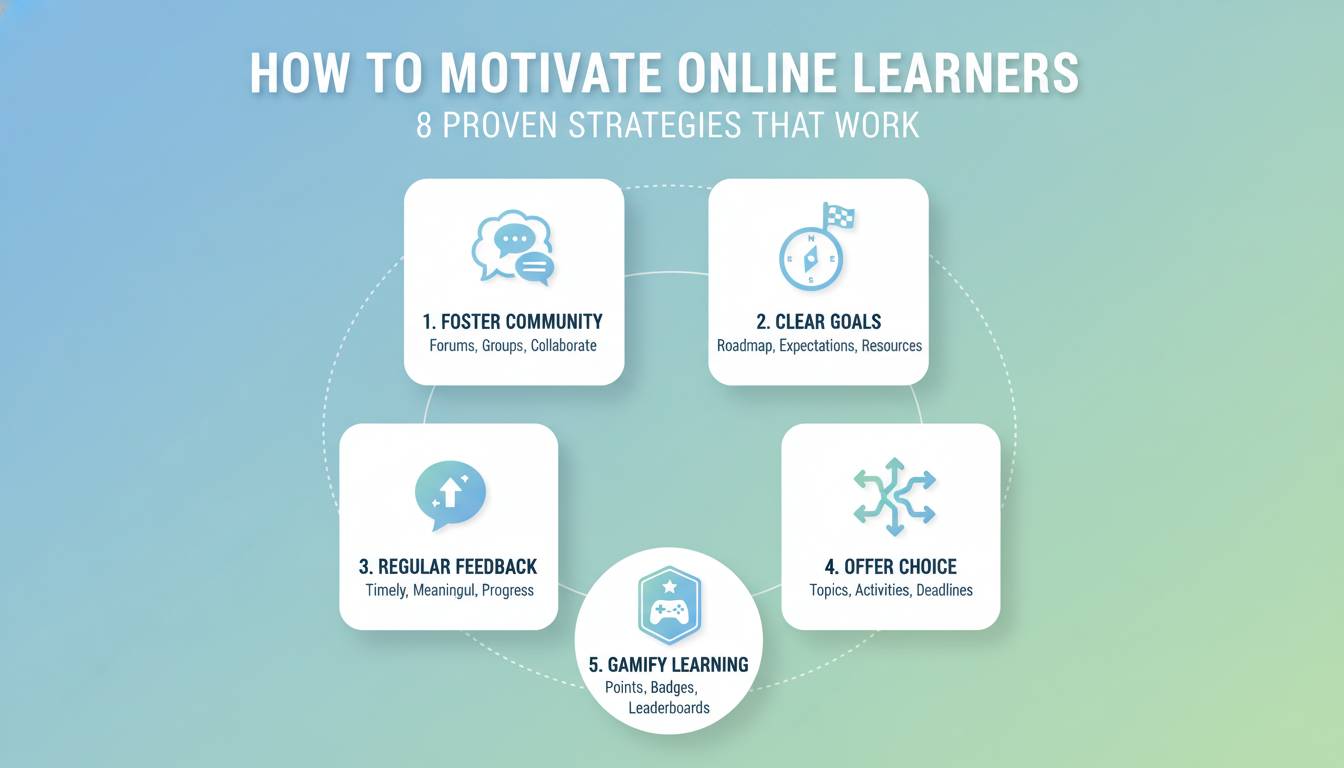
Keeping learners engaged and motivated in digital environments presents unique challenges. Without physical presence, instructors lose immediate feedback loops, spontaneous interactions, and the social pressure that encourages attendance. Yet research consistently shows that motivated learners achieve better outcomes—they complete courses at higher rates, retain information longer, and apply what they’ve learned more effectively. This guide presents eight evidence-based strategies to boost online learner motivation, backed by educational research and practical implementation advice you can use starting today.
Understanding What Drives Online Learner Motivation
Before implementing specific techniques, it’s essential to understand the psychological foundations of learner motivation. Research from the Online Learning Consortium (2024) identifies autonomy, competence, and relatedness as the three core elements driving sustained engagement in digital learning environments.
Autonomy refers to learners feeling they have choice and control over their learning journey. When learners perceive they can make meaningful decisions—what to learn first, how to demonstrate mastery, when to schedule study time—they experience greater intrinsic motivation. Competence emerges when learners feel they’re making progress and mastering skills. Feedback systems, clear progress indicators, and appropriately challenging content all reinforce this sense of growth. Relatedness involves learners feeling connected to instructors and peers. Even in asynchronous settings, creating opportunities for interaction builds the social bonds that encourage continued participation.
Dr. Michelle L. K. Smith, Director of Learning Design at Arizona State University’s School of Global Futures, emphasizes: “The most successful online programs treat learner motivation as a design problem, not an individual character flaw. When courses are structured to satisfy those three core needs, completion rates improve dramatically regardless of learner demographics.”
Strategy 1: Set Clear Goals and Expectations From Day One
One of the most powerful motivators is knowing exactly what you’ll achieve and how you’ll get there. A meta-analysis published in the Review of Educational Research (Chen et al., 2023) examined 156 studies on goal-setting in educational contexts and found that clearly defined learning objectives increased achievement by an average of 23% compared to vague or absent objectives.
Implementing This Strategy
Effective goal-setting happens at multiple levels. Course-level goals answer “what will I be able to do after completing this program?” Module-level goals answer “what will I master in this section?” Session-level goals answer “what will I accomplish in this sitting?”
Structure your course with a visible roadmap showing learners where they’re going. Many platforms like Canvas, Blackboard, and Moodle support custom dashboards that display progress toward completion. Make these visual elements prominent rather than buried in syllabi.
Example in practice: Instead of listing module topics, frame objectives as outcomes: “By the end of this module, you will be able to analyze customer feedback data and identify three actionable improvement opportunities.” This transformation from content coverage to capability building shifts motivation from compliance to growth orientation.
Strategy 2: Provide Immediate and Specific Feedback
Feedback is the fuel that drives the competence need. However, not all feedback is created equal. Research from the Center for Teaching Excellence at Cornell University (2024) distinguishes between evaluative feedback (“Good job!”) and diagnostic feedback (“Your analysis correctly identified the market gap, but your proposed solution lacks specificity because it doesn’t address timing constraints”).
Immediate feedback matters because it closes the loop while the learning experience is still fresh. Delayed feedback requires learners to reconstruct their mental model, which reduces retention and application. In online environments, where learners may go days between sessions, building in checkpoints with automated feedback becomes even more critical.
Implementing This Strategy
Use inline quizzes that provide explanatory feedback for both correct and incorrect answers. The key is explaining why an answer is correct—not just marking it right. For assignment feedback, aim to return comments within 48 hours, though automated rubrics can provide instant preliminary feedback.
Vygotsky’s Zone of Proximal Development research reminds us that effective feedback addresses what learners can accomplish with guidance, not what they can do independently. Frame feedback as scaffolding: here are your next steps, here’s what’s within reach, here’s how to get there.
Strategy 3: Build in Choice and Personalization
Learners who feel ownership over their learning path demonstrate higher persistence rates. A 2024 study published in the Journal of Educational Technology & Society found that learners given choice in assignment topics showed 31% higher completion rates than those assigned identical topics.
This doesn’t mean abandoning structure—it means building flexibility within your framework. Choice can operate at multiple levels: selecting which case study to analyze, choosing between assignment formats (video presentation vs. written report), or deciding the order in which to complete modules.
Implementing This Strategy
Consider offering “learning pathways” within your course. Perhaps one pathway emphasizes practical application while another emphasizes theoretical understanding. Both lead to the same learning outcomes but offer different approaches.
Technology enables personalization at scale. Adaptive learning platforms adjust content difficulty based on performance. Even without sophisticated technology, you can offer tiered resources: “Want more context? Here’s an optional 20-minute deep dive. Want to move faster? Here’s your shortcut to the assessment.”
Strategy 4: Create Opportunities for Social Interaction
The relatedness need is often neglected in online learning design, yet human connection remains a powerful motivator. A longitudinal study by the Online Learning Consortium (2024) following 12,000 online learners found that those who engaged in at least two social interactions per week were 2.4 times more likely to complete their courses than those with minimal social engagement.
Social interaction serves multiple motivational functions: it creates accountability (others notice when you disappear), provides emotional support during challenging material, and makes learning more enjoyable through shared experience.
Implementing This Strategy
Discussion forums remain underutilized in many courses. Move beyond open-ended prompts like “What did you think of this week’s material?” which often produce silence. Instead, use structured discussions with specific scenarios: “Imagine you’re advising a company facing X challenge—based on this week’s concepts, what would you recommend and why?”
Peer review assignments, group projects, and virtual study groups all build community. Even simple features like requiring learners to introduce themselves in an introductory forum, with specific prompts about their background and goals, establish social presence before coursework begins.
Consider synchronous sessions optional but encouraged. Live sessions with Q&A, breakout discussions, or collaborative activities create bonds that asynchronous work cannot replicate—while respecting that adult learners often have scheduling constraints.
Strategy 5: Use Gamification Elements Thoughtfully
Gamification applies game-design elements to non-game contexts. The strategy has gained significant attention in educational technology, with the global gamification market in education projected to reach $1.5 billion by 2027 . However, implementation quality varies dramatically.
Effective gamification taps into intrinsic motivation by providing clear feedback, achievable challenges, and meaningful rewards. Poorly implemented gamification can feel manipulative or reduce learning to point-chasing.
Implementing This Strategy
Start with progress visualization. Progress bars, completion percentages, and achievement badges satisfy the competence need by making growth visible. These work particularly well when tied to meaningful milestones, not just time spent.
Point systems can motivate some learners but may reduce intrinsic motivation for others if they shift focus from learning to reward collection. If using points, ensure they recognize quality and depth, not just quantity of activity.
Leaderboards require careful implementation. They motivate competitive learners but can discourage those who see themselves falling behind. Consider optional or private leaderboards, or leaderboards based on improvement rather than absolute performance.
Strategy 6: Connect Learning to Real-World Application
Adult learners are especially motivated when they see immediate relevance to their work or lives. Malcolm Knowles’ andragogy theory emphasizes that adult learners need to know why they’re learning something before they’ll engage with how.
The more explicitly you can connect course content to learners’ actual situations, the more motivated they’ll be. This connection serves both the autonomy need (seeing how this applies to what matters to you) and the competence need (understanding how this builds capabilities you value).
Implementing This Strategy
Open modules with real-world scenarios rather than abstract concepts. Instead of “Today we’ll cover market segmentation,” try “A mid-sized company just lost a major client because they couldn’t identify shifting customer needs—today you’ll learn the frameworks that would have prevented this.”
Case studies from diverse industries and contexts help learners see applications across their varied situations. Allow learners to suggest or select cases relevant to their fields.
Application assignments that require learners to immediately apply concepts to their own contexts powerfully reinforce both learning and motivation. A sales professional analyzing their own customer data will retain concepts far better than one working with hypothetical examples.
Strategy 7: Foster Growth Mindset Through Communication
Carol Dweck’s research on mindset demonstrates that learners’ beliefs about ability significantly impact their motivation and achievement. Learners with fixed mindsets believe ability is static—they avoid challenges, give up easily, and feel threatened by others’ success. Learners with growth mindset believe ability can develop through effort—they embrace challenges, persist through difficulty, and find inspiration in others’ success.
Instructor communication shapes whether learners develop fixed or growth mindsset. Feedback that emphasizes effort over innate ability, challenges framed as opportunities rather than threats, and language that normalizes struggle as part of learning all foster growth orientation.
Implementing This Strategy
Reframe struggle as essential to learning. When learners encounter difficulty, your response matters: “This is hard because you’re growing” beats “This should be easier.” Avoid language implying some learners simply “get it” while others don’t.
Share stories of struggle and revision. When you explain your own learning journey—how you failed initially, revised your approach, and eventually succeeded—you normalize the process.
Structure assignments with revision opportunities. When first attempts can be refined based on feedback, learners experience learning as a process rather than a single judgment.
Strategy 8: Maintain Consistent Instructor Presence
Research consistently shows that instructor presence correlates with learner satisfaction and persistence. A 2024 study in the Internet and Higher Education journal found that perceived instructor presence was the strongest predictor of online learner satisfaction, even exceeding course content quality.
Presence doesn’t require constant interaction—it requires consistent, meaningful engagement. Learners should feel they’re learning with someone, not just from recorded content.
Implementing This Strategy
Start each module with a brief video welcome—two to three minutes introducing the topic and why it matters. This humanizes the course and provides the parasocial connection that sustains motivation.
Participate in discussion forums, not just to answer questions but to acknowledge good contributions and draw connections between learner insights. A simple “Excellent point—Sarah’s observation about X connects directly to next week’s topic” makes learners feel seen.
Send periodic announcements or emails that feel personal, not mass-produced. Reference what you’ve observed in their work, upcoming deadlines, or encouragement when progress stalls.
Measuring the Impact of Your Motivational Strategies
Implementing these strategies requires tracking their effectiveness. Key metrics include:
| Metric | What It Indicates | Target Range |
|---|---|---|
| Course completion rate | Overall persistence | 70%+ for self-paced courses |
| Module-level drop-off | Where motivation fails | Consistent across modules |
| Discussion participation | Social engagement | 60%+ active participants |
| Assignment submission rates | Competence and relevance | 80%+ on-time submissions |
| Learner satisfaction scores | Overall experience | 4.0+/5.0 |
Collect qualitative feedback mid-course, not just end-of-course evaluations. Simple pulse surveys asking “What’s working? What’s frustrating?” provide actionable insights while demonstrating that learner input shapes their experience.
Frequently Asked Questions
How do I motivate learners who are forced to take my course?
Start by acknowledging their situation honestly. Then focus on relevance—explicitly connect course content to their actual goals, even if those goals are simply completing a requirement efficiently. Build in small wins early so they experience competence before hitting challenging material. Offer meaningful choices within the course to restore some autonomy. Your goal isn’t to make them love the subject—it’s to help them see value and experience progress.
What’s the most important factor in online learner motivation?
Research consistently points to perceived relevance as the most powerful predictor of learner engagement. Learners need to believe the content matters to them personally. Even poorly designed courses with highly relevant content outperform brilliantly designed courses with irrelevant content. Build relevance explicitly into every module through real-world applications, personalized examples, and clear explanations of why each topic matters.
How do I keep learners motivated in asynchronous courses without live interaction?
Asynchronous doesn’t mean isolated. Build interaction through discussion forums, peer review assignments, and collaborative projects. Use automated reminders and check-ins. Create content that feels personal—video introductions, audio feedback, written messages that address learners by name. Break content into manageable chunks with clear progress indicators. The key is designing for interaction rather than assuming learners will engage on their own.
Should I use rewards and incentives to motivate online learners?
Use rewards carefully and intentionally. Extrinsic rewards (points, badges, certificates) can boost short-term engagement but may undermine intrinsic motivation if overused. Focus on intrinsic motivators: meaningful content, relevant applications, social connection, and growth. If using extrinsic rewards, tie them to quality and learning behaviors, not just completion. The best reward is feeling like you’re developing capabilities that matter.
How quickly should I respond to learner questions and submissions?
Aim for 24-48 hours for any response. Longer delays signal that learner engagement doesn’t matter. Within courses, use automated acknowledgment: “Thanks for your question—I’ll respond within 24 hours.” For assignment feedback, faster is better while the work is still fresh. Discussion forums benefit from instructor presence within the first 24-48 hours of a thread going live.
What should I do if learner motivation drops mid-course?
First, diagnose the cause. Is content too difficult (competence issue), too irrelevant (autonomy issue), or too isolating (relatedness issue)? Check your analytics for where learners are dropping off. Send a mid-course check-in asking what’s working and what’s not. Sometimes simple encouragement from the instructor can re-engage learners who’ve lost momentum. Consider adding optional live sessions to inject energy and connection into the course’s second half.
Final Recommendations
Improving online learner motivation requires treating motivation as a design problem rather than assuming individual learners are simply “unmotivated.” By understanding the core needs for autonomy, competence, and relatedness—and implementing strategies that address each—you can create online learning experiences that sustain engagement and drive real outcomes.
Start by auditing your current course against these eight strategies. Pick one or two areas where you’re weakest and focus improvement there before expanding. Small changes—a video introduction, clearer learning objectives, a discussion prompt with specific parameters—can yield significant engagement improvements.
Remember that motivation is not a one-time fix but an ongoing process. Learner needs evolve, and your strategies should too. Collect feedback, track your metrics, and keep iterating. The most effective online instructors are those who treat their courses as living experiments in learner engagement.
LAST UPDATED: January 2025