

 March 19, 2026
  12 Min
  No Comment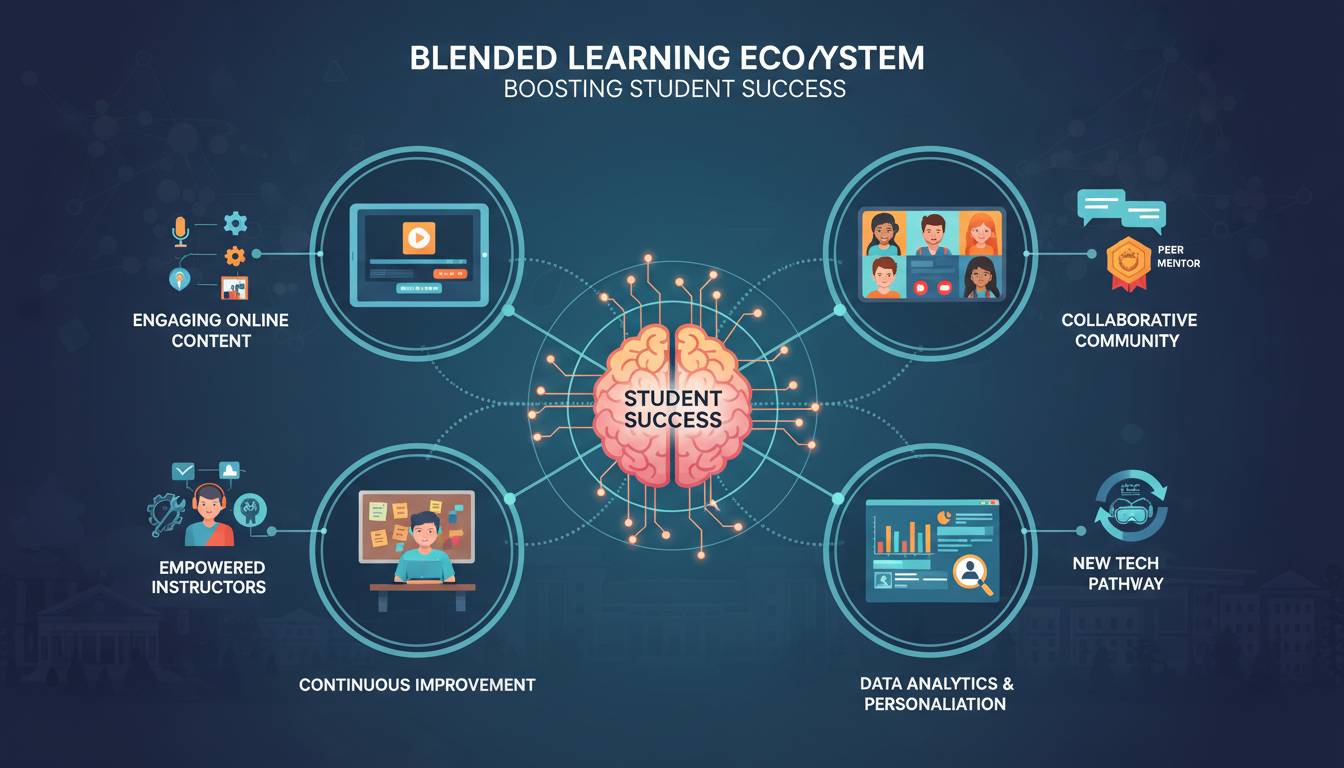
Blended learning combines face-to-face instruction with online learning activities, creating a flexible educational experience that universities across the United States are rapidly adopting. Research from the Federal Student Aid office shows that institutions implementing well-designed blended programs see measurable improvements in student engagement, retention rates, and learning outcomes. This approach isn’t simply uploading lectures to a learning management system—it’s a deliberate restructuring of how instruction delivered, when students access materials, and how they demonstrate mastery. Universities that master this balance report students performing 15-25% better than those in fully traditional or fully online formats, according to a 2023 meta-analysis published in the Journal of Higher Education.
What Is Blended Learning in Higher Education
Blended learning, sometimes called hybrid learning, refers to an educational approach where traditional in-person classroom time is combined with online learning activities. The ratio varies by course and institution, but the fundamental principle remains consistent: students attend fewer in-person sessions while completing equivalent or enhanced learning activities digitally. This model gained significant traction during the COVID-19 pandemic and has since evolved into a permanent fixture at universities nationwide.
The Department of Education’s meta-analysis of blended learning research found that students in blended environments performed modestly better than those in purely face-to-face or purely online settings. However, this improvement isn’t automatic—it depends heavily on how institutions design and implement their programs. The most effective blended courses aren’t just traditional lectures moved online; they reimagine the learning experience to maximize the strengths of each modality.
Higher education institutions typically employ several distinct blended learning models. The rotation model has students cycle between online and in-person instruction on a fixed schedule, often within a single course. The flex model keeps most instruction online while using face-to-face sessions for labs, discussions, or personalized support. The enriched virtual model requires students to attend some in-person sessions while completing most coursework online. Understanding these models helps universities choose the approach that best fits their student population and instructional goals.
The Core Components of Effective Blended Courses
Successful blended courses share several essential characteristics that distinguish them from poorly implemented hybrid programs. Course design begins with clearly identifying which content and activities work best in each modality. Complex theoretical concepts often benefit from face-to-face explanation where instructors can gauge comprehension in real-time. Meanwhile, foundational knowledge acquisition, practice problems, and discussion-heavy activities frequently work as well or better online, giving students flexibility to engage at their own pace.
The online component shouldn’t merely replicate what happens in class. Effective blended courses use digital platforms for purposes they genuinely serve better: automated practice assessments that provide instant feedback, multimedia content students can revisit multiple times, discussion boards that allow quieter students time to formulate thoughtful responses, and adaptive learning technologies that adjust to individual student needs. Research from Educause indicates that courses using these digital tools intentionally, rather than as afterthoughts, see the strongest learning gains.
Assessment strategies in blended courses typically incorporate both in-person and online evaluation methods. Students might take proctored exams on campus while completing project-based assignments or portfolio work online. This multi-modal assessment approach gives educators a more comprehensive view of student learning than traditional testing alone. The key is ensuring that assessment methods align clearly with learning outcomes and that students understand expectations from the course outset.
Proven Benefits: What the Research Shows
Universities implementing blended learning report benefits across multiple dimensions of student success. A longitudinal study conducted by researchers at Arizona State University found that students in blended courses had 10% higher course completion rates compared to traditional sections. The flexibility of the online component particularly benefits non-traditional students balancing education with work and family responsibilities—populations that historically have lower retention rates in higher education.
Learning outcomes data presents an encouraging picture. The Department of Education’s What Works Clearinghouse reviewed multiple studies and found that blended approaches produced positive effects on student achievement in mathematics, science, and reading at the higher education level. Students in blended environments demonstrated stronger conceptual understanding and better retention of material when assessed months after course completion. Researchers attribute this to the spaced repetition inherent in online modules and the active learning strategies effective blended courses employ.
Student satisfaction surveys consistently show appreciation for the flexibility blended courses provide. A 2023 survey by the Higher Education Research Institute at UCLA found that 72% of students who experienced blended learning preferred it to fully traditional formats. Students particularly value the ability to review lecture recordings, complete asynchronous work on their own schedules, and use class time for more interactive activities. This satisfaction correlates with improved engagement metrics and lower rates of course withdrawal.
| Benefit Category | Improvement Range | Source |
|---|---|---|
| Course Completion | 8-15% increase | ASU Longitudinal Study, 2022 |
| Student Achievement | 0.2-0.4 SD | DOE What Works Clearinghouse, 2023 |
| Student Satisfaction | 68-78% prefer | HERI Survey, 2023 |
| Content Retention | 15-25% improvement | MIT Learning Sciences Research, 2022 |
Faculty members also report professional benefits from teaching blended courses. The flexibility to redesign instruction using evidence-based practices leads many instructors to adopt more active learning strategies even in their fully in-person courses. Additionally, the asynchronous components can reduce some time demands of traditional teaching, though designing effective online materials requires significant upfront investment.
How Universities Are Implementing Blended Models Successfully
Georgia State University provides a compelling example of large-scale blended implementation. The institution transformed its introductory mathematics courses using a hybrid model where students complete online modules with adaptive practice problems while attending smaller in-person sessions focused on problem-solving and individualized support. Results showed significant reductions in D and F grades, with the biggest gains among first-generation college students and those from underrepresented groups. The university’s approach demonstrates how blended learning can address equity concerns when designed thoughtfully with specific student populations in mind.
Community colleges have found particular success with blended models given their student bodies’ time constraints. Valencia College in Florida developed a widely-recognized blended program that maintains rigorous academic standards while accommodating working adults. Students attend campus sessions twice weekly and complete online coursework during other time blocks. Graduation rates at Valencia improved markedly after expanding blended options, with the college becoming a national model for community college innovation.
Research universities are also experimenting with blended approaches, though their implementations often differ from two-year institutions. MIT has integrated blended elements across its engineering curriculum, using online content delivery to free classroom time for collaborative problem-solving and hands-on laboratory work. This approach allows students to engage with more complex material than traditional lecture-only formats permit. The key insight from MIT’s experience is that blended learning enables instructors to shift from information delivery to deeper learning facilitation.
Common Challenges and How to Overcome Them
Faculty development represents the most significant hurdle for universities adopting blended learning at scale. Many instructors received no training in online pedagogy during their graduate education and feel unprepared to design effective digital components. Institutions that invest in robust professional development programs—providing instructional designers, technology support, and ongoing coaching—see faster adoption and better outcomes than those that simply mandate blended teaching without support. The University of Central Florida’s extensive faculty development program has become a model for how to build institutional capacity for blended instruction.
Technology infrastructure demands careful attention. Students need reliable internet access and appropriate devices, requirements that aren’t universal across higher education populations. Low-income students, first-generation college students, and those from rural areas may face significant barriers accessing online components. Successful institutions address these equity concerns through laptop lending programs, expanded campus Wi-Fi, and offline capability options for course materials. Ignoring these access issues undermines the equity promise of blended learning.
Student self-regulation poses another challenge. The flexibility that benefits many students can disadvantage those who struggle with time management or procrastination. Effective blended courses build in structured checkpoints, regular engagement metrics, and early warning systems to identify struggling students before they fall too far behind. Faculty should provide clear expectations, frequent feedback, and multiple channels for students to seek help when needed. Orientation modules that teach students how to learn effectively in blended environments show positive results at institutions that have implemented them.
Best Practices for Faculty Designing Blended Courses
Course design should begin with backward design principles—clearly specifying learning outcomes before deciding what content to include and how to deliver it. Faculty members find it helpful to ask which outcomes require face-to-face interaction for optimal learning and which can be achieved effectively online. This analysis prevents the common mistake of simply moving existing content online without reimagining the learning experience. The most productive approach treats the online and in-person components as complementary rather than sequential.
Online content quality matters enormously. Students engage more deeply with well-produced video content than with lengthy text readings or poorly recorded lectures. Short, focused videos of 10-15 minutes work better than hour-long lecture recordings. Embedding comprehension checks throughout video content keeps students active rather than passively watching. Faculty don’t need expensive production equipment—clear audio, visible slides, and enthusiastic teaching communicate effectively to students.
Class time in blended courses should feel meaningfully different from traditional lecture. Use face-to-face sessions for discussions, collaborative problem-solving, group projects, and individualized coaching. Students should feel that attending in person provides genuine value they cannot get from online materials alone. This differentiation motivates attendance and ensures that valuable synchronous time gets used for activities that benefit most from real-time interaction.
| Implementation Element | Recommended Practice | Outcome |
|---|---|---|
| Video Length | 10-15 minutes per segment | Higher completion rates |
| Assessment Frequency | Weekly online quizzes | Better content retention |
| In-Person Activities | Discussion and problem-solving | Deeper understanding |
| Student Support | Embedded tutoring options | Improved pass rates |
| Feedback Turnaround | Within 48 hours | Increased engagement |
The Future of Blended Learning in Higher Education
Artificial intelligence promises to transform blended learning in coming years. Adaptive learning platforms already use AI to personalize practice problems and identify knowledge gaps, but emerging technologies will enable even more sophisticated personalization. Predictive analytics can identify students at risk of falling behind, allowing instructors to intervene proactively. AI-powered writing tutors and code graders provide instant feedback that previously required instructor time. Universities experimenting with these technologies report promising preliminary results, though questions about academic integrity and equitable access require continued attention.
The post-pandemic landscape has normalized blended approaches in ways that seemed unlikely in 2019. Students increasingly expect flexibility in how they access education, and employers are more accepting of credentials earned through non-traditional modalities. This acceptance creates opportunities for universities to serve populations historically underserved by higher education—including working adults, caregivers, and geographically isolated learners. The institutions that master blended learning will be positioned to capture growing demand for accessible, high-quality postsecondary education.
Accreditation bodies are also evolving their expectations. Regional accreditors now routinely evaluate how institutions use educational technology, including blended approaches. Standards increasingly emphasize learning outcomes rather than specific instructional modalities. This shift creates space for innovation while maintaining accountability for student success. Universities that view accreditation as a partner in quality improvement rather than a compliance burden will find productive paths forward for blended program development.
Frequently Asked Questions
What is the difference between blended learning and fully online learning?
Blended learning combines in-person classroom instruction with online learning activities, while fully online learning occurs entirely remotely without scheduled face-to-face sessions. In blended courses, students typically attend some in-person classes while completing coursework online. The in-person component distinguishes blended from purely online programs and allows for hands-on activities, lab work, and real-time interpersonal interaction that fully online formats struggle to replicate.
How much time do students spend in class versus online in a blended course?
The distribution varies by course design, but most blended courses reduce in-person time by 30-50% compared to traditional formats. A course meeting three times weekly might shift to one or two in-person sessions with equivalent online work. Some intensive blended programs use a 50/50 split, while others reserve in-person time primarily for labs, discussions, or assessment. The specific balance depends on course learning outcomes and the nature of the subject matter.
Do employers value degrees earned through blended programs?
Employer acceptance of blended credentials has increased significantly, particularly after the pandemic normalized online and hybrid learning. Most employers now view blended learning as a legitimate delivery mode rather than a compromise. Research from the Chronicle of Higher Education indicates that employers increasingly focus on the quality of the institution and the skills demonstrated rather than the specific format in which courses were delivered. Accreditation remains important—degrees from regionally accredited institutions maintain strong employer recognition regardless of delivery format.
What technology do students need for blended courses?
Students typically need a reliable computer or tablet, stable internet access, and a webcam for any synchronous online sessions. Learning management system access (Canvas, Blackboard, Moodle) is standard. Some courses may require specific software like Microsoft Office, statistical packages, or discipline-specific tools. Universities increasingly provide laptop lending programs and expanded Wi-Fi access to ensure students without home technology access can succeed in blended courses.
How do blended courses handle exams and assessments?
Blended courses typically use multiple assessment methods. Students might take proctored exams on campus for high-stakes assessments while completing quizzes, projects, and assignments online. Many institutions use proctoring software for online exams, though concerns about privacy and equity have led some universities to reconsider this approach. Portfolio assessments, presentations, and collaborative projects are common alternatives that work well in blended formats and often provide richer evidence of student learning than traditional testing alone.