

 March 22, 2026
  13 Min
  No Comment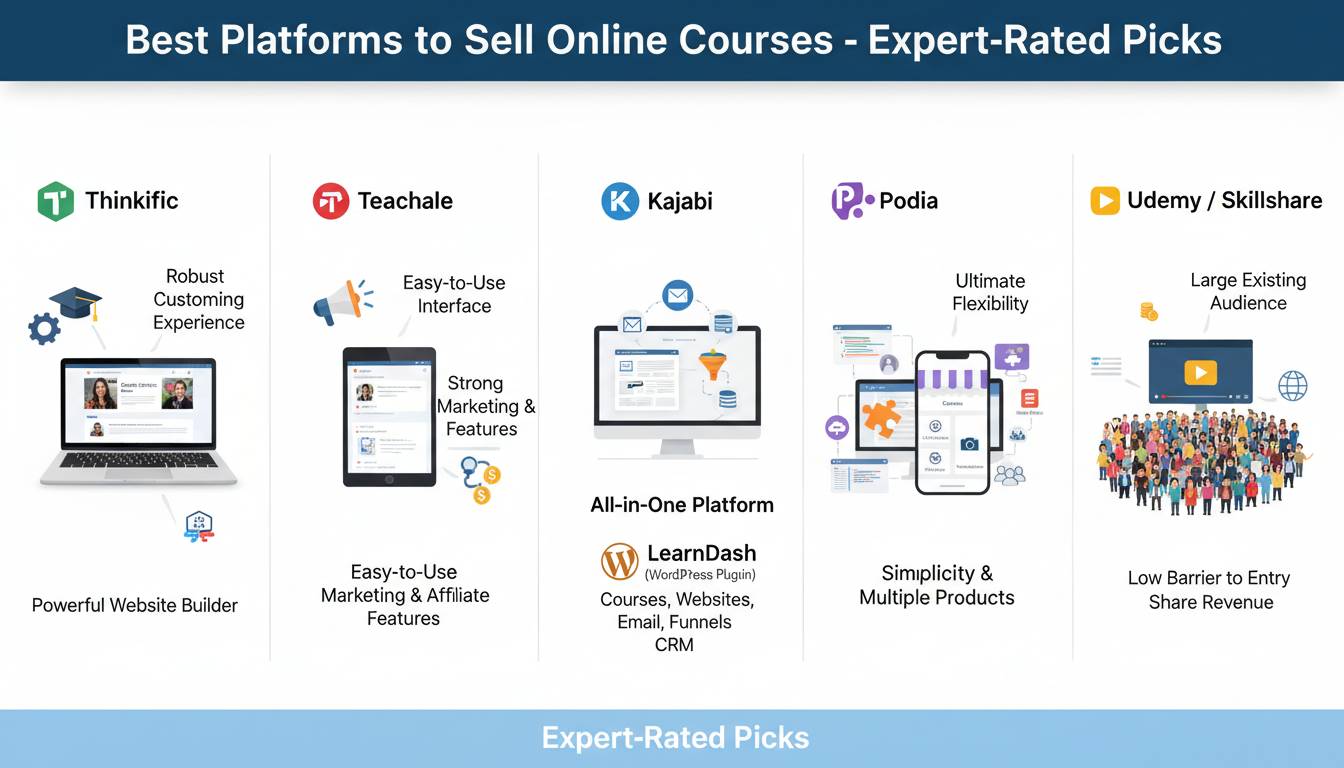
The global e-learning market reached $399 billion in 2022 and projections indicate growth to $1 trillion by 2030, according to HolonIQ. This explosive growth has created unprecedented opportunities for course creators, but selecting the right platform to host and sell your courses remains the critical decision that separates successful educators from those who struggle to gain traction. With over 50 platforms competing for your attention, each promising exceptional results, the research burden falls squarely on your shoulders.
This guide cuts through the marketing noise to deliver an evidence-based analysis of the platforms that actually deliver results. I’ve evaluated pricing structures, revenue share models, marketing features, and real-world creator experiences to help you make an informed decision aligned with your specific goals, technical capabilities, and budget constraints.
Understanding Your Course Platform Options
Before diving into specific platforms, understanding the fundamental categories helps narrow your search effectively. Online course platforms generally fall into three distinct categories, each serving different creator needs and business models.
Marketplace platforms like Udemy and Skillshare handle audience acquisition for you by attracting millions of learners actively searching for courses. In exchange, they take substantial revenue shares—typically 50% or more—and limit your control over pricing and branding. These platforms work best for creators who want passive income without marketing responsibilities and those testing course concepts before building their own brand.
Hosted platform solutions including Teachable, Kajabi, Thinkific, and Podia provide the infrastructure for you to build a standalone business under your own brand. These platforms charge monthly fees or take smaller transaction percentages but require you to drive your own traffic. This category offers the best balance of control, branding, and revenue potential for serious course entrepreneurs building sustainable businesses.
All-in-one platforms like Kajabi go beyond course delivery to include email marketing, website building, and sales funnel creation within a single ecosystem. While more expensive, these solutions reduce the need for multiple software subscriptions and technical integration work.
Your choice depends primarily on where you are in your business journey, your marketing capabilities, and how much control you want over your brand and pricing.
Teachable: The Balanced Choice for Growing Businesses
Teachable has established itself as one of the most popular hosted platforms, powering over 100,000 course creators and facilitating over $1 billion in course sales, according to company data. The platform strikes a compelling balance between ease of use and professional features, making it particularly attractive for first-time course creators who need guidance while retaining flexibility as they scale.
The pricing structure includes a free plan allowing you to create your first course with basic features, though transaction fees apply. Paid plans start at $29 per month for the Basic tier, increasing to $119 per month for the Pro plan that removes transaction fees and provides advanced analytics. The business tier at $299 monthly adds white-labeling and bulk student enrollment capabilities.
Teachable’s strength lies in its intuitive course builder that requires no coding knowledge while still offering sophisticated features like course bundles, drip content scheduling, and integrated checkout pages. The platform handles payment processing through Stripe and PayPal, automatically calculating and collecting sales tax for international sales—a significant administrative burden removed from your plate.
However, creators report limitations in email marketing automation compared to dedicated tools, and the native website builder, while functional, lacks the design flexibility of specialized website platforms. For course creators focused primarily on content delivery without complex marketing funnels, Teachable delivers substantial value at accessible price points.
Kajabi: The Premium All-in-One Ecosystem
Kajabi positions itself as a complete business platform rather than merely a course hosting solution, and this distinction matters significantly for serious entrepreneurs. The platform combines course creation, website hosting, email marketing, automation workflows, landing pages, and analytics into a unified system that eliminates the need for multiple subscriptions—a compelling value proposition despite higher price points.
The platform’s pricing reflects its comprehensive nature, with plans starting at $149 per month for the “Basic” tier, rising to $399 monthly for the “Pro” level that includes advanced automation and up to three websites. For established course businesses requiring enterprise features, the “Growth” plan at $519 monthly offers additional team seats and API access.
Kajabi’s visual course builder uses a block-based system that many creators find more intuitive than Teachable’s rigid template approach. The platform includes a pre-built library of “Pipeline” templates for product launches, webinar registrations, and lead magnets, significantly accelerating the setup process for creators unfamiliar with conversion optimization.
The platform’s marketing automation capabilities deserve particular attention. Kajabi’s workflow builder allows you to create sophisticated email sequences triggered by user behavior, purchase decisions, or time-based triggers without requiring external tools like Mailchimp or ConvertKit. For creators who find juggling multiple software platforms overwhelming, this consolidation represents meaningful time savings.
Critics note that Kajabi’s learning management features, while solid, don’t match specialized platforms in advanced educational features like SCORM compliance or granular completion tracking. Additionally, the learning curve for mastering all features can be steeper than simpler alternatives. When evaluating Kajabi, consider whether you genuinely need all the integrated features or whether you’d pay premium prices for capabilities you won’t fully utilize.
Thinkific: The Value Leader for Self-Paced Courses
Thinkific has emerged as a formidable competitor in the hosted platform space, particularly appealing to creators prioritizing value and course quality over marketing complexity. The platform reports hosting over 1,000 courses and enabling creators to earn over $1 billion in course sales, with particularly strong adoption among independent educators and small teams.
The pricing structure represents Thinkific’s significant competitive advantage. The free “Basic” plan allows completely free course creation with no transaction fees—unusual in the industry—making it genuinely accessible for creators just starting without upfront investment. Paid plans start at $49 monthly for the “Start” tier, $99 monthly for “Grow” that adds course bundles and advanced analytics, and $199 monthly for “Expand” that includes white-labeling and API access.
Thinkific’s course builder emphasizes educational effectiveness, offering features like quizzes, surveys, and discussions alongside course content. The platform integrates with numerous tools including Zapier, Mailchimp, and Zoom, providing flexibility without forcing you into a proprietary ecosystem. The Thinkific App Store allows you to add functionality as needed rather than bundling features you may never use.
The platform’s community features have expanded significantly, with Thinkific Communities enabling cohort-based learning and peer interaction—features that help combat the isolation that often causes course abandonment. This focus on learning outcomes rather than just content delivery reflects understanding of what drives course completion rates and student satisfaction.
The primary trade-off involves marketing features. While Thinkific provides essential tools like coupon codes and affiliate management, its automation capabilities lag behind Kajabi’s sophisticated workflows. For creators who already have email marketing systems in place or plan to build their marketing stack independently, this limitation becomes less significant.
Udemy: The Marketplace Giant
Udemy operates as the world’s largest course marketplace, with over 50 million learners and 150,000 courses across diverse subjects. This massive built-in audience represents Udemy’s primary value proposition—immediate access to students actively seeking to learn without requiring you to build an audience from scratch.
The marketplace model operates on a revenue share basis that significantly impacts your earnings. When students find your course through Udemy’s search or promotional efforts, the platform retains 50% of the revenue. However, if you drive students to your course through your own marketing channels using a unique affiliate link, your share increases to 97%—a distinction that fundamentally changes your business economics depending on your marketing capabilities.
Udemy frequently runs site-wide sales where courses can be purchased for as little as $10-15, significantly reducing per-course revenue but potentially driving volume. These promotional sales can boost enrollment numbers and reviews, improving course visibility within the marketplace algorithm—a double-edged sword requiring careful consideration of your pricing strategy.
The platform handles all payment processing, student support, and certificate generation, removing substantial administrative burden. Your control over branding remains limited, as Udemy maintains its marketplace interface and you’re prohibited from redirecting students to external payment systems or exclusive communities.
Udemy works best as a complement to your own platform rather than your primary business foundation. Many successful creators use Udemy for lead generation, offering free or low-cost courses that introduce students to their expertise, then upsell premium courses hosted on their own platform. This hybrid approach leverages Udemy’s audience while building sustainable long-term asset value.
Podia: The Simple, Transparent Choice
Podia has carved out a distinctive position as a straightforward platform emphasizing simplicity and transparent pricing without hidden transaction fees. The platform hosts courses, memberships, and digital downloads, serving over 75,000 creators according to company data.
Pricing structure reflects Podia’s commitment to simplicity—plans range from $39 monthly for the “Starter” tier to $149 monthly for the “Business” plan that adds white-labeling, affiliate management, and priority support. Notably, Podia does not charge transaction fees on any plan, meaning you keep 100% of your revenue regardless of pricing tier—a meaningful advantage for high-volume creators.
The platform’s interface emphasizes ease of use, with a course builder that requires minimal learning curve and pre-made templates for rapid deployment. Podia includes email marketing capabilities sufficient for most course creators, though these lack the sophistication of dedicated email platforms or Kajabi’s automation features.
Podia differentiates through its community features, offering built-in discussion areas and the ability to create membership sites alongside individual courses. This flexibility enables creators to build multiple revenue streams on a single platform without additional subscriptions.
The platform’s limitations include fewer native integrations compared to competitors, which may require workarounds for creators with specific tool requirements. Additionally, Podia doesn’t currently support live workshops or webinars natively, though integration with external platforms remains possible.
Comparing Platform Economics
Understanding the total cost of ownership across platforms requires examining more than monthly subscription prices. Transaction fees, payment processing rates, and the value of included versus additional features all impact your actual profitability.
| Platform | Starting Price | Transaction Fees | Key Value Driver |
|---|---|---|---|
| Teachable | $29/month | 0-5% depending on plan | Balance of features and ease |
| Kajabi | $149/month | None | All-in-one marketing ecosystem |
| Thinkific | Free available | None on paid plans | Value and course quality focus |
| Udemy | Free to list | 50-97% depending on source | Built-in marketplace audience |
| Podia | $39/month | None | Simplicity and transparency |
For a course generating $5,000 in monthly revenue, the economics vary meaningfully. On Teachable’s Pro plan at $119 monthly with zero transaction fees, your total cost remains $119. On Kajabi’s Basic plan at $149 monthly, your cost is similar but includes extensive marketing features. On Udemy, if students find you through organic search, you might retain only $2,500 while keeping more with direct traffic—though driving that traffic remains your responsibility.
The decision ultimately depends on your revenue trajectory, marketing capabilities, and preference for simplicity versus control.
Selecting Your Ideal Platform
Choosing the right platform requires honest assessment of your specific situation rather than following generic recommendations. Several key questions should guide your decision-making process.
If you’re just starting with no existing audience and limited technical experience, Thinkific’s free tier or Podia’s Starter plan minimize financial risk while providing professional infrastructure. These platforms allow you to validate your course concept with minimal investment before scaling.
If you already have an audience and want to maximize revenue control while maintaining simplicity, Teachable or Podia provide excellent balance. Both offer intuitive interfaces and remove transaction fees on paid plans without requiring advanced technical knowledge.
If you’re building a comprehensive online business beyond courses—incorporating memberships, communities, and sophisticated marketing funnels—Kajabi’s premium pricing becomes justified through consolidated tools and reduced integration complexity. This investment makes sense primarily when you’re confident you’ll utilize the full ecosystem.
If access to massive built-in audiences outweighs revenue share concerns, Udemy provides unparalleled reach. Consider using Udemy strategically as part of a broader business model rather than your sole platform.
Building Your Course for Success
Platform selection, while important, represents only one factor in course business success. Even the best platform cannot compensate for courses that fail to deliver genuine student outcomes. Before investing heavily in platform features, ensure your course addresses a real problem with measurable solutions.
The most successful course creators treat their courses as foundational business assets rather than simple content products. This mindset influences every decision from course structure to pricing strategy to student support systems. Your platform enables your vision—it doesn’t create it.
As the e-learning market continues its explosive growth, platform competition will intensify, potentially bringing more features at lower price points. Starting with a platform that meets your current needs allows you to build an audience and generate revenue while maintaining flexibility to migrate as the market evolves. The best platform ultimately serves your specific goals while accommodating your growth trajectory.
Frequently Asked Questions
Which platform is best for selling online courses for beginners?
Thinkific and Podia offer the most accessible entry points for beginners. Thinkific’s free plan allows you to create and sell courses without upfront costs, while Podia provides straightforward pricing with no transaction fees. Both platforms include intuitive builders that require no technical experience, making them ideal for creators launching their first course.
How much does it cost to sell courses on these platforms?
Costs vary significantly by platform and business volume. Teachable and Thinkific offer plans starting around $29-49 monthly on paid tiers. Podia starts at $39 monthly, while Kajabi begins at $149 monthly for its Basic plan. Udemy is free to list but takes substantial revenue shares. Many platforms offer free tiers with limited features for those just starting.
Can I keep 100% of my course revenue?
Yes, on most hosted platforms you can keep 100% of revenue after paying your monthly subscription fee. Podia, Thinkific (on paid plans), Teachable (on Pro and above), and Kajabi all allow you to keep full revenue. Udemy varies between 50-97% depending on how students find your course.
Which platform has the best marketing features?
Kajabi offers the most comprehensive built-in marketing features, including email automation, sales funnels, and CRM capabilities. However, if you prefer using dedicated tools like ConvertKit or ActiveCampaign, platforms like Teachable, Thinkific, and Podia integrate well with external marketing systems while providing core functionality.
Do I need technical skills to use these platforms?
No. All major course platforms are designed for non-technical users. Course builders use drag-and-drop interfaces with pre-made templates. Payment processing, course delivery, and student management happen automatically. Technical skills become relevant primarily if you want custom integrations or advanced customizations.
Can I switch platforms after starting with one?
Yes, most creators successfully migrate between platforms. However, the process requires careful planning—exporting course content, transferring student data, and updating payment integrations. Choose your initial platform thoughtfully but know that migration remains possible as your needs evolve.